
Pulp Fiction, 1954 · page 85 of 146
Authentic Science Fiction Monthly No. 47 — page 85: what you’re looking at
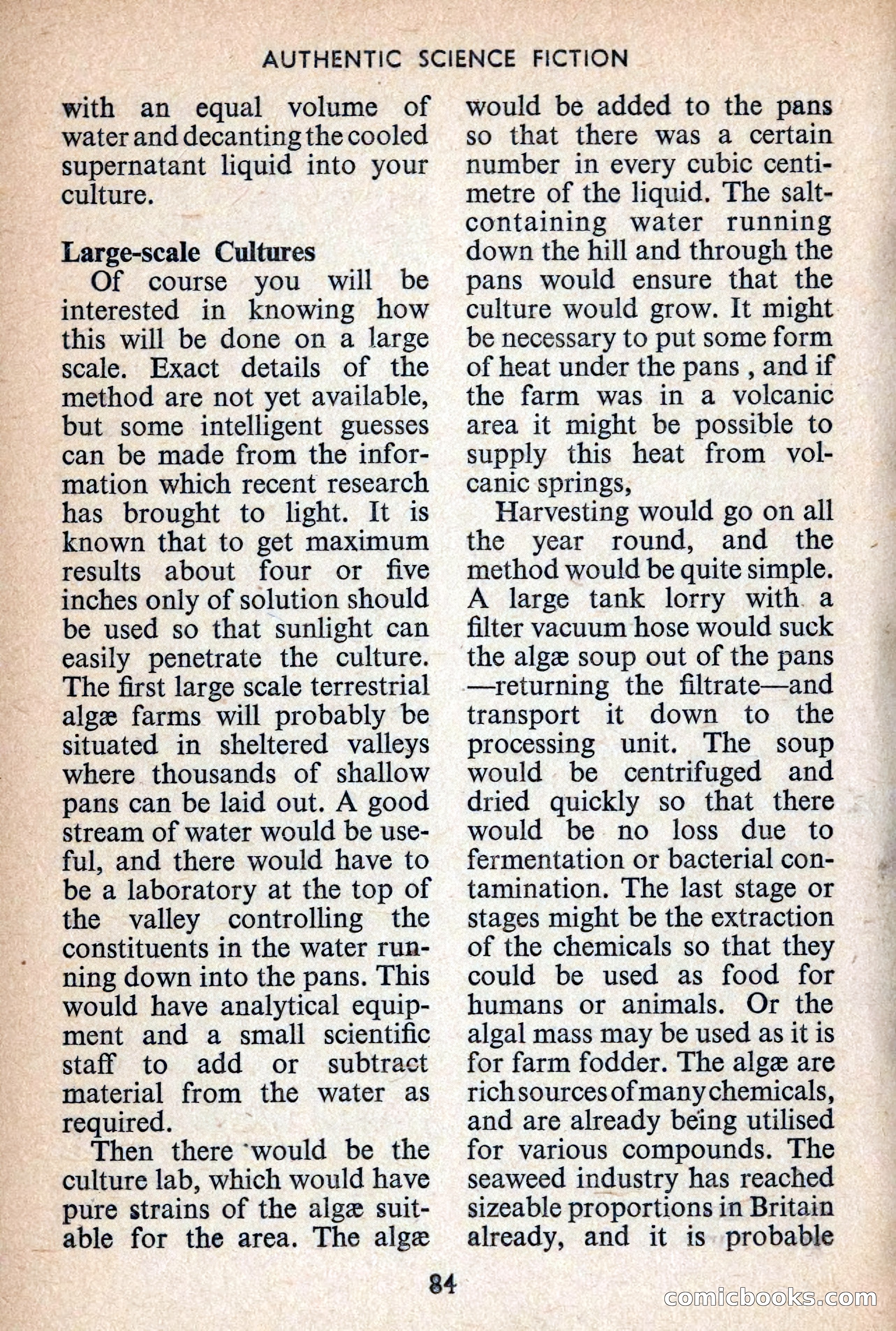
A restored page from Pulp Fiction, 1954. Page through the whole issue in the reader above.
📄 Transcribed text from this page (OCR, searchable)
Machine-transcribed from the original scan — historical spelling and the odd misread are preserved.
AUTHENTIC SCIENCE FICTION with an equal volume of water and decanting the cooled supernatant liquid into your culture. Large-scale Cultures Of course you will be interested in knowing how this will be done on a large scale. Exact details of the method are not yet available, but some intelligent guesses can be made from the infor- mation which recent research has brought to light. It is known that to get maximum results about four or five inches only of solution should be used so that sunlight can easily penetrate the culture. The first large scale terrestrial alge farms will probably be situated in sheltered valleys where thousands of shallow pans can be laid out. A good stream of water would be use- ful, and there would have to be a laboratory at the top of the valley controlling the constituents in the water run- ning down into the pans. This would have analytical equip- ment and a small scientific staff to add or _ subtract material from the water as required. Then there ‘would be the culture lab, which would have pure strains of the alge suit- able for the area. The alge 84 would be added to the pans so that there was a certain number in every cubic centi- metre of the liquid. The salt- containing water running down the hill and through the pans would ensure that the culture would grow. It might be necessary to put some form of heat under the pans , and if the farm was in a volcanic area it might be possible to supply this heat from vol- canic springs, Harvesting would go on all the year round, and the method would be quite simple. A large tank lorry with a filter vacuum hose would suck the alge soup out of the pans —returning the filtrate—and transport it down to the processing unit. The soup would be centrifuged and dried quickly so that there would be no loss due to fermentation or bacterial con- tamination. The last stage or stages might be the extraction of the chemicals so that they could be used as food for humans or animals. Or the algal mass may be used as it is for farm fodder. The alge are richsources of many chemicals, and are already being utilised for various compounds. The seaweed industry has reached sizeable proportions in Britain already, and it is. probable comicloooks.conn