
Pulp Fiction, 1954 · page 86 of 146
Authentic Science Fiction Monthly No. 47 — page 86: what you’re looking at
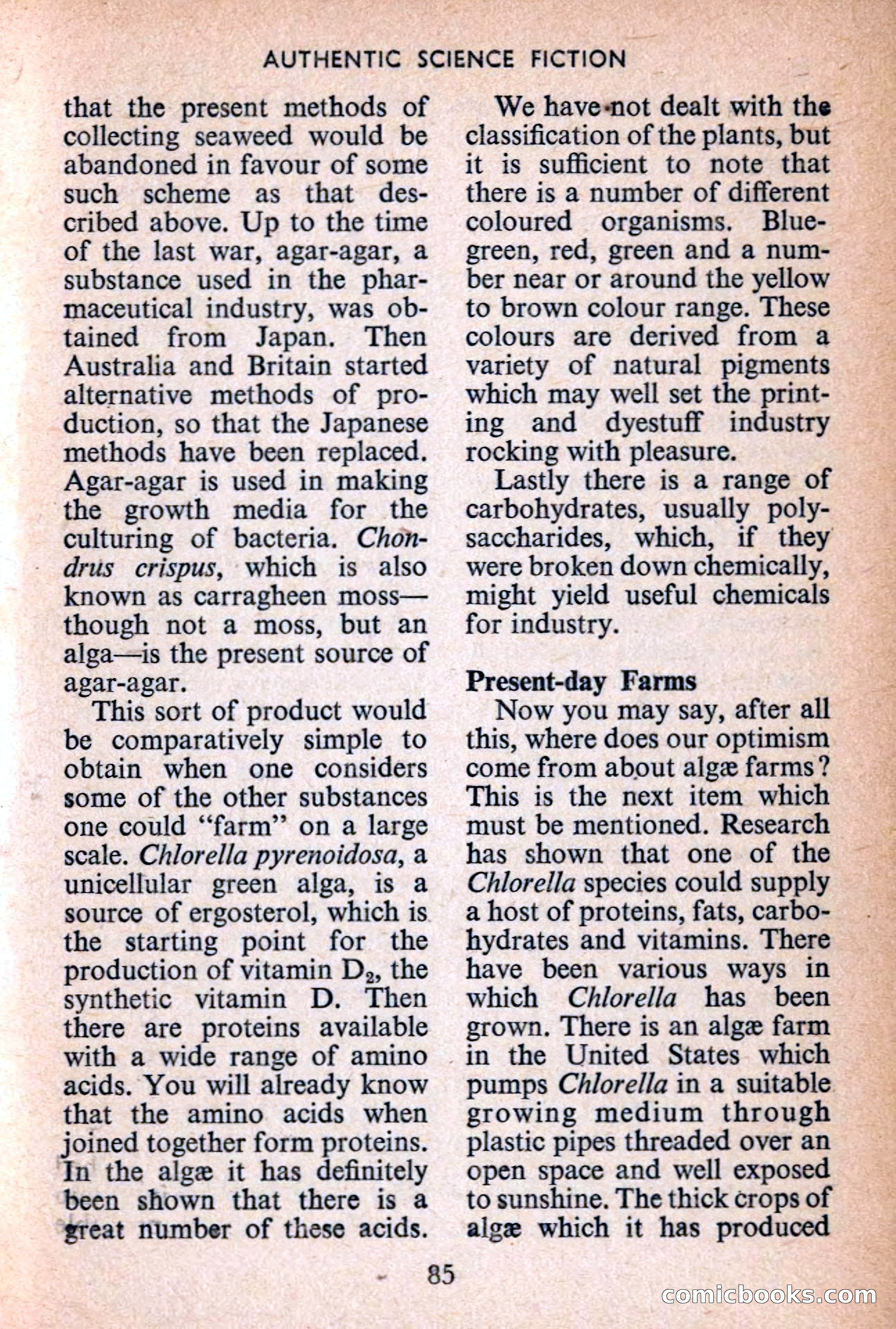
A restored page from Pulp Fiction, 1954. Page through the whole issue in the reader above.
📄 Transcribed text from this page (OCR, searchable)
Machine-transcribed from the original scan — historical spelling and the odd misread are preserved.
AUTHENTIC SCIENCE FICTION that the present methods of collecting seaweed would be abandoned in favour of some such scheme as that des- cribed above. Up to the time of the last war, agar-agar, a substance used in the phar- maceutical industry, was ob- tained from Japan. Then Australia and Britain started alternative methods of pro- duction, so that the Japanese methods have been replaced. Agar-agar is used in making the growth media for the culturing of bacteria. Chon- drus crispus, which is also known as carragheen moss— though not a moss, but an alga—is the present source of agar-agar. This sort of product would be comparatively simple to obtain when one considers some of the other substances one could “farm” on a large scale. Chlorella pyrenoidosa, a unicellular green alga, is a source of ergosterol, which is the starting point for the production of vitamin D,, the synthetic vitamin D. Then there are proteins available with a wide range of amino acids. You will already know that the amino acids when joined together form proteins. In the alge it has definitely been shown that there is a great number of these acids. a. Bo We have-not dealt with the classification of the plants, but it is sufficient to note that there is a number of different coloured organisms. Blue- green, red, green and a num- ber near or around the yellow to brown colour range. These colours are derived from a variety of natural pigments which may well set the print- ing and dyestuff industry rocking with pleasure. Lastly there is a range of carbohydrates, usually poly- saccharides, which, if they were broken down chemically, might yield useful chemicals for industry. Present-day Farms Now you may say, after all this, where does our optimism come from about alge farms? This is the next item which must be mentioned. Research has shown that one of the Chlorella species could supply a host of proteins, fats, carbo- hydrates and vitamins. There have been various ways in which Chlorella has been grown. There is an alge farm in the United States which pumps Chlorella in a suitable growing medium through plastic pipes threaded over an open space and well exposed to sunshine. The thick crops of alge which it has produced 1.45 #2 ee ee comichooks.conn =