
Pulp Fiction, 1954 · page 82 of 146
Authentic Science Fiction Monthly No. 47 — page 82: what you’re looking at
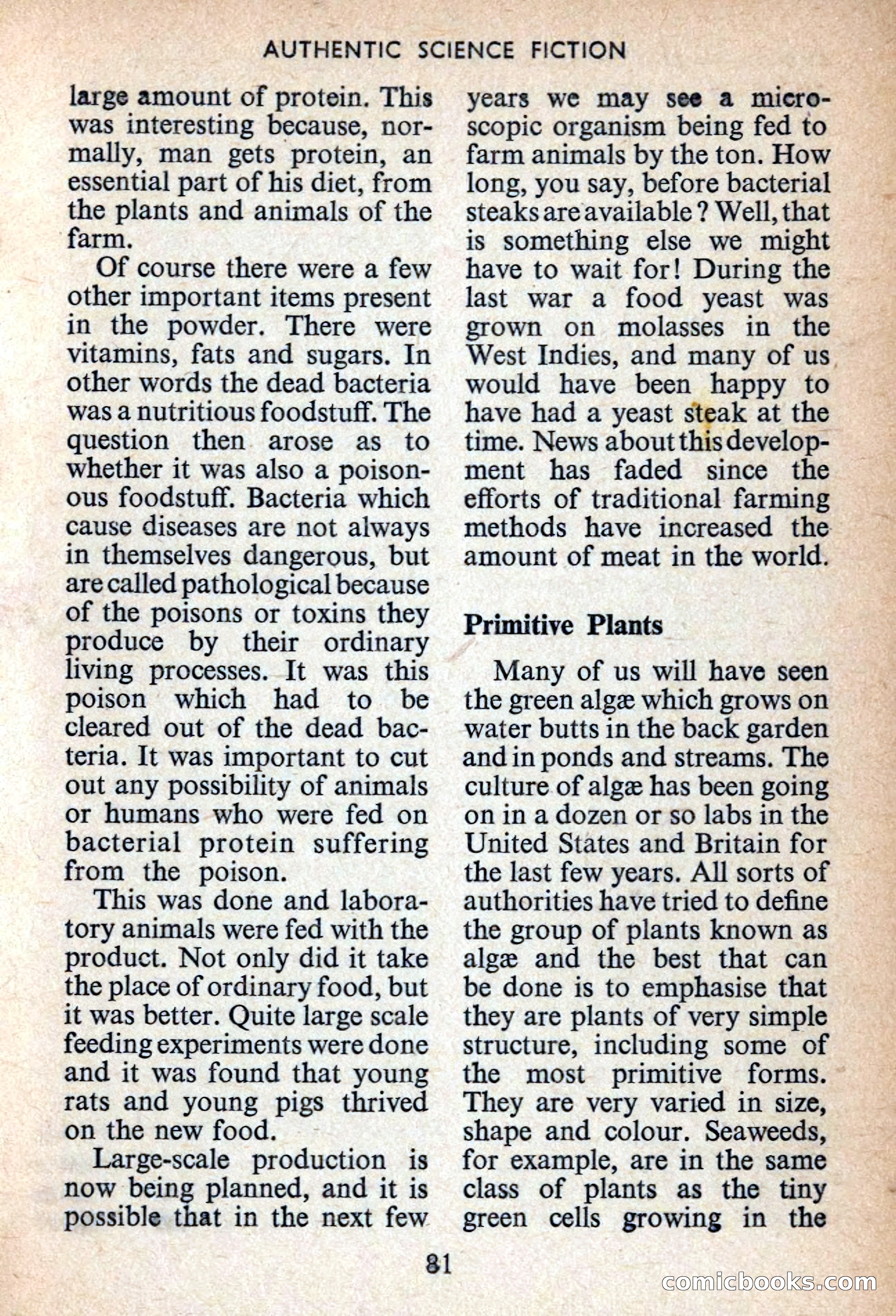
A restored page from Pulp Fiction, 1954. Page through the whole issue in the reader above.
📄 Transcribed text from this page (OCR, searchable)
Machine-transcribed from the original scan — historical spelling and the odd misread are preserved.
AUTHENTIC SCIENCE FICTION large amount of protein. This was interesting because, nor- mally, man gets protein, an essential part of his diet, from the plants and animals of the farm. Of course there were a few other important items present in the powder. There were vitamins, fats and sugars. In other words the dead bacteria was a nutritious foodstuff. The question then arose as to whether it was also a poison- ous foodstuff. Bacteria which cause diseases are not always in themselves dangerous, but are called pathological because of the poisons or toxins they produce by their ordinary living processes. It was this poison which had to be cleared out of the dead bac- teria. It was important to cut out any possibility of animals or humans who were fed on bacterial protein suffering from the poison. This was done and labora- tory animals were fed with the product. Not only did it take the place of ordinary food, but it was better. Quite large scale feeding experiments were done and it was found that young rats and young pigs thrived on the new food. Large-scale production is now being planned, and it is possible that in the next few 81 years we may see a micro- scopic organism being fed to farm animals by the ton. How long, you say, before bacterial steaks areavailable ? Well, that is something else we might have to wait for! During the last war a food yeast was grown on molasses in the West Indies, and many of us. would have been happy to have had a yeast steak at the time. News about this develop- ment has faded since the efforts of traditional farming methods have increased the amount of meat in the world. Primitive Plants Many of us will have seen the green alge which grows on water butts in the back garden and in ponds and streams. The culture of alge has been going on in a dozen or so labs in the United States and Britain for the last few years. All sorts of authorities have tried to define the group of plants known as alge and the best that can be done is to emphasise that they are plants of very simple structure, including some of the most primitive forms. They are very varied in size, shape and colour. Seaweeds, for example, are in the same class of plants as the tiny green cells growing in the comiicbooks.con