
Pulp Fiction, 1954 · page 81 of 146
Authentic Science Fiction Monthly No. 47 — page 81: what you’re looking at
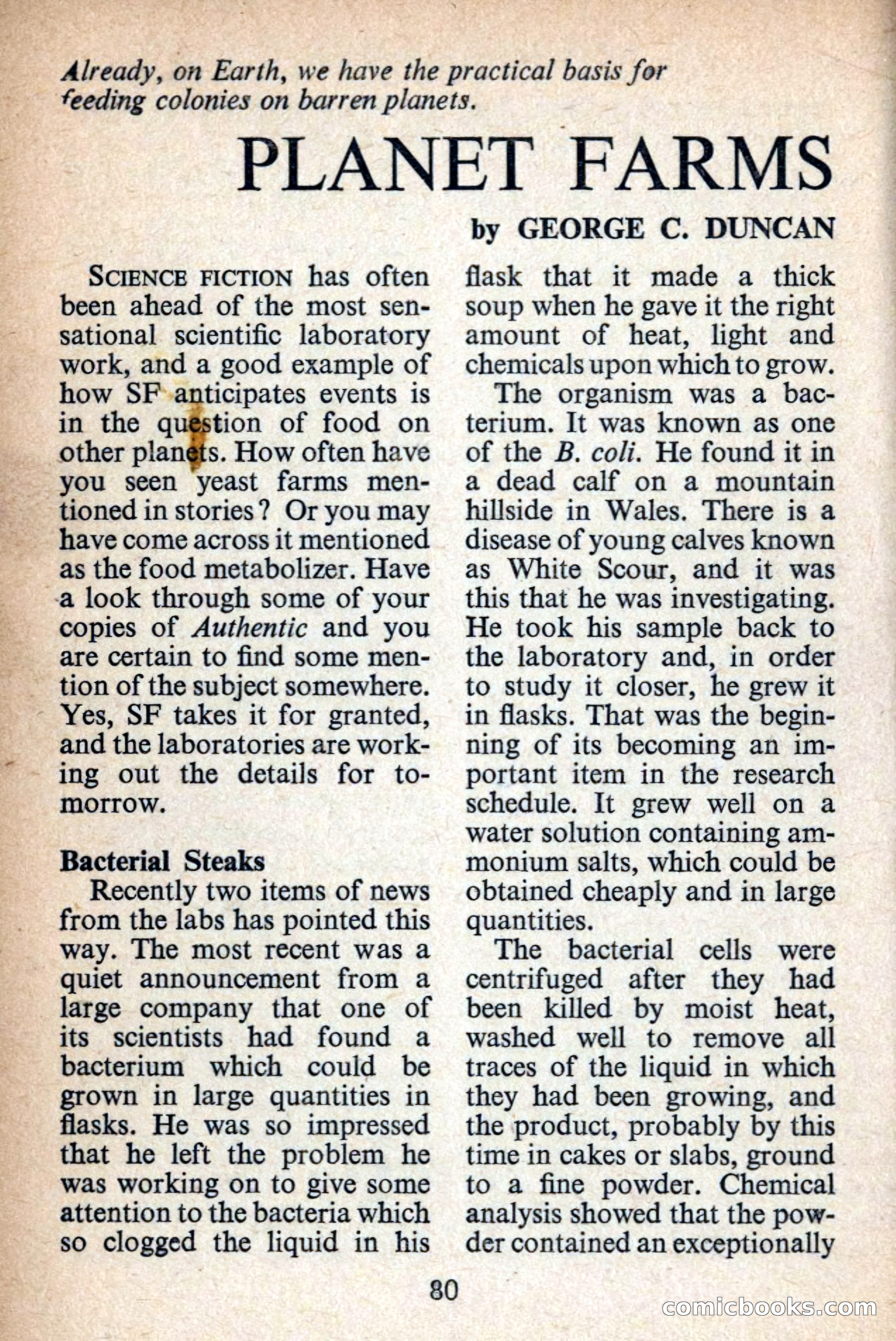
A restored page from Pulp Fiction, 1954. Page through the whole issue in the reader above.
📄 Transcribed text from this page (OCR, searchable)
Machine-transcribed from the original scan — historical spelling and the odd misread are preserved.
Already, on Earth, we have the practical basis for eeding colonies on barren planets. PLANET FARMS SCIENCE FICTION has often been ahead of the most sen- sational scientific laboratory work, and a good example of how SF anticipates events is in the qué@stion of food on other planéts. How often have you seen yeast farms men- tioned in stories? Or you may have come across it mentioned as the food metabolizer. Have -a look through some of your copies of Authentic and you are certain to find some men- tion of the subject somewhere. - Yes, SF takes it for granted, and the laboratories are work- - ing out the details for to- morrow. Bacterial Steaks Recently two items of news from the labs has pointed this way. The most recent was a - guiet announcement from a large company that one of its scientists had found a bacterium which could be grown in large quantities in flasks. He was so impressed that he left the problem he was working on to give some attention to the bacteria which so clogged the liquid in his 80 by GEORGE C. DUNCAN flask that it made a thick soup when he gave it the right amount of heat, light and chemicals upon which to grow. The organism was a bac- terium. It was known as one of the B. coli. He found it in a dead calf on a mountain hillside in Wales. There is a disease of young calves known as White Scour, and it was this that he was investigating. He took his sample back to the laboratory and, in order to study it closer, he grew it in flasks. That was the begin- ning of its becoming an im- portant item in the research schedule. It grew well on a water solution containing am- monium salts, which could be obtained cheaply and in large quantities. The bacterial cells were centrifuged after they had been killed by moist heat, washed well to remove all traces of the liquid in which they had been growing, and the product, probably by this time in cakes or slabs, ground to a fine powder. Chemical analysis showed that the pow- der contained an exceptionally comiclooks.conn