
Pulp Fiction, 1954 · page 67 of 146
Authentic Science Fiction Monthly No. 47 — page 67: what you’re looking at
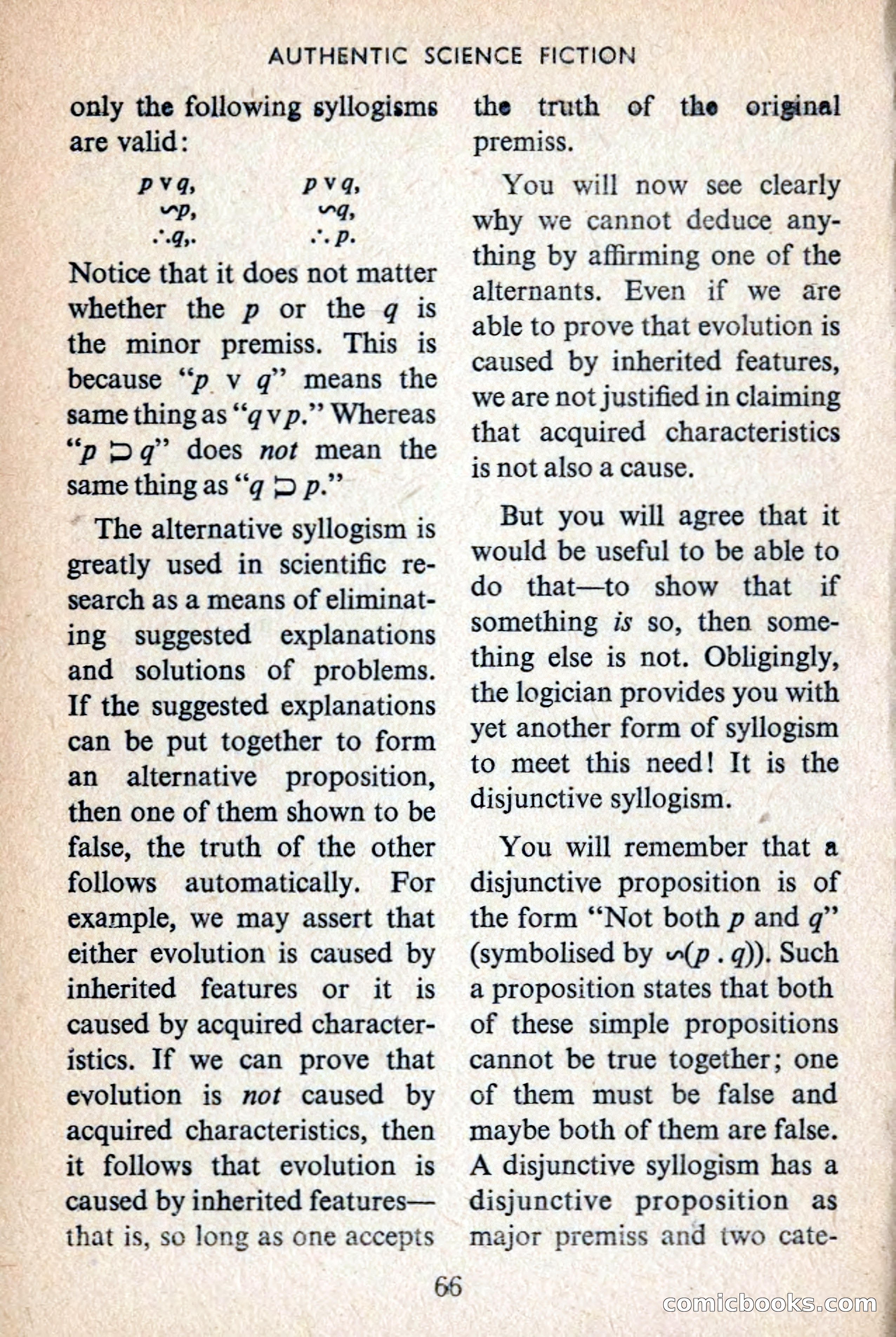
A restored page from Pulp Fiction, 1954. Page through the whole issue in the reader above.
📄 Transcribed text from this page (OCR, searchable)
Machine-transcribed from the original scan — historical spelling and the odd misread are preserved.
AUTHENTIC SCIENCE FICTION only the following syllogisms are valid: PY, PY, ne “qd, LS a ey F Notice that it does not matter whether the p or the g is the minor premiss. This is because “‘p v g’ means the same thing as “qv p.”’ Whereas “‘p >q’ does not mean the same thing as ““g D p.”’ - The alternative syllogism is greatly used in scientific re- search as a means of eliminat- ing suggested explanations and solutions of problems. If the suggested explanations can be put together to form an alternative proposition, then one of them shown to be false, the truth of the other follows automatically. For example, we may assert that either evolution is caused by inherited features or it is caused by acquired character- istics. If we can prove that evolution is mot caused by acquired characteristics, then it follows that evolution is caused by inherited features— that is, so long as one accepts 66 the truth of the original premiss. You will now see clearly why we cannot deduce any- thing by affirming one of the alternants. Even if we are able to prove that evolution is caused by inherited features, we are not justified in claiming that acquired characteristics is not also a cause. But you will agree that it would be useful to be able to do that—to show that if something is so, then some- thing else is not. Obligingly, the logician provides you with yet another form of syllogism to meet this need! It is the disjunctive syllogism. You will remember that a disjunctive proposition is of the form ‘‘Not both p and q”’ (symbolised by “(p.q)). Such a proposition states that both of these simple propositions cannot be true together; one of them must be false and maybe both of them are false. A disjunctive syllogism has a disjunctive proposition as major premiss and two cate- COMmMICOOKS.COnN