
Pulp Fiction, 1954 · page 66 of 146
Authentic Science Fiction Monthly No. 47 — page 66: what you’re looking at
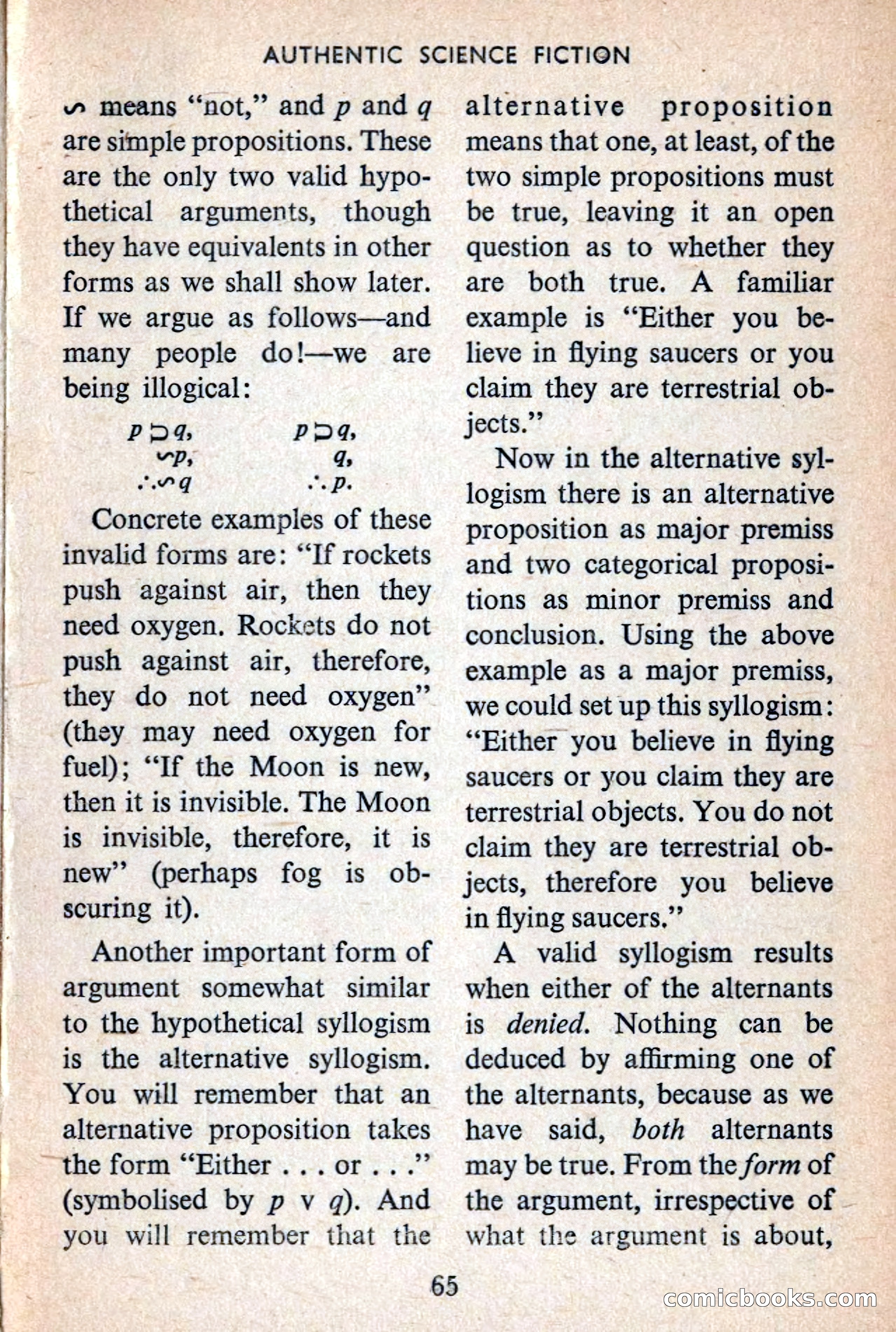
A restored page from Pulp Fiction, 1954. Page through the whole issue in the reader above.
📄 Transcribed text from this page (OCR, searchable)
Machine-transcribed from the original scan — historical spelling and the odd misread are preserved.
AUTHENTIC SCIENCE FICTION w means “not,” and p and q are simple propositions. These ' are the only two valid hypo- thetical arguments, though they have equivalents in other forms as we shall show later. If we argue as follows—and many people do!—we are being illogical: PD4 PD, “Pp; qs Concrete examples of these invalid forms are: “If rockets push against air, then they need oxygen. Rockets do not push against air, therefore, they do not need oxygen” (they may need oxygen for fuel); “If the Moon is new, then it is invisible. The Moon is invisible, therefore, it is new’ (perhaps fog is ob- scuring it). Another important form of argument somewhat similar to the hypothetical syllogism is the alternative syllogism. You will remember that an alternative 2ahgarie takes the form “Either ...or...”’ (symbolised by p v 4). And you will remember that the 65 alternative proposition means that one, at least, of the two simple propositions must be true, leaving it an open question as to whether they are both true. A familiar example is “Either you be- lieve in flying saucers or you claim they are terrestrial ob- jects.”’ Now in the alternative syl- logism there is an alternative proposition as major premiss and two categorical proposi- tions as minor premiss and conclusion. Using the above example as a major premiss, we could set up this syllogism: ‘“‘Rither you believe in flying saucers or you claim they are terrestrial objects. You do not claim they are terrestrial ob- jects, therefore you believe in flying saucers,” A valid syllogism results when either of the alternants is denied. Nothing can be deduced by affirming one of the alternants, because as we have said, both alternants may be true. From the form of the argument, irrespective of what the argument is about, comiclooks.conn