
Pulp Fiction, 1954 · page 68 of 146
Authentic Science Fiction Monthly No. 47 — page 68: what you’re looking at
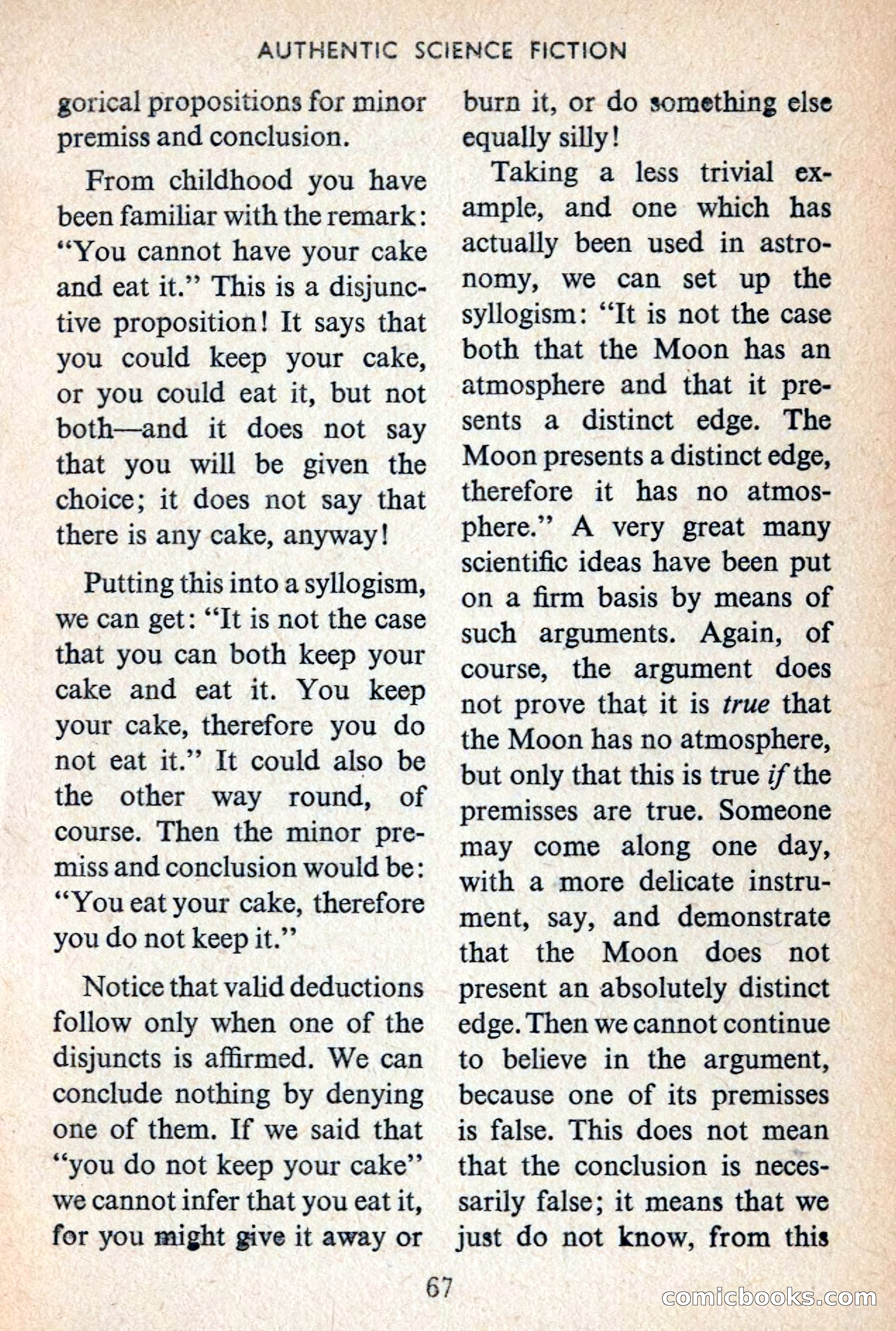
A restored page from Pulp Fiction, 1954. Page through the whole issue in the reader above.
📄 Transcribed text from this page (OCR, searchable)
Machine-transcribed from the original scan — historical spelling and the odd misread are preserved.
AUTHENTIC SCIENCE FICTION gorical propositions for minor premiss and conclusion. From childhood you have been familiar with the remark: *“You cannot have your cake and eat it.”’ This is a disjunc- tive proposition! It says that you could keep your cake, or you could eat it, but not both—and it does not say that you will be given the choice; it does not say that there is any cake, anyway! Putting this into a syllogism, we can get: “It is not the case that you can both keep your cake and eat it. You keep your cake, therefore you do not eat it.’’ It could also be the other way round, of course. Then the minor pre- miss and conclusion would be: ““You eat your cake, therefore you do not keep it.”’ Notice that valid deductions follow only when one of the disjuncts is affirmed. We can conclude nothing by denying one of them. If we said that *“‘you do not keep your cake”’ we cannot infer that you eat it, for you might give it away or 67 burn it, or do something else equally silly! Taking a less trivial ex- ample, and one which has actually been used in astro- nomy, we can set up the syllogism: “‘It is not the case both that the Moon has an atmosphere and that it pre- sents a distinct edge. The Moon presents a distinct edge, therefore it has no atmos- phere.” A very great many scientific ideas have been put on a firm basis by means of such arguments. Again, of course, the argument does not prove that it is true that the Moon has no atmosphere, but only that this is true if the premisses are true. Someone may come along one day, with a more delicate instru- ment, say, and demonstrate that the Moon does not present an absolutely distinct edge. Then we cannot continue to believe in the argument, because one of its premisses is false. This does not mean that the conclusion is neces- sarily false; it means that we just do not know, from this conmicloooks.conrn