
Pulp Fiction, 1954 · page 101 of 146
Authentic Science Fiction Monthly No. 47 — page 101: what you’re looking at
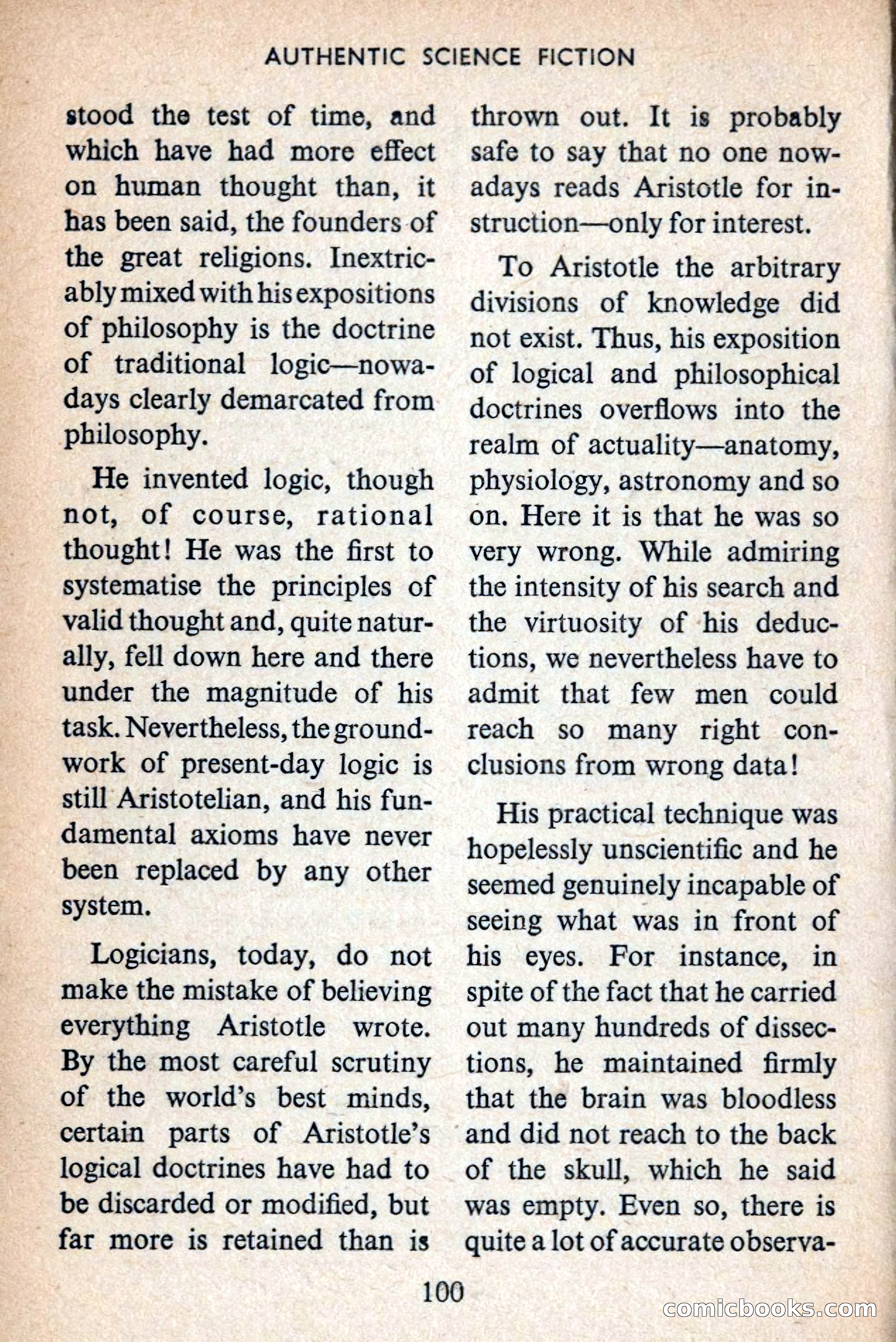
A restored page from Pulp Fiction, 1954. Page through the whole issue in the reader above.
📄 Transcribed text from this page (OCR, searchable)
Machine-transcribed from the original scan — historical spelling and the odd misread are preserved.
AUTHENTIC SCIENCE FICTION stood the test of time, and which have had more effect on human thought than, it has been said, the founders of the great religions. Inextric- ably mixed with his expositions of philosophy is the doctrine of traditional logic—nowa- days clearly demarcated from philosophy. He invented logic, though not, of course, rational thought! He was the first to systematise the principles of valid thought and, quite natur- ally, fell down here and there under the magnitude of his task. Nevertheless, the ground- work of present-day logic is still Aristotelian, and his fun- damental axioms have never been replaced by any other system. Logicians, today, do not make the mistake of believing everything Aristotle wrote. By the most careful scrutiny of the world’s best minds, certain parts of Aristotle’s logical doctrines have had to be discarded or modified, but far more is retained than is 100 thrown out. It is probably safe to say that no one now- adays reads Aristotle for in- struction—only for interest. To Aristotle the arbitrary divisions of knowledge did not exist. Thus, his exposition of logical and philosophical doctrines overflows into the realm of actuality—anatomy, physiology, astronomy and so on. Here it is that he was so very wrong. While admiring the intensity of his search and the virtuosity of his deduc- tions, we nevertheless have to admit that few men could reach so many right con- clusions from wrong data! His practical technique was hopelessly unscientific and he seemed genuinely incapable of seeing what was in front of his eyes. For instance, in spite of the fact that he carried out many hundreds of dissec- tions, he maintained firmly that the brain was bloodless and did not reach to the back of the skull, which he said was empty. Even so, there is quite a lot of accurate observa- comicbooks.com § F