
Pulp Fiction, 1954 · page 100 of 146
Authentic Science Fiction Monthly No. 47 — page 100: what you’re looking at
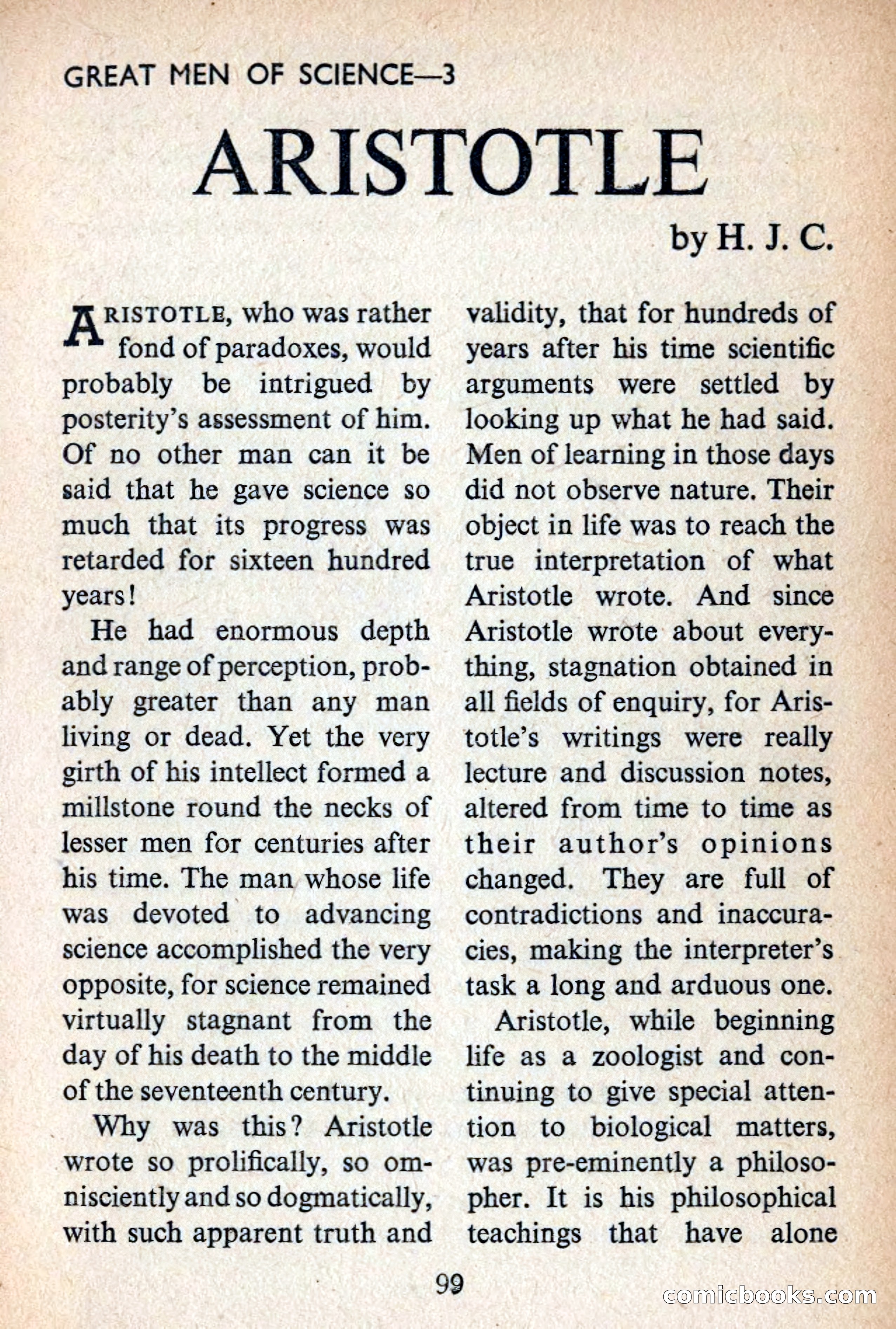
A restored page from Pulp Fiction, 1954. Page through the whole issue in the reader above.
📄 Transcribed text from this page (OCR, searchable)
Machine-transcribed from the original scan — historical spelling and the odd misread are preserved.
GREAT MEN OF SCIENCE—3 ARISTOTLE RISTOTLE, who was rather fond of paradoxes, would probably be intrigued by posterity’s assessment of him. Of no other man can it be said that he gave science so much that its progress was retarded for sixteen hundred years! He had enormous depth and range of perception, prob- ably greater than any man living or dead. Yet the very girth of his intellect formed a millstone round the necks of lesser men for centuries after his time. The man whose life was devoted to advancing science accomplished the very opposite, for science remained virtually stagnant from the day of his death to the middle of the seventeenth century. Why was this? Aristotle wrote so prolifically, so om- nisciently and so dogmatically, with such apparent truth and 99 by H.J.C. validity, that for hundreds of years after his time scientific arguments were settled by looking up what he had said. Men of learning in those days did not observe nature. Their object in life was to reach the true interpretation of what Aristotle wrote. And since Aristotle wrote about every- thing, stagnation obtained in all fields of enquiry, for Aris- totle’s writings were really lecture and discussion notes, altered from time to time as their authors opinions changed. They are full of contradictions and inaccura- cies, making the interpreter’s. task a long and arduous one. Aristotle, while beginning life as a zoologist and con- tinuing to give special atten- tion to biological matters, was pre-eminently a philoso- pher. It is his philosophical teachings that have alone comiclooks.conrn