
Pulp Fiction, 1954 · page 102 of 146
Authentic Science Fiction Monthly No. 47 — page 102: what you’re looking at
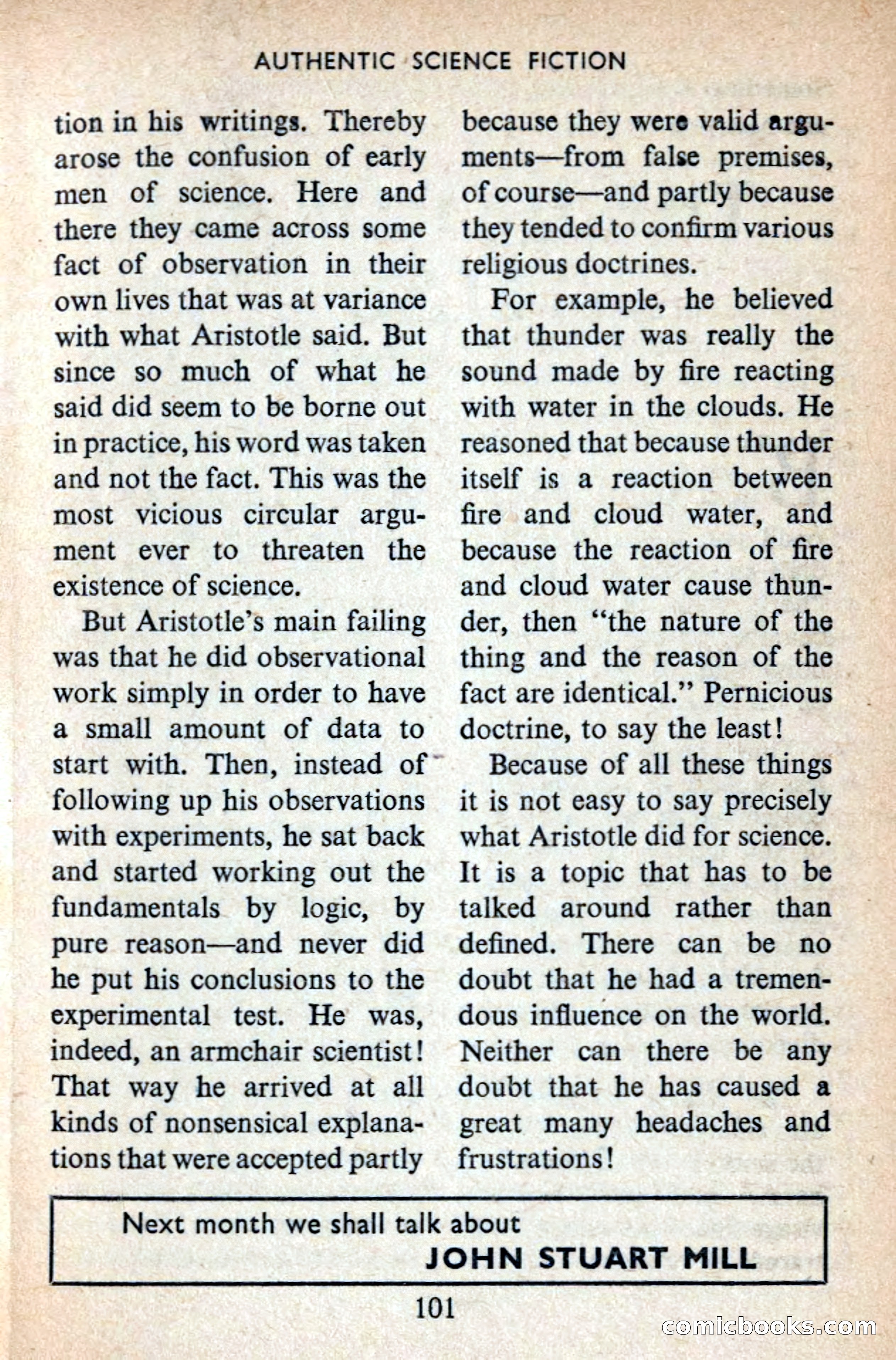
A restored page from Pulp Fiction, 1954. Page through the whole issue in the reader above.
📄 Transcribed text from this page (OCR, searchable)
Machine-transcribed from the original scan — historical spelling and the odd misread are preserved.
AUTHENTIC ‘SCIENCE FICTION tion in his writings. Thereby arose the confusion of early men of science. Here and there they came across some fact of observation in their own lives that was at variance with what Aristotle said. But since so much of what he said did seem to be borne out in practice, his word was taken and not the fact. This was the most vicious circular argu- ment ever to threaten the existence of science. But Aristotle’s main failing was that he did observational work simply in order to have a small amount of data to start with. Then, instead of” following up his observations with experiments, he sat back and started working out the fundamentals by logic, by pure reason—and never did he put his conclusions to the experimental test. He was, indeed, an armchair scientist! That way he arrived at all kinds of nonsensical explana- tions that were accepted partly because they were valid argu- ments—from false premises, of course—and partly because they tended to confirm various religious doctrines. For example, he believed that thunder was really the sound made by fire reacting with water in the clouds. He reasoned that because thunder itself is a reaction between fire and cloud water, and because the reaction of fire and cloud water cause thun- der, then “‘the nature of the thing and the reason of the fact are identical.’’ Pernicious doctrine, to say the least! Because of all these things it is not easy to say precisely what Aristotle did for science. It is a topic that has to be talked around rather than defined. There can be no doubt that he had a tremen- dous influence on the world. Neither can there be any doubt that he has caused a great many headaches and frustrations! Next month we shall talk about JOHN STUART MILL 101 comiclooolks.comn