
Pulp Fiction, 1954 · page 81 of 162
Authentic Science Fiction Monthly No. 46 — page 81: what you’re looking at
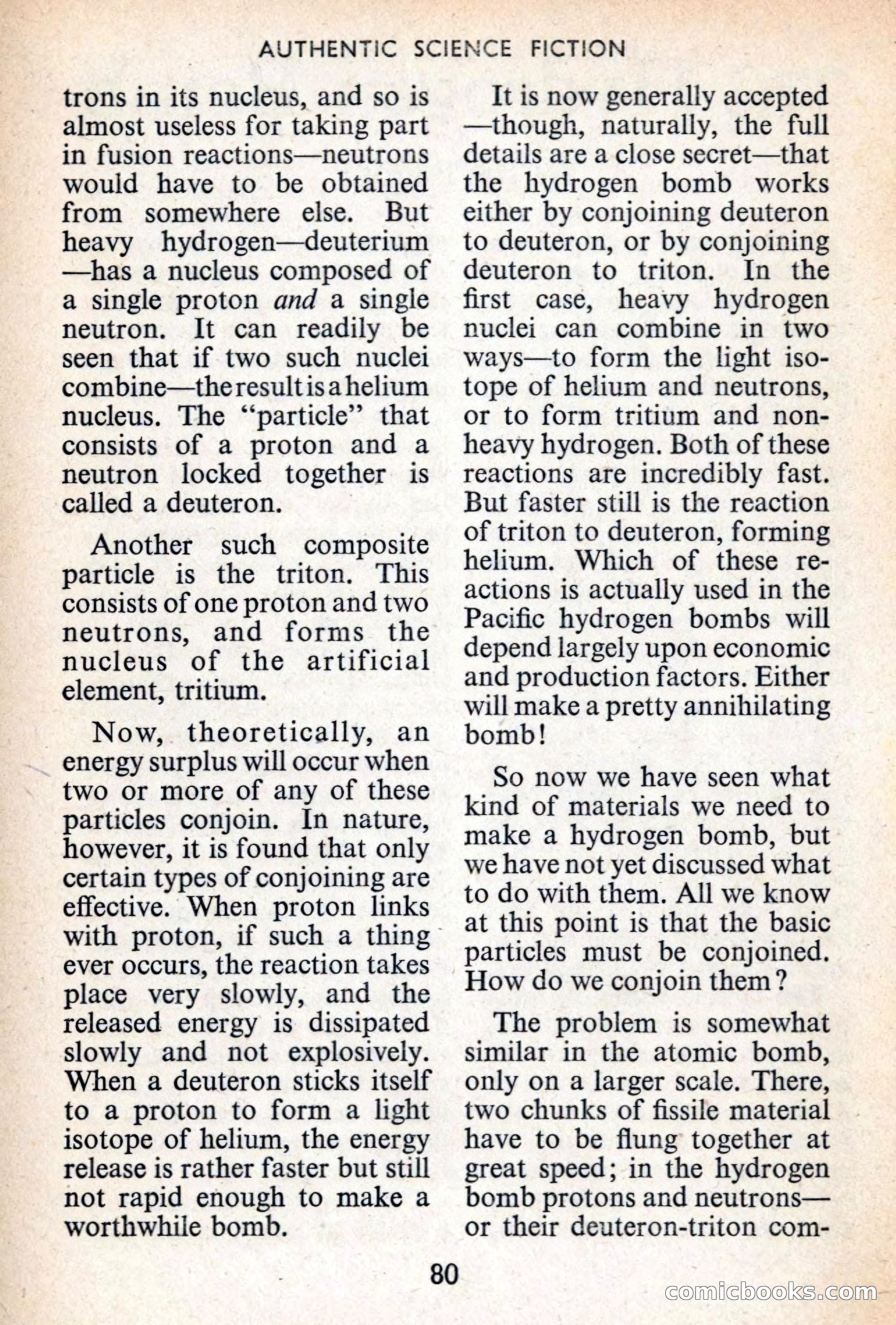
A restored page from Pulp Fiction, 1954. Page through the whole issue in the reader above.
📄 Transcribed text from this page (OCR, searchable)
Machine-transcribed from the original scan — historical spelling and the odd misread are preserved.
AUTHENTIC SCIENCE FICTION trons in its nucleus, and so is almost useless for taking part in fusion reactions—neutrons would have to be obtained from somewhere else. But heavy hydrogen—deuterium —has a nucleus composed of a single proton and a single neutron. It can readily be seen that if two such nuclei combine—the resultis a helium nucleus. The “particle” that consists of a proton and a neutron locked together is called a deuteron. Another such composite particle is the triton. This consists of one proton and two neutrons, and forms the nucleus of the artificial element, tritium. Now, theoretically, an energy surplus will occur when two or more of any of these particles conjoin. In nature, however, it is found that only certain types of conjoining are effective. When proton links with proton, if such a thing ever occurs, the reaction takes place very slowly, and the released energy is dissipated slowly and not explosively. When a deuteron sticks itself to a proton to form a light isotope of helium, the energy release is rather faster but still not rapid enough to make a worthwhile bomb. 80 It is now generally accepted —though, naturally, the full details are a close secret—that the hydrogen bomb works either by conjoining deuteron to deuteron, or by conjoining deuteron to triton. In the first case, heavy hydrogen nuclei can combine in two ways—to form the light iso- tope of helium and neutrons, or to form tritium and non- heavy hydrogen. Both of these reactions are incredibly fast. But faster still is the reaction of triton to deuteron, forming helium. Which of these re- actions is actually used in the Pacific hydrogen bombs will depend largely upon economic and production factors. Either will make a pretty annihilating bomb! So now we have seen what kind of materials we need to make a hydrogen bomb, but we have not yet discussed what to do with them. All we know at this point is that the basic particles must be conjoined. How do we conjoin them? The problem is somewhat similar in the atomic bomb, only on a larger scale. There, two chunks of fissile material have to be flung together at great speed; in the hydrogen bomb protons and neutrons— or their deuteron-triton com- comiclbooks.comn-