
Pulp Fiction, 1954 · page 82 of 162
Authentic Science Fiction Monthly No. 46 — page 82: what you’re looking at
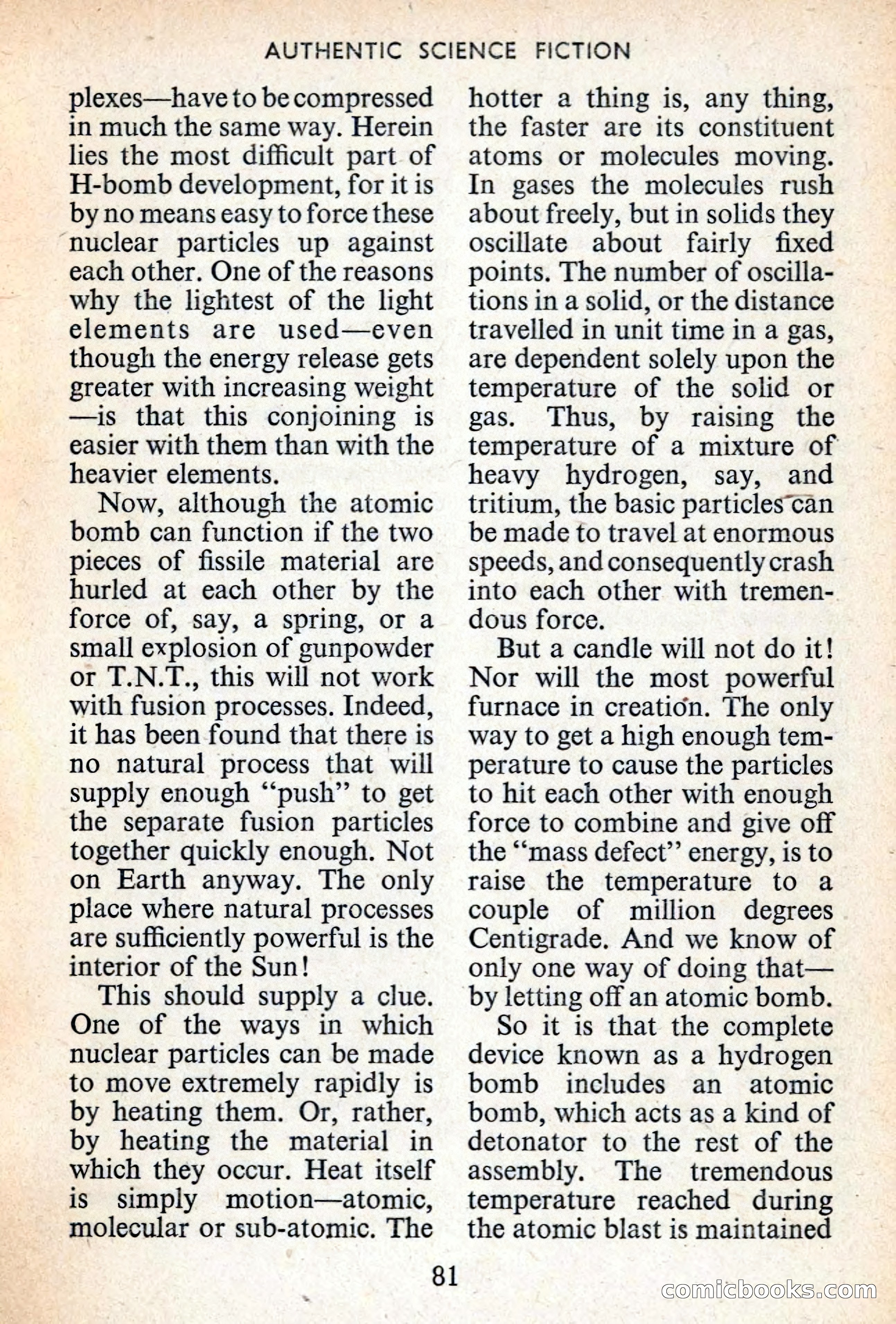
A restored page from Pulp Fiction, 1954. Page through the whole issue in the reader above.
📄 Transcribed text from this page (OCR, searchable)
Machine-transcribed from the original scan — historical spelling and the odd misread are preserved.
AUTHENTIC SCIENCE FICTION plexes—have to be compressed in much the same way. Herein lies the most difficult part of H-bomb development, for it is by no means easy to force these nuclear particles up against each other. One of the reasons why the lightest of the light elements are used—even though the energy release gets greater with increasing weight —is that this conjoining is easier with them than with the heavier elements. Now, although the atomic bomb can function if the two pieces of fissile material are hurled at each other by the force of, say, a spring, or a small explosion of gunpowder or T.N.T., this will not work with fusion processes. Indeed, it has been found that there is no natural process that will supply enough “‘push”’ to get the separate fusion particles together quickly enough. Not on Earth anyway. The only place where natural processes are sufficiently powerful is the interior of the Sun! This should supply a clue. One of the ways in which nuclear particles can be made to move extremely rapidly is by heating them. Or, rather, by heating the material in which they occur. Heat itself is simply motion—atomic, molecular or sub-atomic. The 81 hotter a thing is, any thing, the faster are its constituent atoms or molecules moving. In gases the molecules rush about freely, but in solids they oscillate about fairly fixed points. The number of oscilla- tions in a solid, or the distance travelled in unit time in a gas, are dependent solely upon the temperature of the solid or gas. Thus, by raising the temperature of a mixture of heavy hydrogen, say, and tritium, the basic particlescan be made to travel at enormous speeds, and consequently crash into each other with tremen- dous force. But a candle will not do it! Nor will the most powerful furnace in creation. The only way to get a high enough tem- perature to cause the particles to hit each other with enough force to combine and give off the “‘mass defect”’ energy, is to raise the temperature to a couple of million degrees Centigrade. And we know of only one way of doing that— by letting off an atomic bomb. So it is that the complete device known as a hydrogen bomb includes an atomic bomb, which acts as a kind of detonator to the rest of the assembly. The tremendous temperature reached during the atomic blast is maintained connicloooks.con