
Pulp Fiction, 1954 · page 80 of 162
Authentic Science Fiction Monthly No. 46 — page 80: what you’re looking at
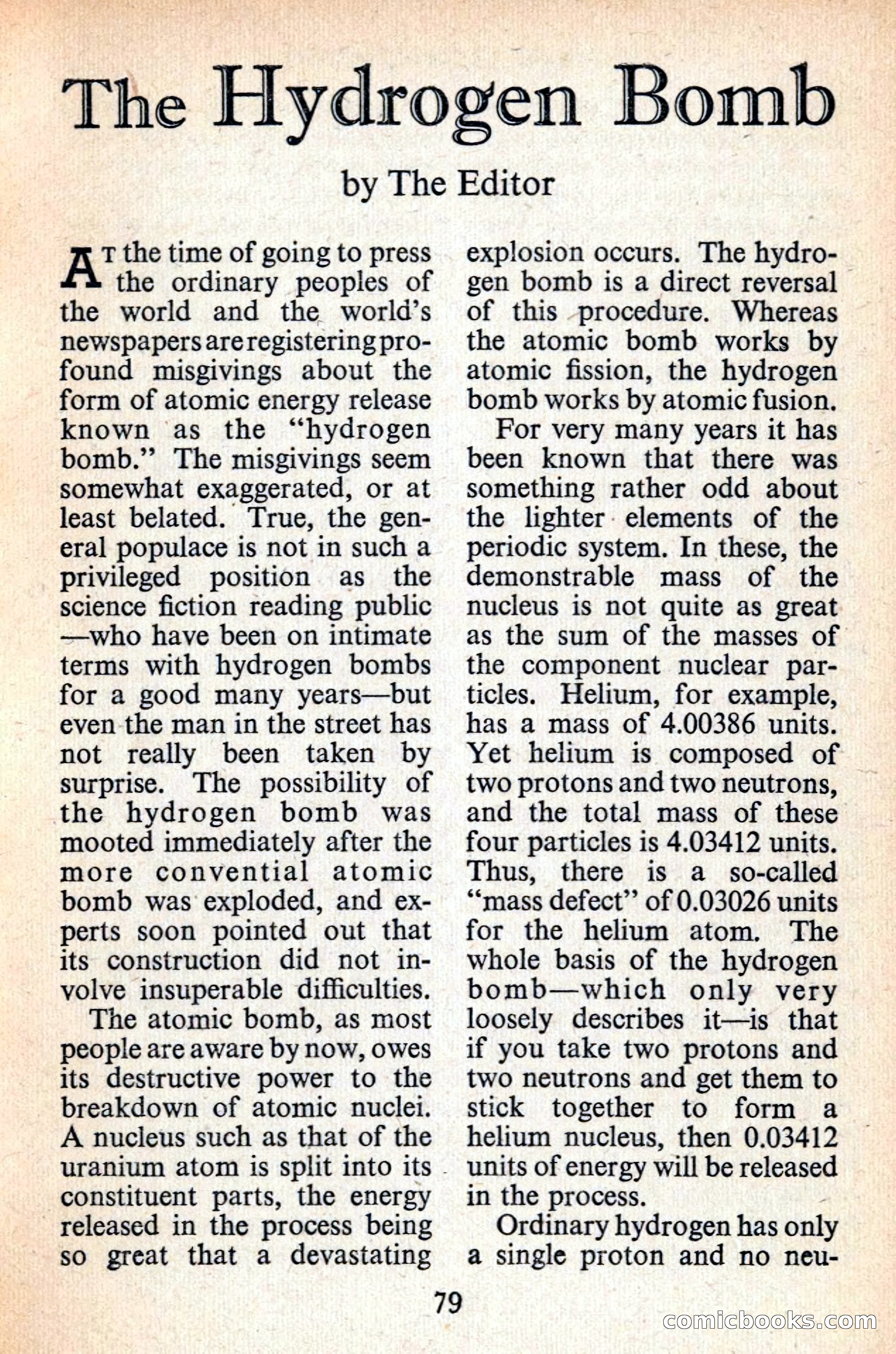
A restored page from Pulp Fiction, 1954. Page through the whole issue in the reader above.
📄 Transcribed text from this page (OCR, searchable)
Machine-transcribed from the original scan — historical spelling and the odd misread are preserved.
The Hydrogen Bomb by The Editor A’ the time of going to press the ordinary peoples of the world and the world’s newspapers are registering pro- found misgivings about the form of atomic energy release known as the “hydrogen bomb.” The misgivings seem somewhat exaggerated, or at least belated. True, the gen- eral populace is not in such a privileged position as the science fiction reading public —who have been on intimate terms with hydrogen bombs for a good many years—but even the man in the street has not really been taken by surprise. The possibility of the hydrogen bomb was mooted immediately after the more convential atomic bomb was exploded, and ex- perts soon pointed out that its construction did not in- volve insuperable difficulties. The atomic bomb, as most people are aware by now, owes its destructive power to the breakdown of atomic nuclei. A nucleus such as that of the uranium atom is split into its - constituent parts, the energy released in the process being so great that a devastating 79 explosion occurs. The hydro- gen bomb is a direct reversal of this procedure. Whereas the atomic bomb works by atomic fission, the hydrogen bomb works by atomic fusion. For very many years it has been known that there was something rather odd about the lighter: elements of the periodic system. In these, the demonstrable mass of the nucleus is not quite as great as the sum of the masses of the component nuclear par- ticles. Helium, for example, has a mass of 4.00386 units. Yet helium is composed of two protons and two neutrons, and the total mass of these four particles is 4.03412 units. Thus, there is a_ so-called ““mass defect’’ of 0.03026 units for the helium atom. The whole basis of the hydrogen bomb—which only very loosely describes it—is that if you take two protons and two neutrons and get them to stick together to form a helium nucleus, then 0.03412 units of energy will be released in the process. Ordinary hydrogen has only a single proton and no neu- conniclooolkks.com