
Pulp Fiction, 1954 · page 148 of 162
Authentic Science Fiction Monthly No. 46 — page 148: what you’re looking at
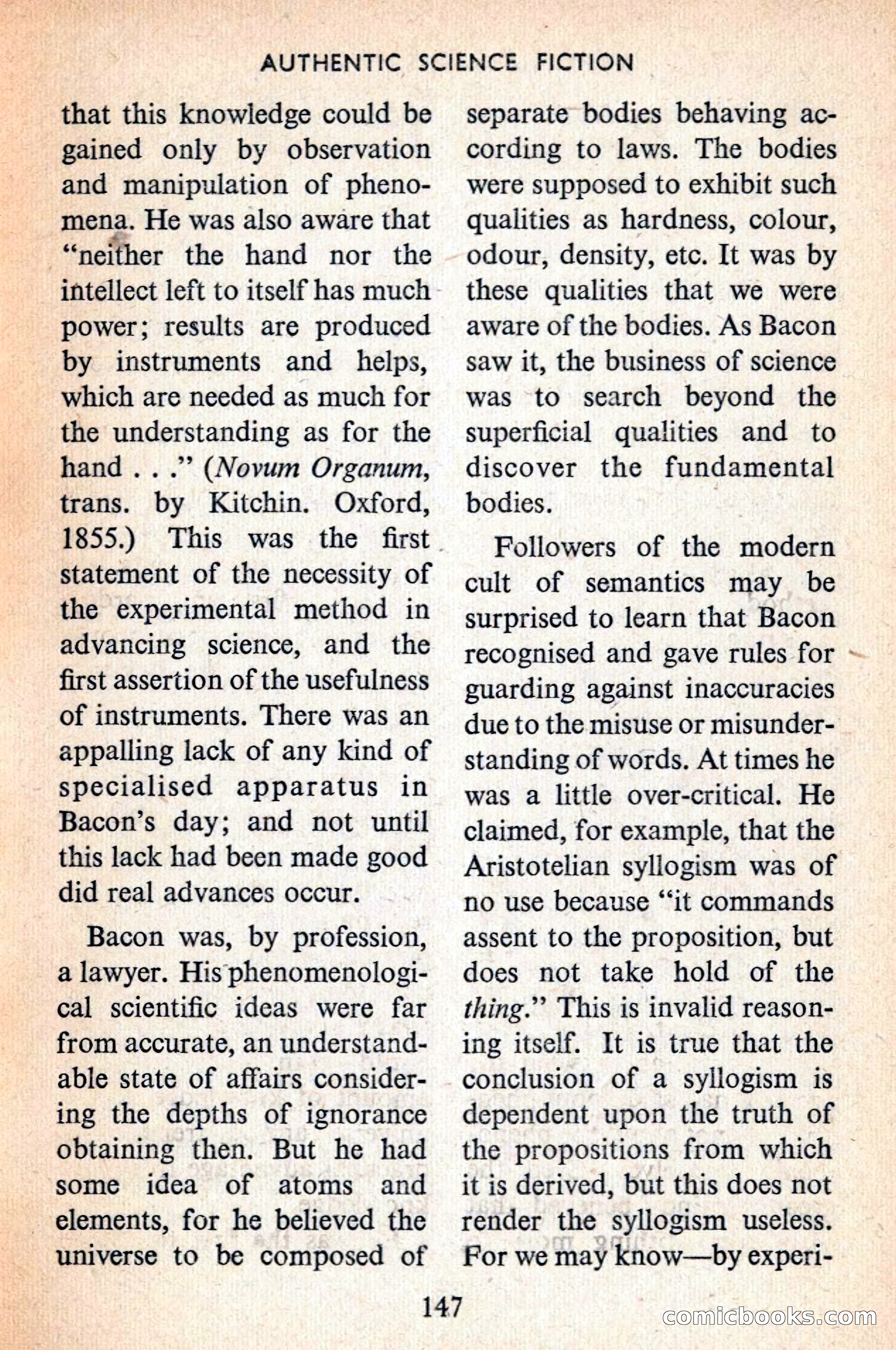
A restored page from Pulp Fiction, 1954. Page through the whole issue in the reader above.
📄 Transcribed text from this page (OCR, searchable)
Machine-transcribed from the original scan — historical spelling and the odd misread are preserved.
AUTHENTIC SCIENCE FICTION that this knowledge could be gained only by observation and manipulation of pheno- mena. He was also aware that “neither the hand nor the intellect left to itself has much power; results are produced by instruments and helps, which are needed as much for the understanding as for the hand...” (Novum Organum, trans. by Kitchin. Oxford, 1855.) This was the first. statement of the necessity of the experimental method in advancing science, and the first assertion of the usefulness of instruments. There was an appalling lack of any kind of specialised apparatus in Bacon’s day; and not until this lack had been made good did real advances occur. Bacon was, by profession, a lawyer. His phenomenologi- cal scientific ideas were far from accurate, an understand- able state of affairs consider- ing the depths of ignorance obtaining then. But he had some idea of atoms and - elements, for he believed the universe to be composed of 147 separate bodies behaving ac- cording to laws. The bodies were supposed to exhibit such qualities as hardness, colour, odour, density, etc. It was by these qualities that we were aware of the bodies. As Bacon saw it, the business of science was to search beyond the superficial qualities and to discover the fundamental bodies. Followers of the modern cult of semantics may be surprised to learn that Bacon recognised and gave rules for guarding against inaccuracies due to the misuse or misunder- standing of words. At times he was a little over-critical. He claimed, for example, that the Aristotelian syllogism was of no use because “‘it commands assent to the proposition, but does not take hold of the thing.’ This is invalid reason- ing itself. It is true that the conclusion of a syllogism is dependent upon the truth of the propositions from which ~ it is derived, but this does not render the syllogism useless. For we may know—by experi- f comicloooks.com