
Pulp Fiction, 1954 · page 149 of 162
Authentic Science Fiction Monthly No. 46 — page 149: what you’re looking at
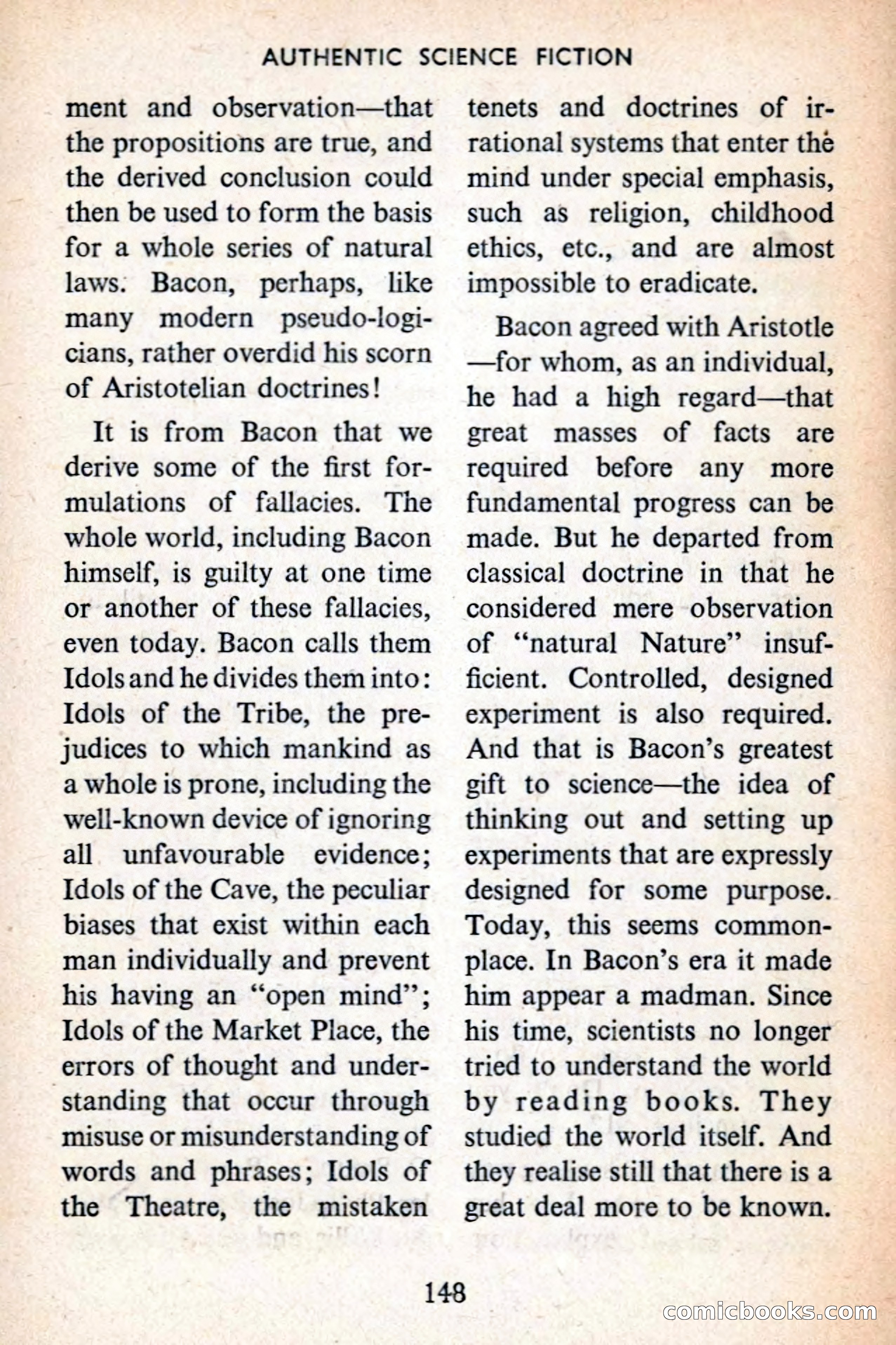
A restored page from Pulp Fiction, 1954. Page through the whole issue in the reader above.
📄 Transcribed text from this page (OCR, searchable)
Machine-transcribed from the original scan — historical spelling and the odd misread are preserved.
AUTHENTIC SCIENCE FICTION ment and observation—that the propositions are true, and the derived conclusion could then be used to form the basis for a whole series of natural laws: Bacon, perhaps, like many modern pseudo-logi- cians, rather overdid his scorn of Aristotelian doctrines! It is from Bacon that we derive some of the first for- mulations of fallacies. The whole world, including Bacon himself, is guilty at one time or another of these fallacies, even today. Bacon calls them Idols and he divides them into: Idols of the Tribe, the pre- judices to which mankind as a whole is prone, including the well-known device of ignoring all unfavourable evidence; Idols of the Cave, the peculiar biases that exist within each man individually and prevent his having an “open mind”; Idols of the Market Place, the errors of thought and under- ‘standing that occur through misuse Or misunderstanding of words and phrases; Idols of the Theatre, the mistaken 148 tenets and doctrines of ir- rational systems that enter the mind under special emphasis, such as religion, childhood ethics, etc., and are almost impossible to eradicate. Bacon agreed with Aristotle —for whom, as an individual, he had a high regard—that great masses of facts are required before any more fundamental progress can be made. But he departed from classical doctrine in that he considered mere observation of “natural Nature’ insuf- ficient. Controlled, designed experiment is also required. And that is Bacon’s greatest gift to science—the idea of thinking out and setting up experiments that are expressly designed for some purpose. Today, this seems common- place. In Bacon’s era it made him appear a madman. Since his time, scientists no longer tried to understand the world by reading books. They studied the world itself. And they realise still that there is a great deal more to be known. comichooks.con