
Pulp Fiction, 1954 · page 142 of 162
Authentic Science Fiction Monthly No. 46 — page 142: what you’re looking at
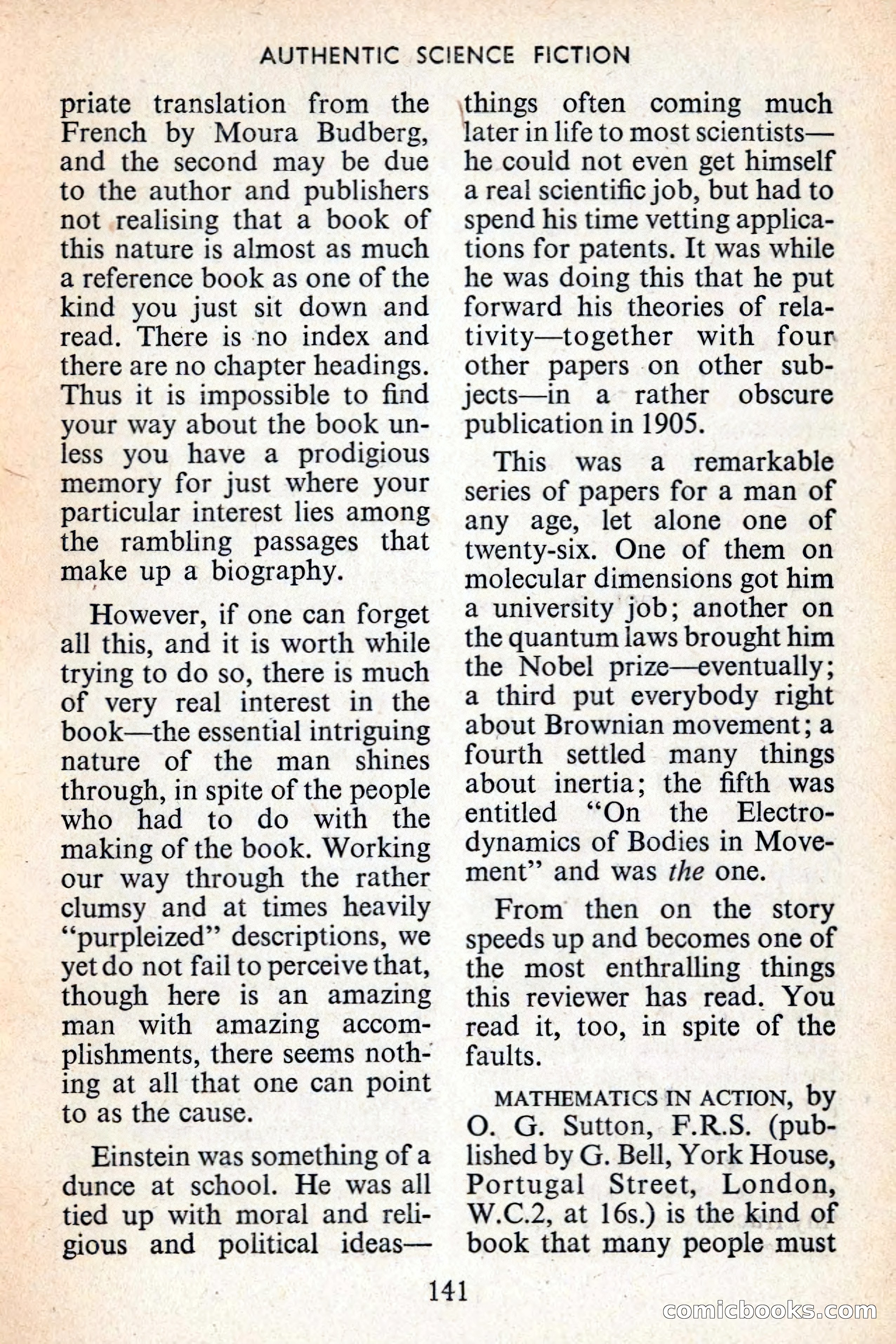
A restored page from Pulp Fiction, 1954. Page through the whole issue in the reader above.
📄 Transcribed text from this page (OCR, searchable)
Machine-transcribed from the original scan — historical spelling and the odd misread are preserved.
AUTHENTIC SCIENCE FICTION priate translation from the French by Moura Budberg, and the second may be due to the author and publishers not realising that a book of this nature is almost as much a reference book as one of the kind you just sit down and read. There is no index and there are no chapter headings. Thus it is impossible to find your way about the book un- less you have a prodigious memory for just where your particular interest lies among the rambling passages that make up a biography. However, if one can forget all this, and it is worth while trying to do so, there is much of very real interest in the book—the essential intriguing nature of the man _ shines through, in spite of the people who had to do with the making of the book. Working our way through the rather clumsy and at times heavily “‘purpleized”’ descriptions, we yet do not fail to perceive that, though here is an amazing man with amazing accom- plishments, there seems noth- ing at all that one can point to as the cause. Einstein was something of a dunce at school. He was all tied up with moral and reli- gious and political ideas— things often coming much later in life to most scientists— he could not even get himself a real scientific job, but had to spend his time vetting applica- tions for patents. It was while he was doing this that he put forward his theories of rela- tivity—together with four other papers on other sub- jects—in a rather obscure publication in 1905. This was a_ remarkable series of papers for a man of any age, let alone one of twenty-six. One of them on molecular dimensions got him a university job; another on the quantum laws brought him the Nobel prize—eventually; a third put everybody right about Brownian movement; a fourth settled many things about inertia; the fifth was entitled ‘On the Electro- dynamics of Bodies in Move- ment” and was the one. From then on the story speeds up and becomes one of the most enthralling things this reviewer has read. You read it, too, in spite of the faults. MATHEMATICS IN ACTION, by O. G. Sutton, F.R.S. (pub- lished by G. Bell, York House, Portugal Street, London, W.C.2, at 16s.) is the kind of book that many people must 141 comiclooks.corn