
Pulp Fiction, 1954 · page 143 of 162
Authentic Science Fiction Monthly No. 46 — page 143: what you’re looking at
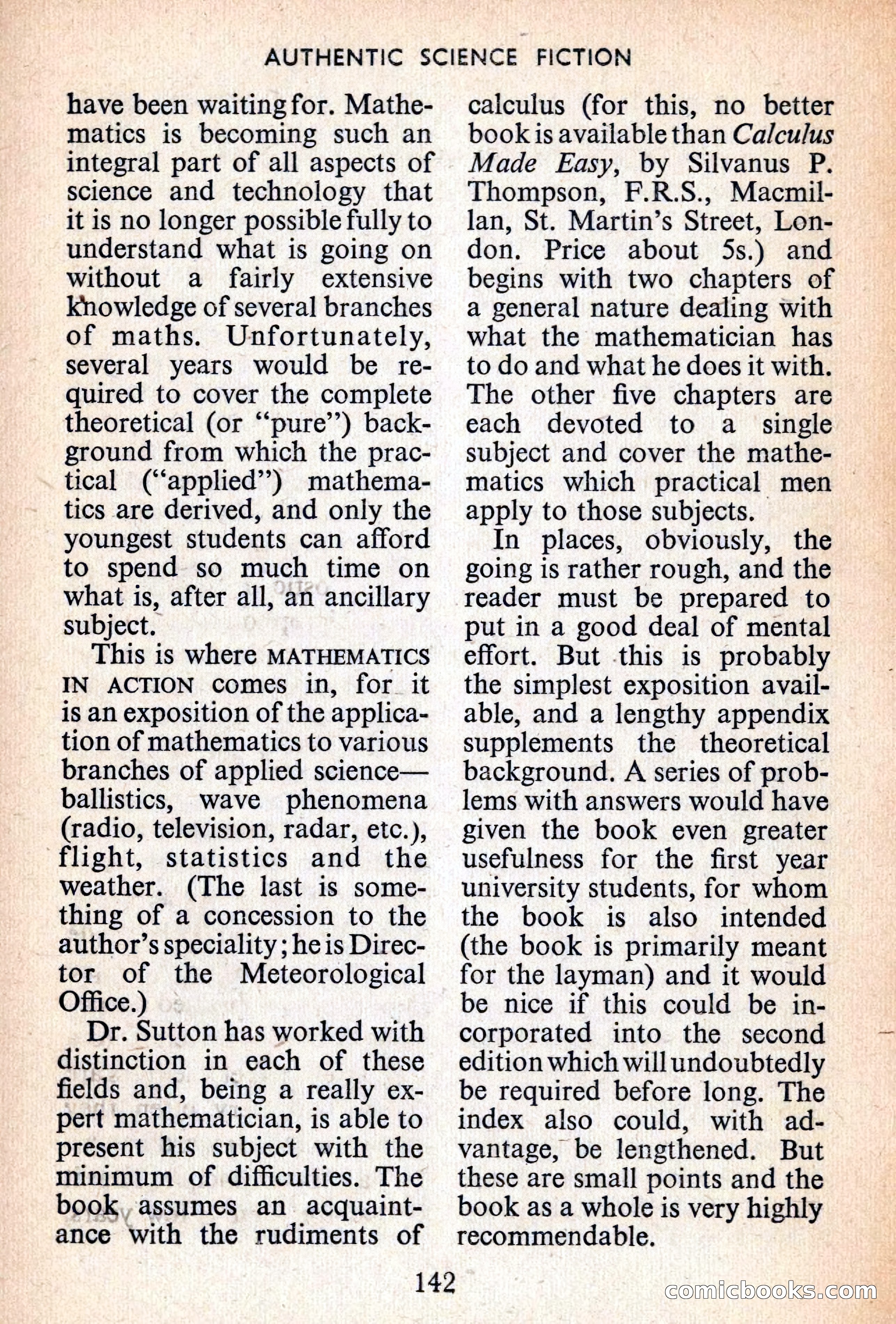
A restored page from Pulp Fiction, 1954. Page through the whole issue in the reader above.
📄 Transcribed text from this page (OCR, searchable)
Machine-transcribed from the original scan — historical spelling and the odd misread are preserved.
AUTHENTIC SCIENCE FICTION have been waiting for. Mathe- matics is becoming such an integral part of all aspects of science and technology that it is no longer possible fully to understand what is going on without a fairly extensive knowledge of several branches of maths. Unfortunately, several years would be re- quired to cover the complete theoretical (or “pure’’) back- ground from which the prac- tical (“applied”) mathema- tics are derived, and only the youngest students can afford to spend so much time on what is, after all, an ancillary subject. This is where MATHEMATICS IN ACTION comes in, for it is an exposition of the applica- tion of mathematics to various branches of applied science— ballistics, wave phenomena (radio, television, radar, etc.), flight, statistics and the weather. (The last is some- thing of a concession to the author’s speciality ; he is Direc- tor of the Meteorological Office.) Dr. Sutton has worked with distinction in each of these fields and, being a really ex- pert mathematician, is able to present his subject with the minimum of difficulties. The book, assumes an acquaint- ance with the rudiments of 142 calculus (for this, no better book is available than Calculus Made Easy, by Silvanus P. Thompson, F.R.S., Macmil- lan, St. Martin’s Street, Lon- don. Price about 5s.) and begins with two chapters of a general nature dealing with what the mathematician has to do and what he does it with. The other five chapters are each devoted to a single subject and cover the mathe- matics which practical men — apply to those subjects. In places, obviously, the going is rather rough, and the reader must be prepared to put in a good deal of mental effort. But this is probably the simplest exposition avail- able, and a lengthy appendix supplements the theoretical background. A series of prob- lems with answers would have given the book even greater usefulness for the first year university students, for whom the book is also intended (the book is primarily meant for the layman) and it would be nice if this could be in- corporated into the second edition which will undoubtedly be required before long. The index also could, with ad- vantage, be lengthened. But these are small points and the book as a whole is very highly recommendable. Comicbooks.CoOm