
Pulp Fiction, 1954 · page 141 of 162
Authentic Science Fiction Monthly No. 46 — page 141: what you’re looking at
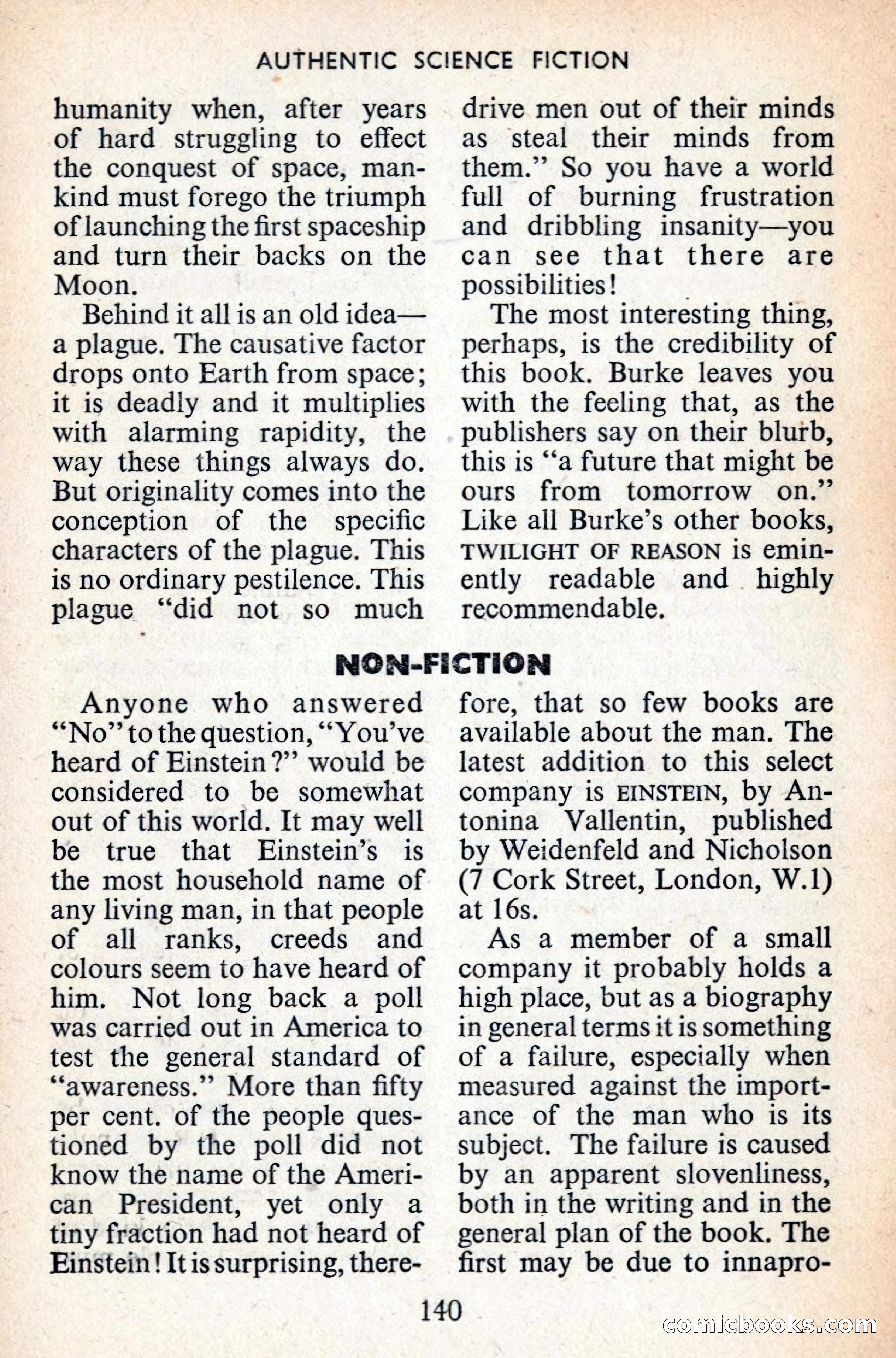
A restored page from Pulp Fiction, 1954. Page through the whole issue in the reader above.
📄 Transcribed text from this page (OCR, searchable)
Machine-transcribed from the original scan — historical spelling and the odd misread are preserved.
AUTHENTIC SCIENCE FICTION humanity when, after years of hard struggling to effect the conquest of space, man- kind must forego the triumph of launching the first spaceship and turn their backs on the Moon. Behind it all is an old idea— a plague. The causative factor drops onto Earth from space; it is deadly and it multiplies with alarming rapidity, the way these things always do. But originality comes into the conception of the specific characters of the plague. This is no ordinary pestilence. This plague “did not so much drive men out of their minds as steal their minds from them.’ So you have a world full of burning frustration and dribbling insanity—you can see that there are possibilities! The most interesting thing, perhaps, is the credibility of this book. Burke leaves you with the feeling that, as the publishers say on their blurb, this is “‘a future that might be ours from tomorrow on.” Like all Burke’s other books, TWILIGHT OF REASON is emin- ently readable and_ highly recommendable. NON-FICTION Anyone who answered “No” to the question, ““You’ve heard of Einstein ?’? would be considered to be somewhat out of this world. It may well be true that Einstein’s is the most household name of any living man, in that people of all ranks, creeds and colours seem to have heard of him. Not long back a poll was carried out in America to test the general standard of “‘awareness.’’ More than fifty per cent. of the people ques- tioned by the poll did not know the name of the Ameri- can President, yet only a tiny fraction had not heard of Einstein! It is surprising, there- 140 fore, that so few books are available about the man. The latest addition to this select company is EINSTEIN, by An- tonina Vallentin, published by Weidenfeld and Nicholson (7 Cork Street, London, W.1) at 16s. As a member of a small company it probably holds a high place, but as a biography in general terms it is something of a failure, especially when measured against the import- ance of the man who is its subject. The failure is caused by an apparent slovenliness, both in the writing and in the general plan of the book. The first may be due to innapro- commiclooolkks. com