
Pulp Fiction, 1954 · page 103 of 162
Authentic Science Fiction Monthly No. 46 — page 103: what you’re looking at
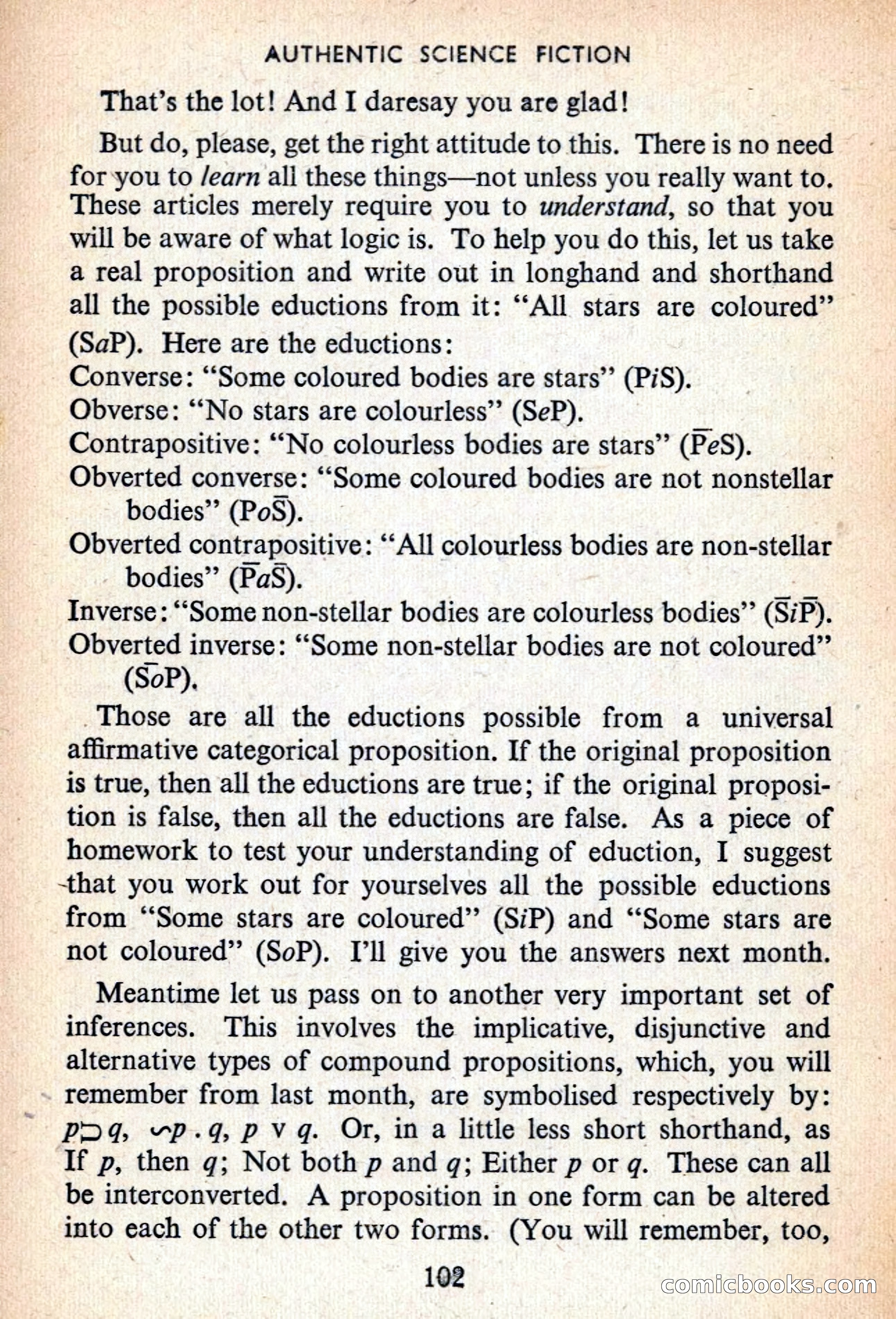
A restored page from Pulp Fiction, 1954. Page through the whole issue in the reader above.
📄 Transcribed text from this page (OCR, searchable)
Machine-transcribed from the original scan — historical spelling and the odd misread are preserved.
AUTHENTIC SCIENCE FICTION That’s the lot! And I daresay you are glad! But do, please, get the right attitude to this. There is no need for you to /earn ali these things—not unless you really want to. These articles merely require you to understand, so that you will be aware of what logic is. To help you do this, let us take a real proposition and write out in longhand and shorthand all the possible eductions from it: “All stars are coloured” (SaP). Here are the eductions: Converse: “Some coloured bodies are stars’’ (PiS). Obverse: “‘No stars are colourless’’ (SeP). Contrapositive: ‘“No colourless bodies are stars” (PeS). Obverted converse: “Some coloured bodies are not nonstellar bodies”’ (PoS). Obverted contrapositive: “All colourless bodies are non-stellar bodies” (PaS). Inverse : “Some non-stellar bodies are colourless bodies” (SiP). Obverted inverse: “Some non-stellar bodies are not coloured” (SoP). Those are all the eductions possible from a _ universal affirmative categorical proposition. If the original proposition is true, then all the eductions are true; if the original proposi- tion is false, then all the eductions are false. As a piece of homework to test your understanding of eduction, I suggest -that you work out for yourselves all the possible eductions from “‘Some stars are coloured’’ (SiP) and ‘“‘Some stars are not coloured” (SoP). V’ll give you the answers next month. Meantime let us pass on to another very important set of inferences. This involves the implicative, disjunctive and alternative types of compound propositions, which, you will ~ remember from last month, are symbolised respectively by: ' pDq, “P.g, p Vv q. Or, in a little less short shorthand, as If p, then g; Not both p and q; Either p or g. These can all be interconverted. A proposition in one form can be altered into each of the other two forms. (You will remember, too, 102 comicbooks.con