
Pulp Fiction, 1954 · page 102 of 162
Authentic Science Fiction Monthly No. 46 — page 102: what you’re looking at
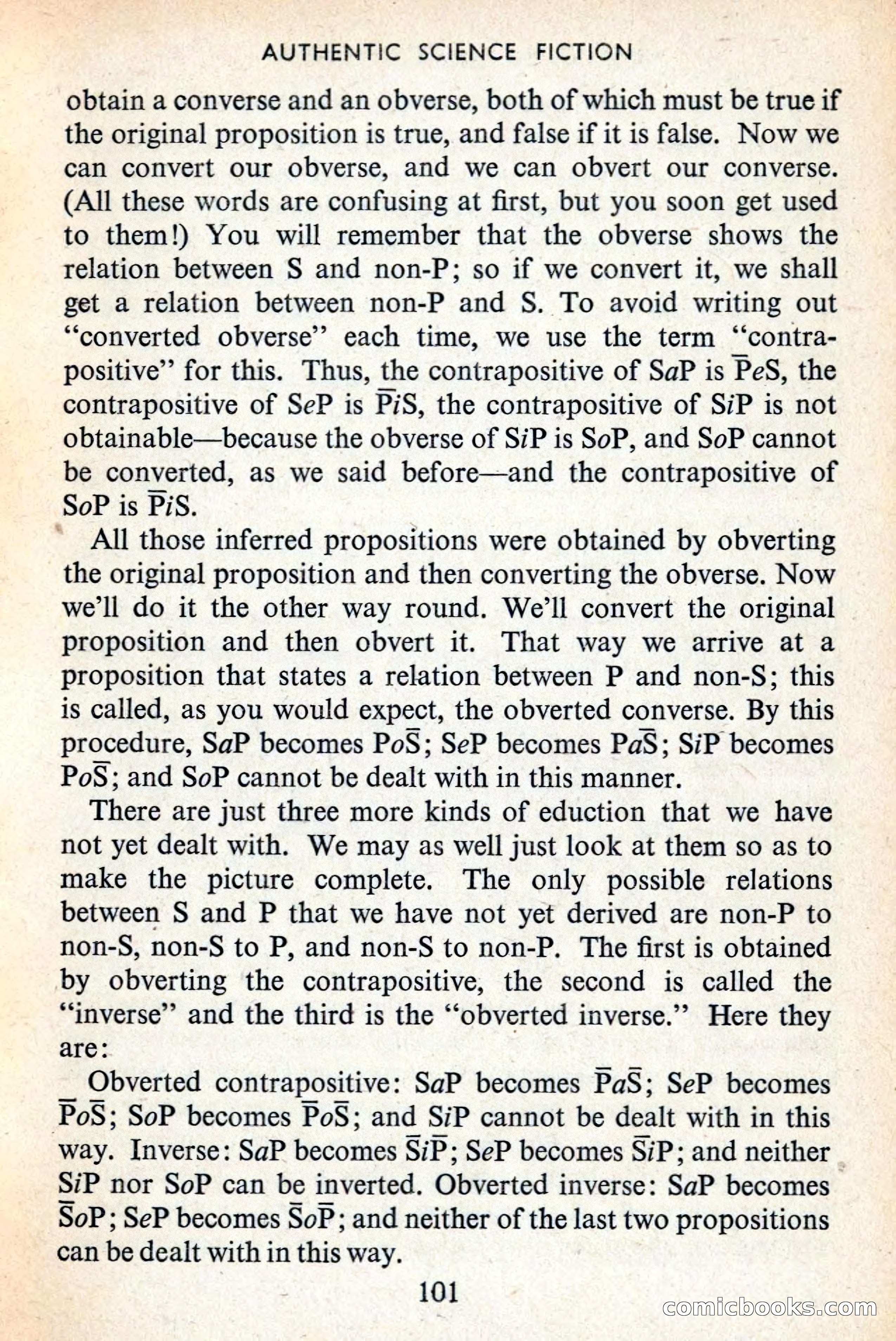
A restored page from Pulp Fiction, 1954. Page through the whole issue in the reader above.
📄 Transcribed text from this page (OCR, searchable)
Machine-transcribed from the original scan — historical spelling and the odd misread are preserved.
AUTHENTIC SCIENCE FICTION obtain a converse and an obverse, both of which must be true if the original proposition is true, and false if it is false. Now we can convert our obverse, and we can obvert our converse. (All these words are confusing at first, but you soon get used to them!) You will remember that the obverse shows the relation between S and non-P; so if we convert it, we shall get a relation between non-P and S. To avoid writing out “converted obverse’”’ each time, we use the term ‘“‘contra- positive” for this. Thus, the contrapositive of SaP is PeS, the contrapositive of SeP is PiS, the contrapositive of SiP is not obtainable—because the obverse of SiP is SoP, and SoP cannot be converted, as we said before—and the contrapositive of SoP is PiS. All those inferred propositions were obtained by obverting the original proposition and then converting the obverse. Now we'll do it the other way round. We’ll convert the original proposition and then obvert it. That way we arrive at a proposition that states a relation between P and non-S; this is called, as you would expect, the obverted converse. By this procedure, SaP becomes PoS; SeP becomes PaS; SiP becomes PoS; and SoP cannot be dealt with in this manner. There are just three more kinds of eduction that we have not yet dealt with. We may as well just look at them so as to make the picture complete. The only possible relations between S and P that we have not yet derived are non-P to non-S, non-S to P, and non-S to non-P. The first is obtained by obverting the contrapositive, the second is called the “‘inverse”’ and the third is the “‘obverted inverse.’’ Here they are: _ Obverted contrapositive: SaP becomes PaS; SeP becomes PoS; SoP becomes PoS; and SiP cannot be dealt with in this way. Inverse: SaP becomes SiP; SeP becomes SiP; and neither _ SiP nor SoP can be inverted. Obverted inverse: SaP becomes SoP ; SeP becomes SoP; and neither of the last two propositions can be dealt with in this way. 101 conmicbooks.com