
Pulp Fiction, 1954 · page 104 of 162
Authentic Science Fiction Monthly No. 46 — page 104: what you’re looking at
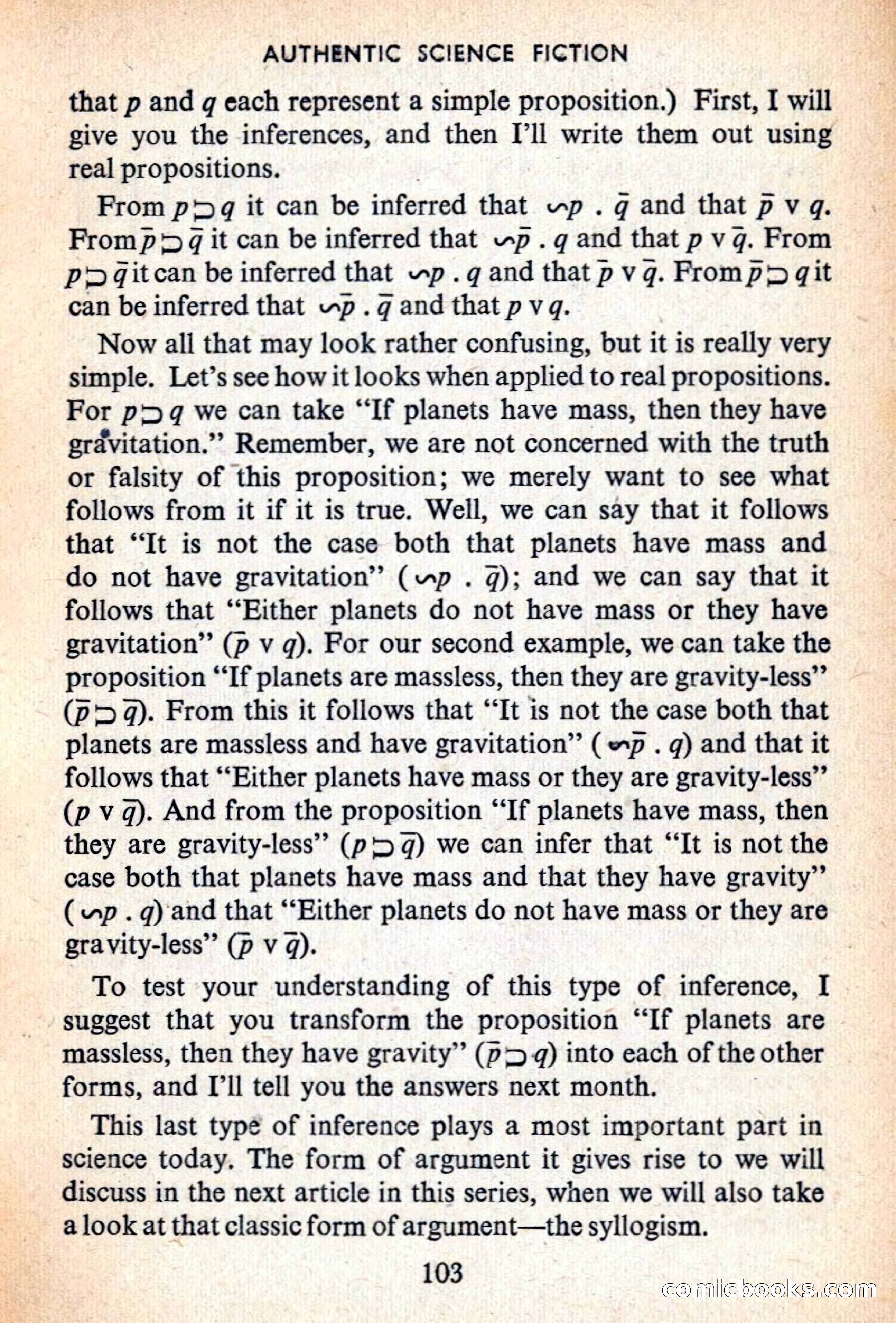
A restored page from Pulp Fiction, 1954. Page through the whole issue in the reader above.
📄 Transcribed text from this page (OCR, searchable)
Machine-transcribed from the original scan — historical spelling and the odd misread are preserved.
AUTHENTIC SCIENCE FICTION that p and g each represent a simple proposition.) First, I will give you the inferences, and then I’ll write them out using real propositions. | From p'>q it can be inferred that wp. g and that p v q. From pq it can be inferred that wp . q and that p vq. From p> qitcan be inferred that »p .q and that p vq. Fromp» qit can be inferred that wp .g and that pvq. Now all that may look rather confusing, but it is really very simple. Let’s see how it looks when applied to real propositions. For p>q we can take “If planets have mass, then they have gravitation.”’ Remember, we are not concerned with the truth or falsity of this proposition; we merely want to see what follows from it if it is true. Well, we can say that it follows that “It is not the case both that planets have mass and do not have gravitation’? (wp . g); and we can say that it follows that “Either planets do not have mass or they have gravitation” (p v qg). For our second example, we can take the proposition “If planets are massless, then they are gravity-less”’ (p'> q). From this it follows that “It is not the case both that planets are massless and have gravitation”’’ ( ~p . q) and that it follows that “Either planets have mass or they are gravity-less”’ (p v q). And from the proposition “If planets have mass, then they are gravity-less’’ (p'> q) we can infer that “It is not the case both that planets have mass and that they have gravity” ( wp . gq) and that “Either planets do not have mass or they are gravity-less” (p v q). To test your understanding of this type of inference, I suggest that you transform the proposition “If planets are massless, then they have gravity” (p> q) into each of the other forms, and [ll tell you the answers next month. This last typé of inference plays a most important part in science today. The form of argument it gives rise to we will discuss in the next article in this series, when we will also take a look at that classic form of argument—the syllogism. 103 comicloooks. com