
Pulp Fiction, 1954 · page 70 of 162
Authentic Science Fiction Monthly, Issue 45 — page 70: what you’re looking at
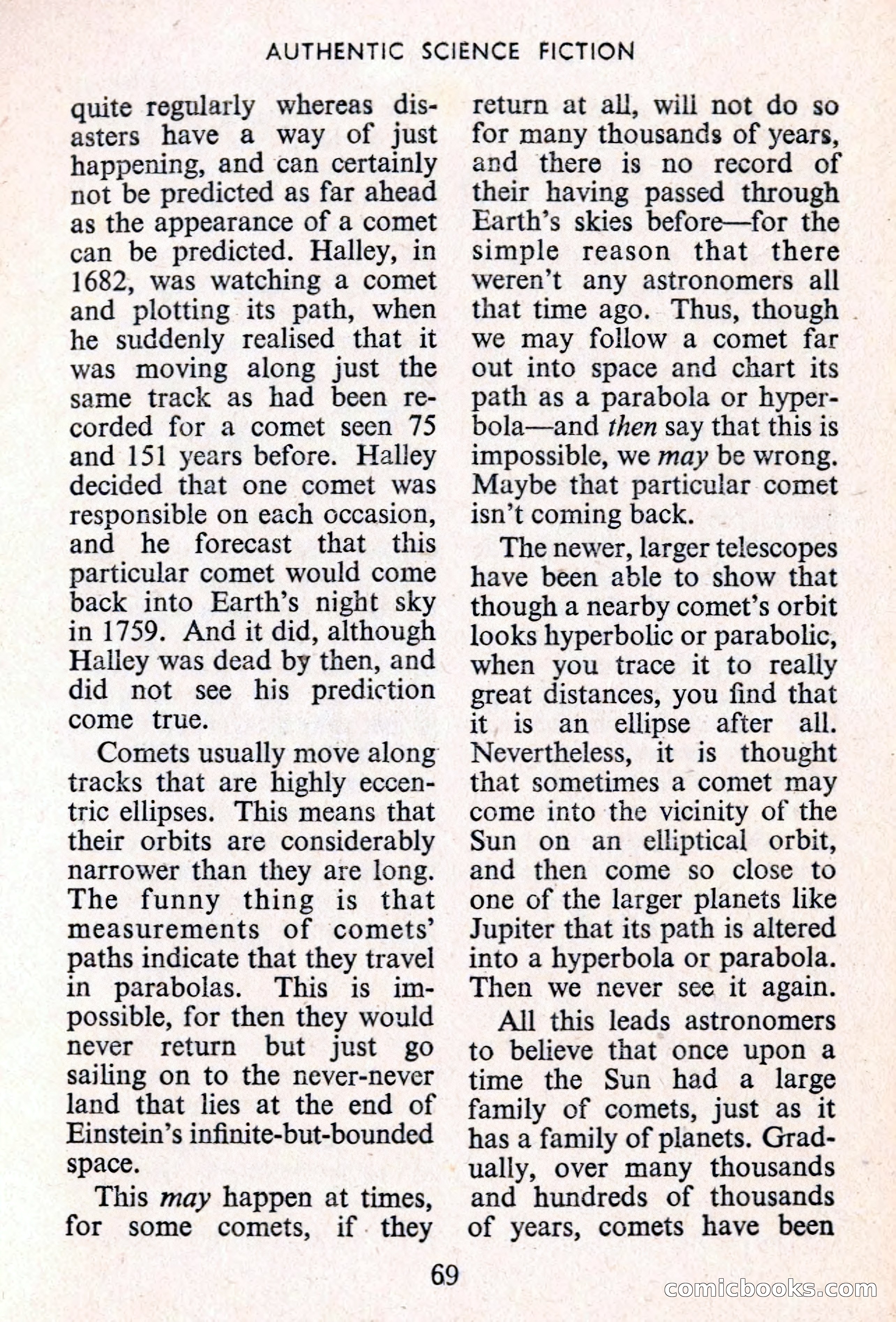
A restored page from Pulp Fiction, 1954. Page through the whole issue in the reader above.
📄 Transcribed text from this page (OCR, searchable)
Machine-transcribed from the original scan — historical spelling and the odd misread are preserved.
AUTHENTIC SCIENCE FICTION quite regularly whereas dis- asters have a way of just happening, and can certainly not be predicted as far ahead as the appearance of a comet can be predicted. Halley, in 1682, was watching a comet and plotting its path, when he suddenly realised that it was moving along just the same track as had been re- corded for a comet seen 75 and 151 years before. Halley decided that one comet was responsible on each occasion, and he forecast that this particular comet would come back into Earth’s night sky in 1759. And it did, although Halley was dead by then, and did not see his prediction come true. Comets usually move along tracks that are highly eccen- tric ellipses. This means that their orbits are considerably narrower than they are long. The funny thing is that measurements of comets’ paths indicate that they travel in parabolas. This is im- possible, for then they would never return but just go sailing on to the never-never land that lies at the end of Einstein’s infinite-but-bounded space. This may happen at times, for some comets, if. they 69 return at all, wili not do so for many thousands of years, and there is no record of their having passed through Earth’s skies before—for the simple reason that there weren’t any astronomers all that time ago. Thus, though . we may follow a comet far out into space and chart its path as a parabola or hyper- bola—and then say that this is impossible, we may be wrong. Maybe that particular comet isn’t coming back. The newer, larger telescopes have been able to show that though a nearby comet’s orbit looks hyperbolic or parabolic, when you trace it to really great distances, you find that it is an ellipse after all. Nevertheless, it is thought that sometimes a comet may come into the vicinity of the Sun on an elliptical orbit, and then come so close to one of the larger planets like Jupiter that its path is altered into a hyperbola or parabola. Then we never see it again. All this leads astronomers to believe that once upon a time the Sun had a large family of comets, just as it has a family of planets. Grad- ually, over many thousands and hundreds of thousands of years, comets have been comiclbooks.corn