
Pulp Fiction, 1954 · page 71 of 162
Authentic Science Fiction Monthly, Issue 45 — page 71: what you’re looking at
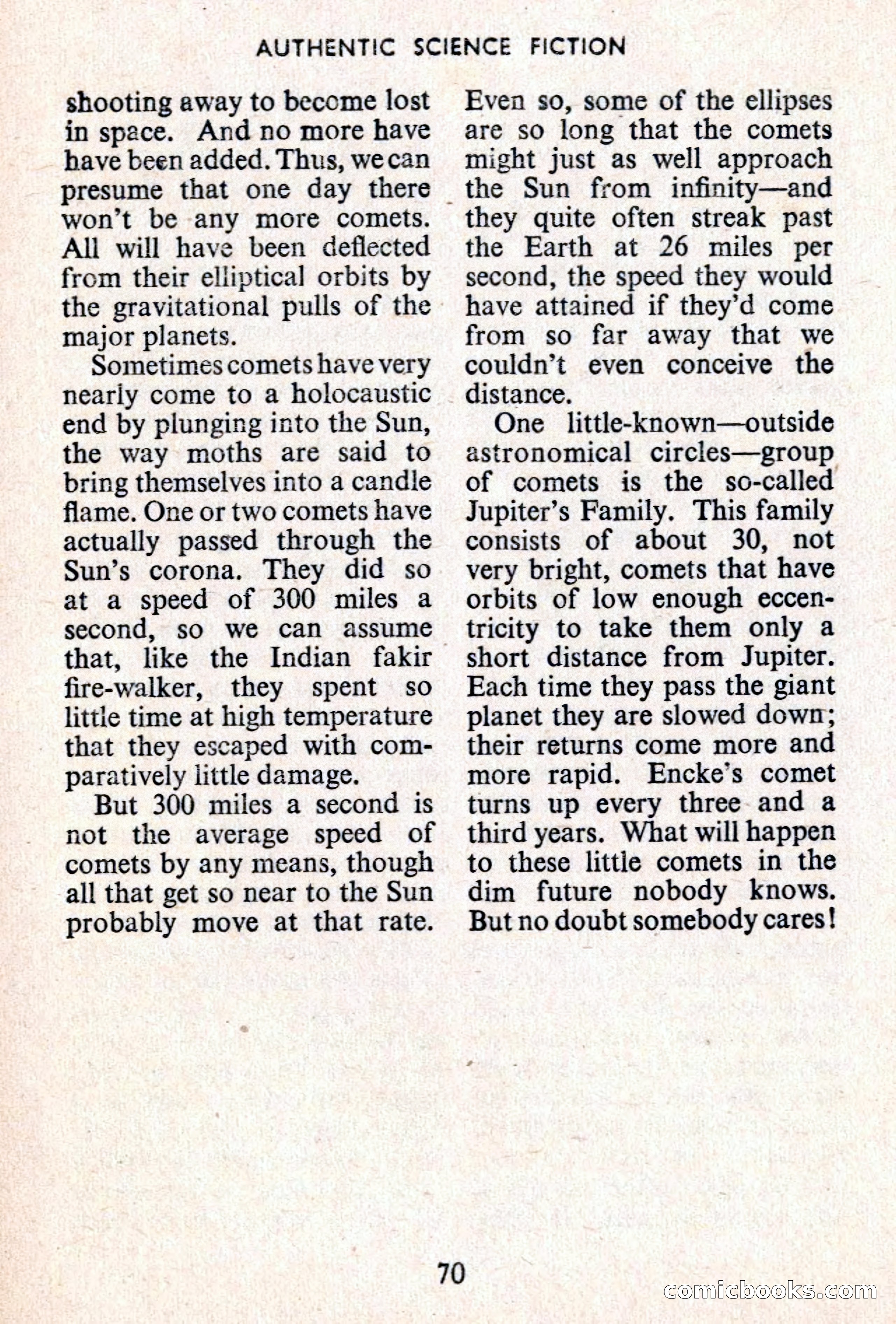
A restored page from Pulp Fiction, 1954. Page through the whole issue in the reader above.
📄 Transcribed text from this page (OCR, searchable)
Machine-transcribed from the original scan — historical spelling and the odd misread are preserved.
AUTHENTIC SCIENCE FICTION shooting away to become lost in space. And no more have have been added. Thus, wecan presume that one day there won’t be any more comets. All will have been deflected from their elliptical orbits by the gravitational pulls of the major planets. Sometimes comets have very nearly come to a holocaustic end by plunging into the Sun, the way moths are said to bring themselves into a candle flame. One or two comets have actually passed through the Sun’s corona. They did so at a speed of 300 miles a second, so we can assume that, like the Indian fakir fire-walker, they spent so little time at high temperature that they escaped with com- paratively little damage. But 300 miles a second is not the average speed of comets by any means, though all that get so near to the Sun probably move at that rate. Even so, some of the ellipses are so long that the comets might just as well approach the Sun from infinity—and 70 they quite often streak past the Earth at 26 miles per second, the speed they would have attained if they’d come from so far away that we couldn’t even conceive the distance. One little-known—outside astronomical circles—group of comets is the so-called Jupiter’s Family. This family consists of about 30, not very bright, comets that have orbits of low enough eccen- tricity to take them only a short distance from Jupiter. Each time they pass the giant planet they are slowed down; their returns come more and more rapid. Encke’s comet turns up every three and a third years. What will happen to these little comets in the dim future nobody knows. But no doubt somebody cares! comiclooks.conn