
Pulp Fiction, 1954 · page 69 of 162
Authentic Science Fiction Monthly, Issue 45 — page 69: what you’re looking at
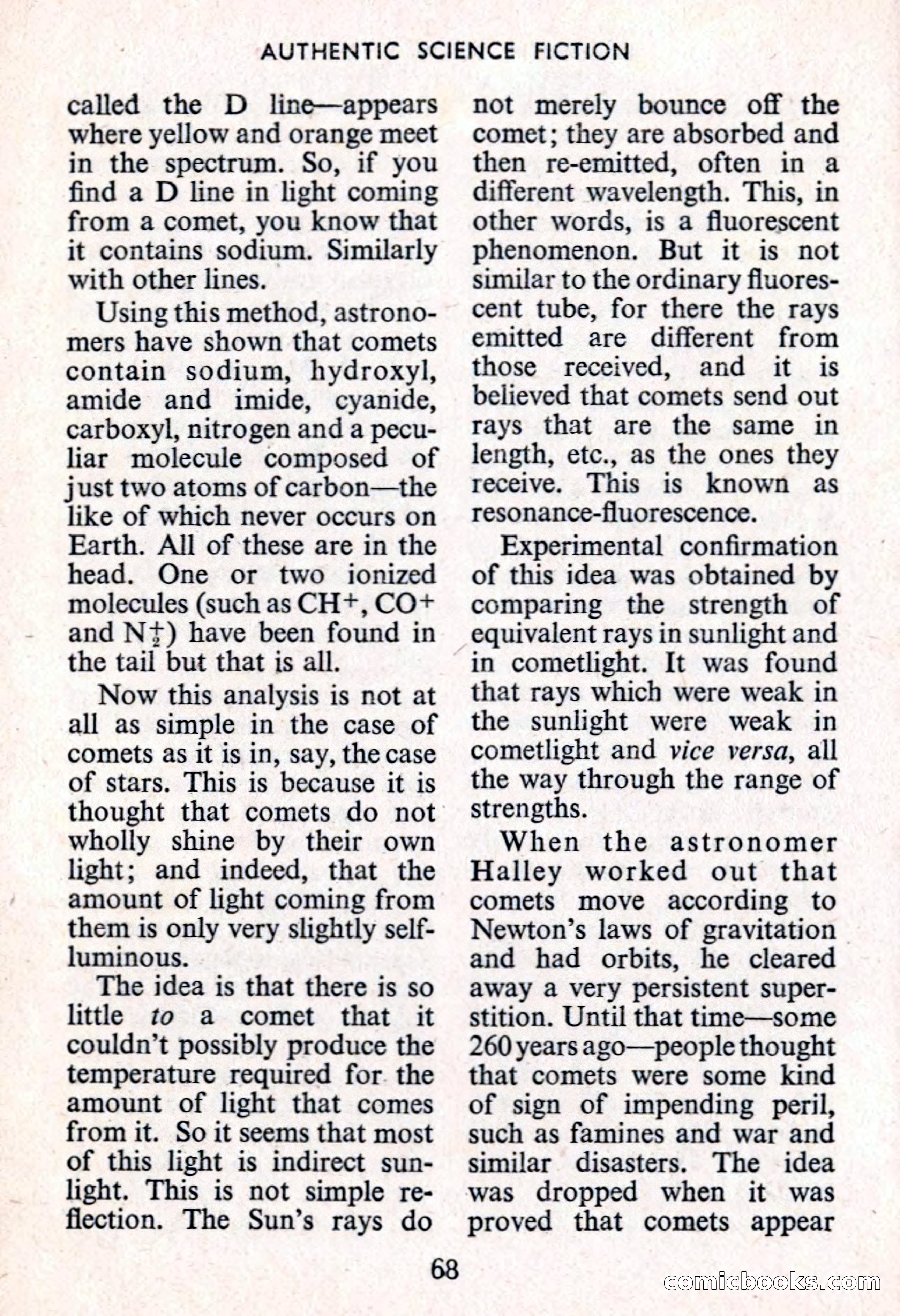
A restored page from Pulp Fiction, 1954. Page through the whole issue in the reader above.
📄 Transcribed text from this page (OCR, searchable)
Machine-transcribed from the original scan — historical spelling and the odd misread are preserved.
AUTHENTIC SCIENCE FICTION called the D line—appears where yellow and orange meet in the spectrum. So, if you find a D line in light coming from a comet, you know that it contains sodium. Similarly with other lines. Using this method, astrono- mers have shown that comets contain sodium, hydroxyl, amide and imide, cyanide, carboxyl, nitrogen and a pecu- liar molecule composed of just two atoms of carbon—the like of which never occurs on Earth. All of these are in the head. One or two ionized molecules (such as CH+, CO+ and Nt) have been found in the tail but that is all. Now this analysis is not at all as simple in the case of comets as it is in, say, the case of stars. This is because it is thought that comets do not wholly shine by their own light; and indeed, that the amount of light coming from them is only very slightly self- luminous. The idea is that there is so little to a comet that it couldn’t possibly produce the temperature required for. the amount of light that comes from it. So it seems that most of this light is indirect sun- light. This is not simple re- flection. The Sun’s rays do 68 not merely bounce off the comet; they are absorbed and then re-emitted, often in a different wavelength. This, in other words, is a fluorescent phenomenon. But it is not similar to the ordinary fluores- cent tube, for there the rays emitted are different from those received, and it is believed that comets send out rays that are the same in length, etc., as the ones they receive. This is known as resonance-fluorescence. Experimental confirmation of this idea was obtained by comparing the strength of equivalent rays in sunlight and in cometlight. It was found that rays which were weak in the sunlight were weak in cometlight and vice versa, all the way through the range of strengths. When the astronomer Halley worked out that comets move according to Newton’s laws of gravitation and had orbits, he cleared away a very persistent super- stition. Until that time—some 260 years ago—people thought that comets were some kind of sign of impending peril, such as famines and war and similar disasters. The idea was dropped when it was proved that comets appear comicloooks.com