
Pulp Fiction, 1954 · page 68 of 162
Authentic Science Fiction Monthly, Issue 45 — page 68: what you’re looking at
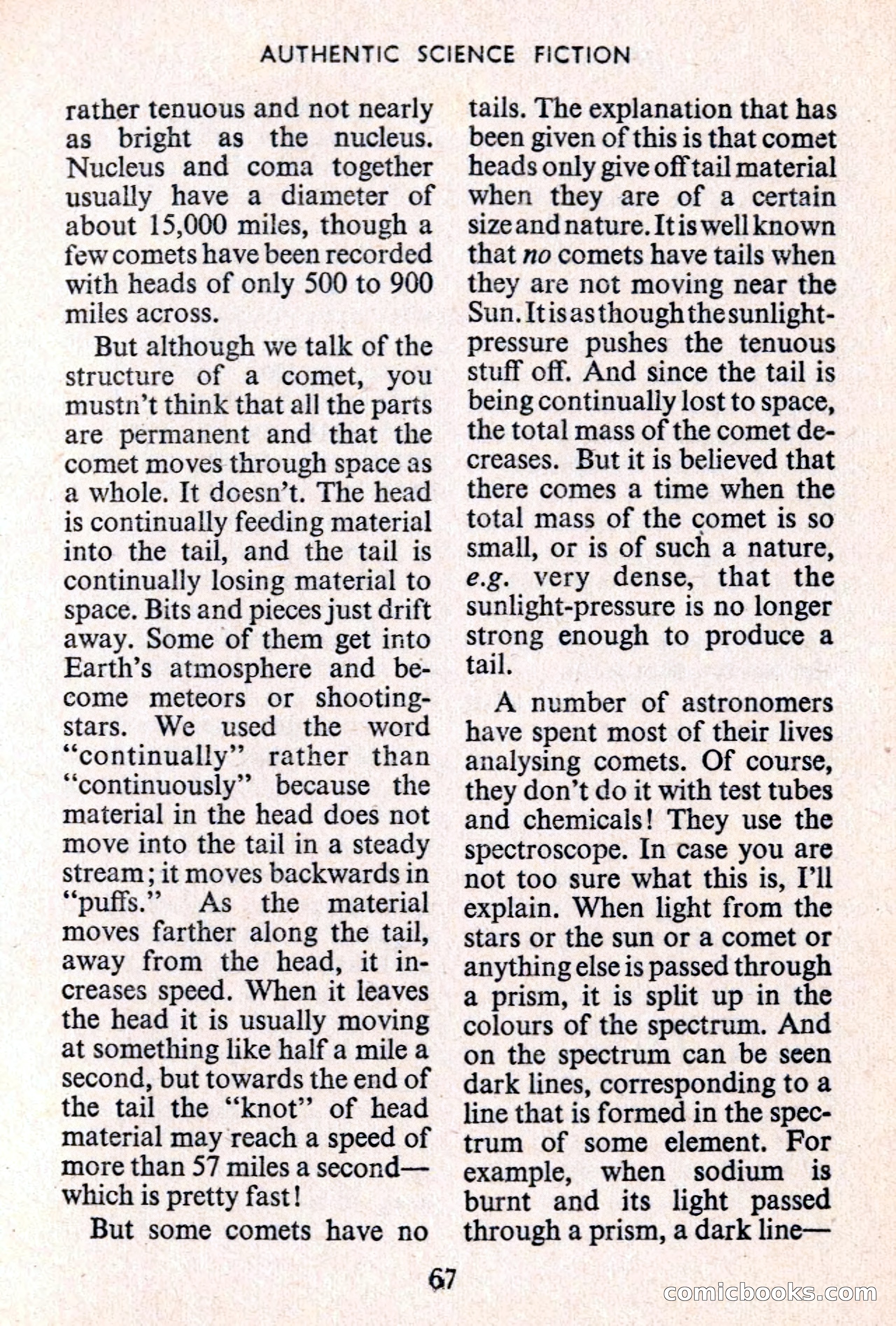
A restored page from Pulp Fiction, 1954. Page through the whole issue in the reader above.
📄 Transcribed text from this page (OCR, searchable)
Machine-transcribed from the original scan — historical spelling and the odd misread are preserved.
AUTHENTIC SCIENCE FICTION rather tenuous and not nearly as bright as the nucleus. Nucleus and coma together usually have a diameter of about 15,000 miles, though a few comets have been recorded with heads of only 500 to 900 miles across. But although we talk of the structure of a comet, you mustn’t think that all the parts are permanent and that the comet moves through space as a whole. It doesn’t. The head is continually feeding material into the tail, and the tail is continually losing material to space. Bits and pieces just drift away. Some of them get into Earth’s atmosphere and be- come meteors or shooting- stars. We used the word “continually” rather than “continuously” because the material in the head does not move into the tail in a steady stream; it moves backwards in ‘“puffs.”” As the material moves farther along the tail, away from the head, it in- creases speed. When it leaves the head it is usually moving at something like half a mile a second, but towards the end of the tail the “‘knot’’ of head material may reach a speed of more than 57 miles a second— which is pretty fast! But some comets have no 67 tails. The explanation that has been given of this is that comet heads only give off tail material When they are of a certain size and nature. Itis well known that no comets have tails when they are not moving near the Sun. [tisasthoughthesunlight- pressure pushes the tenuous stuff off. And since the tail is being continually lost to space, the total mass of the comet de- creases. But it is believed that there comes a time when the total mass of the comet is so small, or is of such a nature, e.g. very dense, that the sunlight-pressure is no longer ae enough to produce a tail. A number of astronomers have spent most of their lives analysing comets. Of course, they don’t do it with test tubes and chemicals! They use the spectroscope. In case you are not too sure what this is, [ll explain. When light from the stars or the sun or a comet or anything else is passed through a prism, it is split up in the colours of the spectrum. And on the spectrum can be seen dark lines, corresponding to a line that is formed in the spec- trum of some element. For example, when sodium is burnt and its light passed through a prism, a dark line— comiclooks.corn