
Pulp Fiction, 1954 · page 67 of 162
Authentic Science Fiction Monthly, Issue 45 — page 67: what you’re looking at
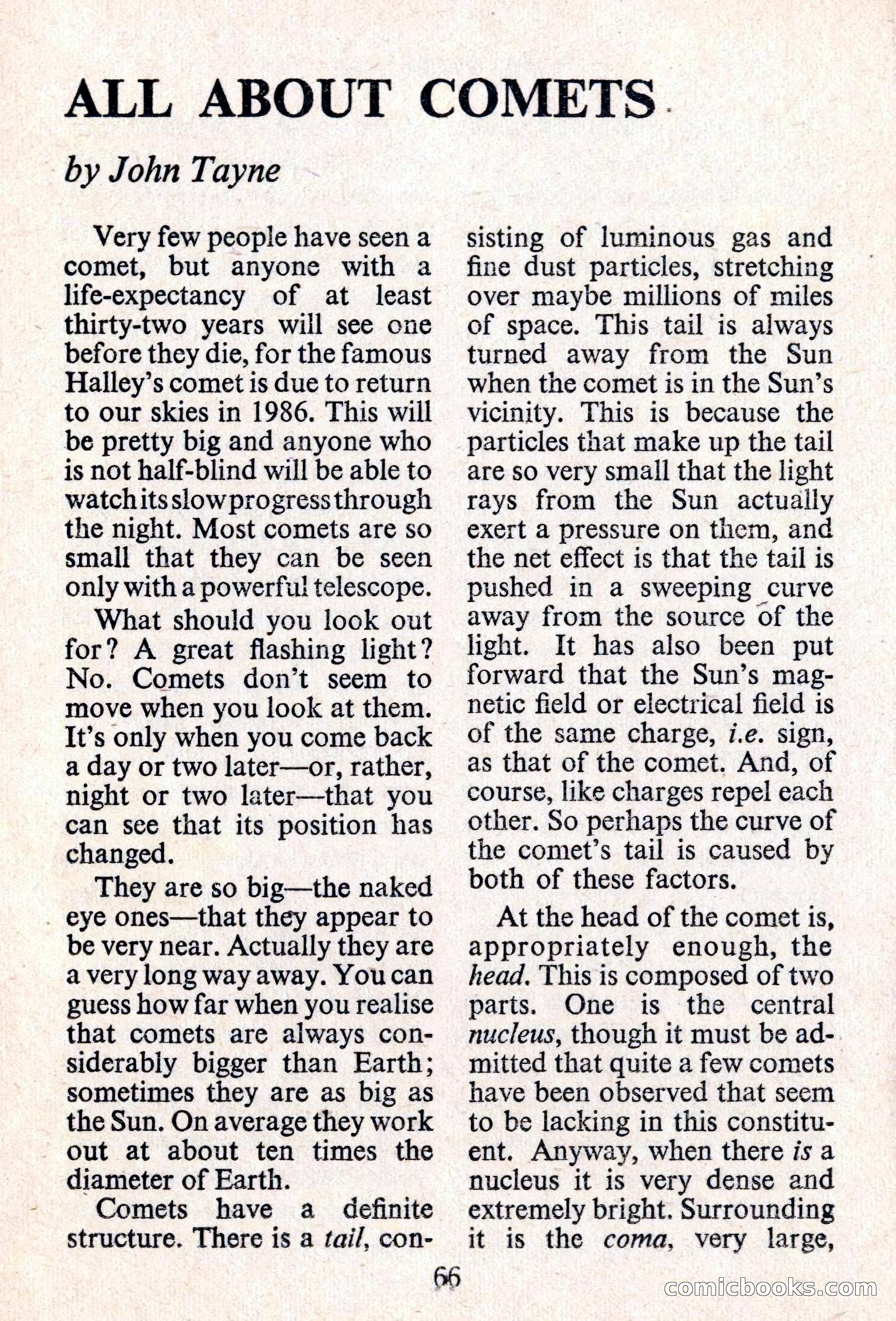
A restored page from Pulp Fiction, 1954. Page through the whole issue in the reader above.
📄 Transcribed text from this page (OCR, searchable)
Machine-transcribed from the original scan — historical spelling and the odd misread are preserved.
ALL ABOUT COMETS. by John Tayne Very few people have seen a comet, but anyone with a life-expectancy of at least thirty-two years wiil see one before they die, for the famous Halley’s comet is due to return to our skies in 1986. This wiil be pretty big and anyone who is not half-blind will be able to watchits slow progressthrough the night. Most comets are so small that they can be seen only with a powerful telescope. What should you look out for? A great flashing light? No. Comets don’t seem to move when you look at them. It’s only when you come back a day or two later—or, rather, night or two later—that you can see that its position has changed. They are so big—the naked _ eye ones—that they appear to be very near. Actually they are a very long way away. Youcan guess how far when you realise that comets are always con- siderably bigger than Earth; sometimes they are as big as the Sun. On average they work out at about ten times the diameter of Earth. Comets have a _ definite structure. There is a tai/, con- sisting of luminous gas and fine dust particles, stretching over maybe millions of miles of space. This tail is always turned away from the Sun when the comet is in the Sun’s vicinity. This is because the particles that make up the tail are so very small that the light rays from the Sun actuaily exert a pressure on them, and the net effect is that the tail is pushed in a sweeping curve away from the source of the light. It has also been put forward that the Sun’s mag- netic field or electrical field is of the same charge, i.e. sign, as that of the comet. And, of course, like charges repel each other. So perhaps the curve of the comet’s tail is caused by both of these factors. At the head of the comet is, appropriately enough, the head. This is composed of two parts. One is the central nucleus, though it must be ad- mitted that quite a few comets have been observed that seem to be lacking in this constitu- ent. Anyway, when there is a nucleus it is very dense and extremely bright. Surrounding it is the coma, very large, comiclooks.cormn