
Pulp Fiction, 1954 · page 133 of 162
Authentic Science Fiction Monthly, Issue 45 — page 133: what you’re looking at
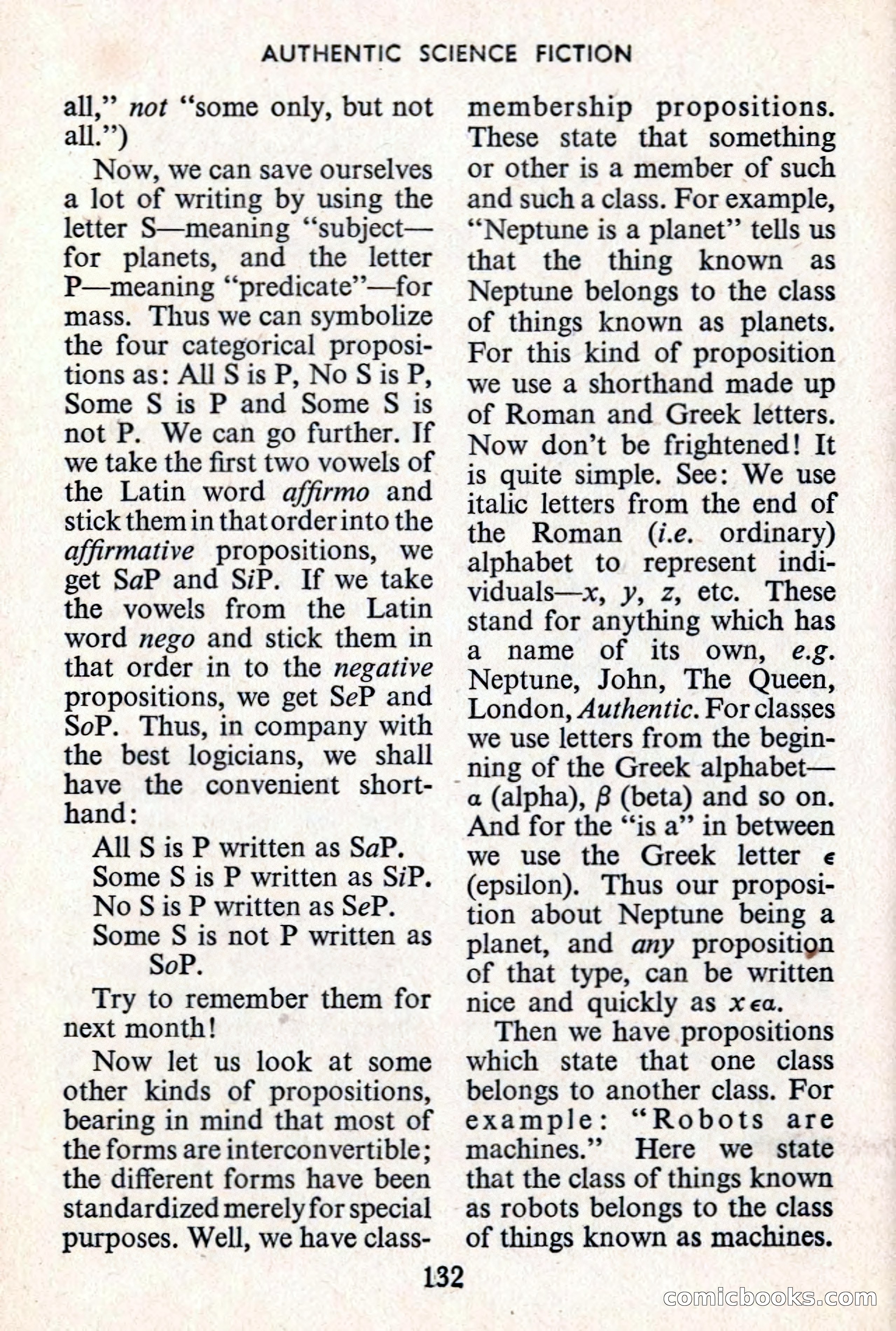
A restored page from Pulp Fiction, 1954. Page through the whole issue in the reader above.
📄 Transcribed text from this page (OCR, searchable)
Machine-transcribed from the original scan — historical spelling and the odd misread are preserved.
AUTHENTIC SCIENCE FICTION all,’ not “some only, but not all.’’) Now, we can save ourselves a lot of writing by using the letter S—meaning “‘subject— for planets, and the letter P—meaning “‘predicate’’—for mass. Thus we can symbolize the four categorical proposi- tions as: All Sis P, No S is P, Some §S is P and Some S is not P. We can go further. If we take the first two vowels of the Latin word affirmo and stick them in that order into the affirmative propositions, we get SaP and SiP. If we take the vowels from the Latin word nego and stick them in that order in to the negative propositions, we get SeP and SoP. Thus, in company with the best logicians, we shall have the convenient short- hand: All S is P written as SaP. Some §S is P written as SiP. No S is P written as SeP. Some S is not P written as SoP. Try to remember them for next month! Now let us look at some other kinds of propositions, bearing in mind that most of the forms are interconvertible; the different forms have been standardized merely for special purposes. Well, we have class- 132 membership propositions. These state that something or other is a member of such and such a class. For example, “Neptune is a planet”’ tells us that the thing known as Neptune belongs to the class of things known as planets. For this kind of proposition we use a shorthand made up of Roman and Greek letters. Now don’t be frightened! It is quite simple. See: We use italic letters from the end of the Roman (i.e. ordinary) alphabet to represent indi- viduals—x, y, z, etc. These stand for anything which has a name of its own, e.g. Neptune, John, The Queen, London, Authentic. For classes we use letters from the begin- ning of the Greek alphabet— a (alpha), 8 (beta) and so on. And for the “‘is a”’ in between we use the Greek letter e¢ (epsilon). Thus our proposi- tion about Neptune being a planet, and any propositign of that type, can be written nice and quickly as xea. Then we have propositions which state that one class belongs to another class. For example: “Robots are machines.”’ Here we state that the class of things known as robots belongs to the class of things known as machines. comiclooks.comn