
Pulp Fiction, 1954 · page 134 of 162
Authentic Science Fiction Monthly, Issue 45 — page 134: what you’re looking at
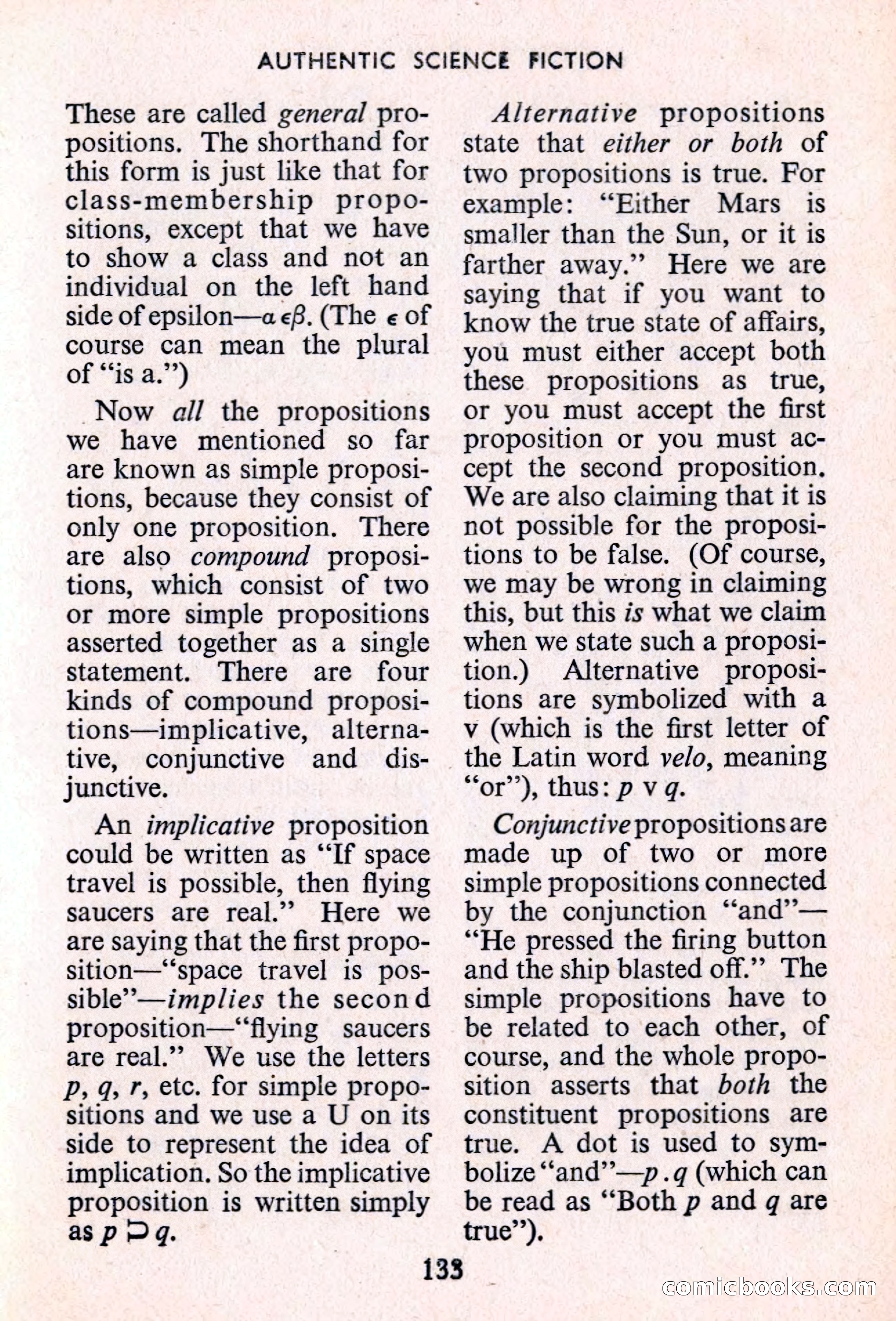
A restored page from Pulp Fiction, 1954. Page through the whole issue in the reader above.
📄 Transcribed text from this page (OCR, searchable)
Machine-transcribed from the original scan — historical spelling and the odd misread are preserved.
AUTHENTIC SCIENCE FICTION These are called general pro- positions. The shorthand for this form is just like that for class-membership propo- sitions, except that we have to show a class and not an individual on the left hand side of epsilon—a ¢f. (The e of course can mean the plural of “is a.” Now all the propositions we have mentioned so far are known as simple proposi- tions, because they consist of only one proposition. There are also compound proposi- tions, which consist of two or more simple propositions asserted together as a single statement. There are four kinds of compound proposi- tions—implicative, alterna- tive, conjunctive and dis- junctive. An implicative proposition could be written as “If space travel is possible, then flying saucers are real.’’ Here we are saying that the first propo- sition—*“‘space travel is pos- sible’—implies the second proposition—‘“‘flying saucers are real.”” We use the letters P, q, r, etc. for simple propo- sitions and we use a U on its side to represent the idea of implication. So the implicative proposition is written simply asp Pg. 133 Alternative propositions state that either or both of two propositions is true. For example: “Either Mars is smaller than the Sun, or it is farther away.’ Here we are saying that if you want to know the true state of affairs, you must either accept both these propositions as true, or you must accept the first proposition or you must ac- cept the second proposition. We are also claiming that it is not possible for the proposi- tions to be false. (Of course, we may be wrong in claiming this, but this is what we claim when we state such a proposi- tion.) Alternative proposi- tions are symbolized with a v (which is the first letter of the Latin word velo, meaning “or’’), thus: p v q. Conjunctive propositions are made up of two or more simple propositions connected by the conjunction “and’— ‘*He pressed the firing button and the ship blasted off.’’ The simple propositions have to be related to each other, of course, and the whole propo- sition asserts that both the constituent propositions are true. A dot is used to sym- bolize ‘‘and’’—p .qg (which can be read as “Both p and gq are true’’). conmicloooks.con