
Pulp Fiction, 1954 · page 132 of 162
Authentic Science Fiction Monthly, Issue 45 — page 132: what you’re looking at
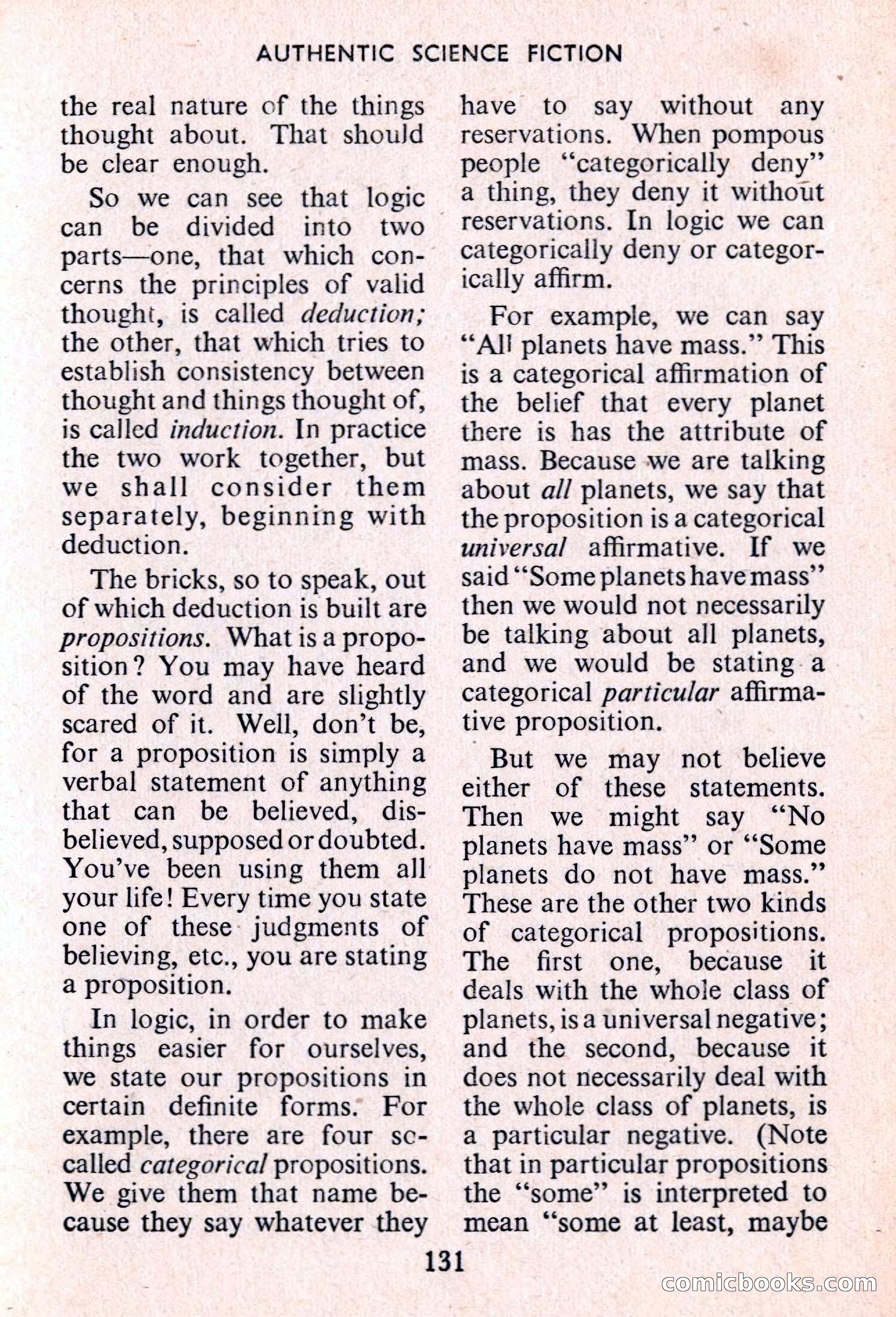
A restored page from Pulp Fiction, 1954. Page through the whole issue in the reader above.
📄 Transcribed text from this page (OCR, searchable)
Machine-transcribed from the original scan — historical spelling and the odd misread are preserved.
AUTHENTIC SCIENCE FICTION the real nature of the things thought about. That shoud be clear enough. So we can see that logic can be divided into two parts—one, that which con- cerns the principles of valid thought, is called deduction; the other, that which tries to establish consistency between thought and things thought of, is called induction. In practice the two work together, but we shall consider them separately, beginning with deduction. The bricks, so to speak, out of which deduction is built are propositions. What is a propo- sition? You may have heard of the word and are slightly scared of it. Weil, don’t be, for a proposition is simply a verbal statement of anything that can be believed, dis- believed, supposed or doubted. You’ve been using them all your life! Every time you state one of these: judgments of believing, etc., you are stating a proposition. In logic, in order to make things easier for ourselves, we state our propositions in certain definite forms. For example, there are four sc- called categorical propositions. We give them that name be- cause they say whatever they have to say without any reservations. When pompous people “categorically deny”’ a thing, they deny it without reservations. In logic we can categorically deny or categor- ically affirm. For example, we can say ‘All planets have mass.”’ This is a categorical affirmation of the belief that every planet there is has the attribute of mass. Because we are talking about a// planets, we say that the proposition is a categorical universal affirmative. If we said ““Some planets have mass”’ then we would not necessarily be talking about all planets, and we would be stating. a categorical particular affirma- tive proposition. | But we may not believe either of these statements. Then we might say “No planets have mass” or ““Some planets do not have mass.” These are the other two kinds of categorical propositions. The first one, because it deals with the whole class of planets, is a universal negative; and the second, because it does not necessarily deal with the whole class of planets, is a particular negative. (Note that in particular propositions the ‘“‘some”’ is interpreted to mean “‘some at least, maybe 131 conmcloooks.comn