
Pulp Fiction, 1954 · page 93 of 162
Authentic Science Fiction Monthly No. 44 — page 93: what you’re looking at
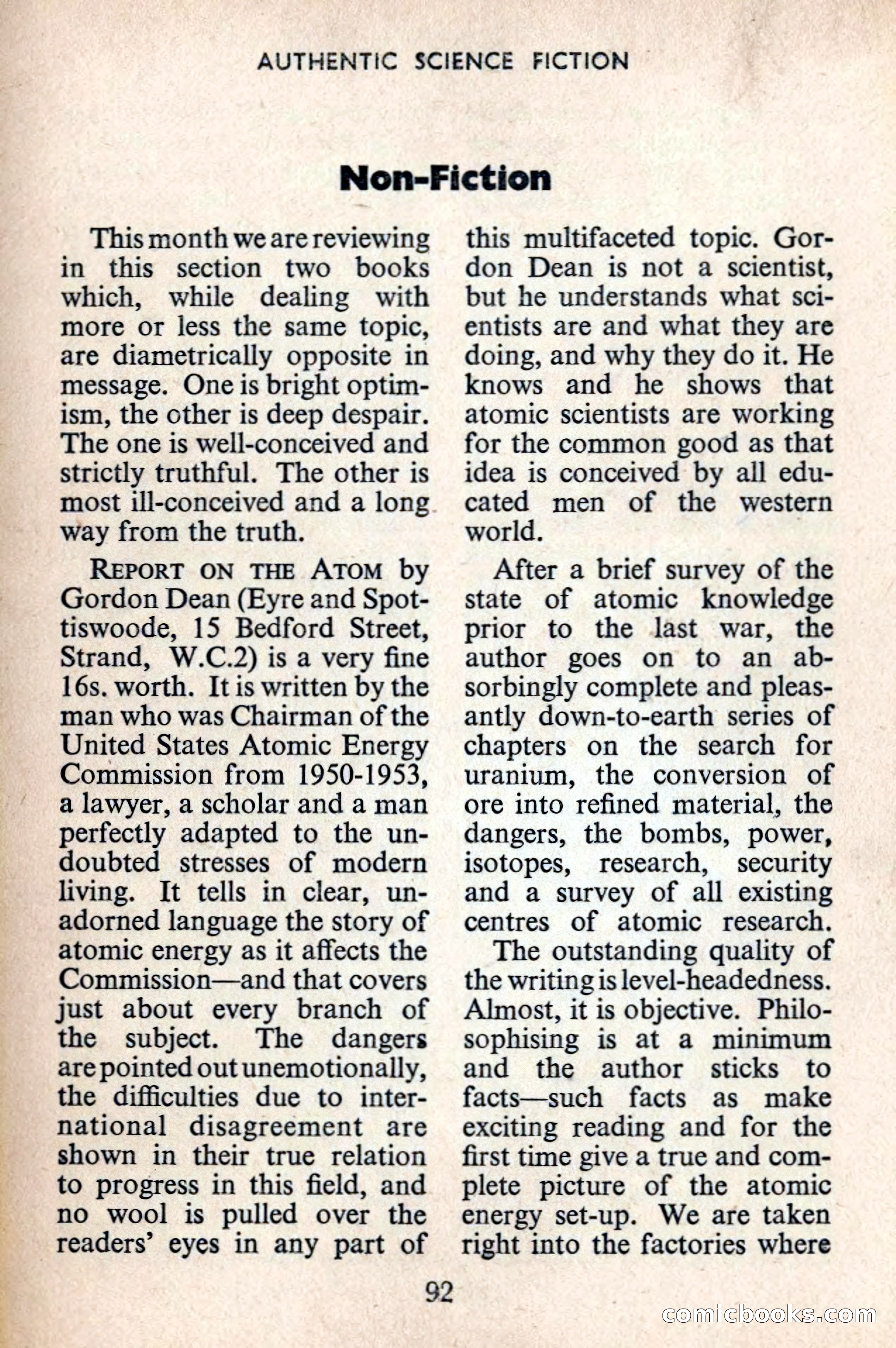
A restored page from Pulp Fiction, 1954. Page through the whole issue in the reader above.
📄 Transcribed text from this page (OCR, searchable)
Machine-transcribed from the original scan — historical spelling and the odd misread are preserved.
4 pet? Had oe, Su i atk ‘ i AUTHENTIC SCIENCE FICTION © Non-Fiction This month we are reviewing in this section two books which, while dealing with more or less the same topic, are diametrically opposite in message. One is bright optim- ism, the other is deep despair. The one is well-conceived and strictly truthful. The other is most ill-conceived and a long way from the truth. REPORT ON THE ATOM by Gordon Dean (Eyre and Spot- tiswoode, 15 Bedford Street, Strand, W.C.2) is a very fine 16s. worth. It is written by the man who was Chairman of the United States Atomic Energy Commission from 1950-1953, a lawyer, a scholar and a man perfectly adapted to the un- doubted stresses of modern living. It tells in clear, un- adorned language the story of atomic energy as it affects the Commission—and that covers just about every branch of the subject. The dangers are pointed out unemotionally, the difficulties due to inter- national disagreement are shown in their true relation to progress in this field, and no wool is pulled over the readers’ eyes in any part of 92 this multifaceted topic. Gor- don Dean is not a scientist, but he understands what sci- entists are and what they are doing, and why they do it. He knows and he shows that atomic scientists are working for the common good as that idea is conceived by all edu- cated men of the western world. After a brief survey of the state of atomic knowledge prior to the last war, the author goes on to an ab- sorbingly complete and pleas- antly down-to-earth series of chapters on the search for uranium, the conversion of ore into refined material, the dangers, the bombs, power, isotopes, research, security and a survey of all existing centres of atomic research. The outstanding quality of the writing is level-headedness. Almost, it is objective. Philo- sophising is at a minimum and the author sticks to facts—such facts as make exciting reading and for the first time give a true and com- plete picture of the atomic energy set-up. We are taken right into the factories where comiclooks.conn