
Pulp Fiction, 1954 · page 94 of 162
Authentic Science Fiction Monthly No. 44 — page 94: what you’re looking at
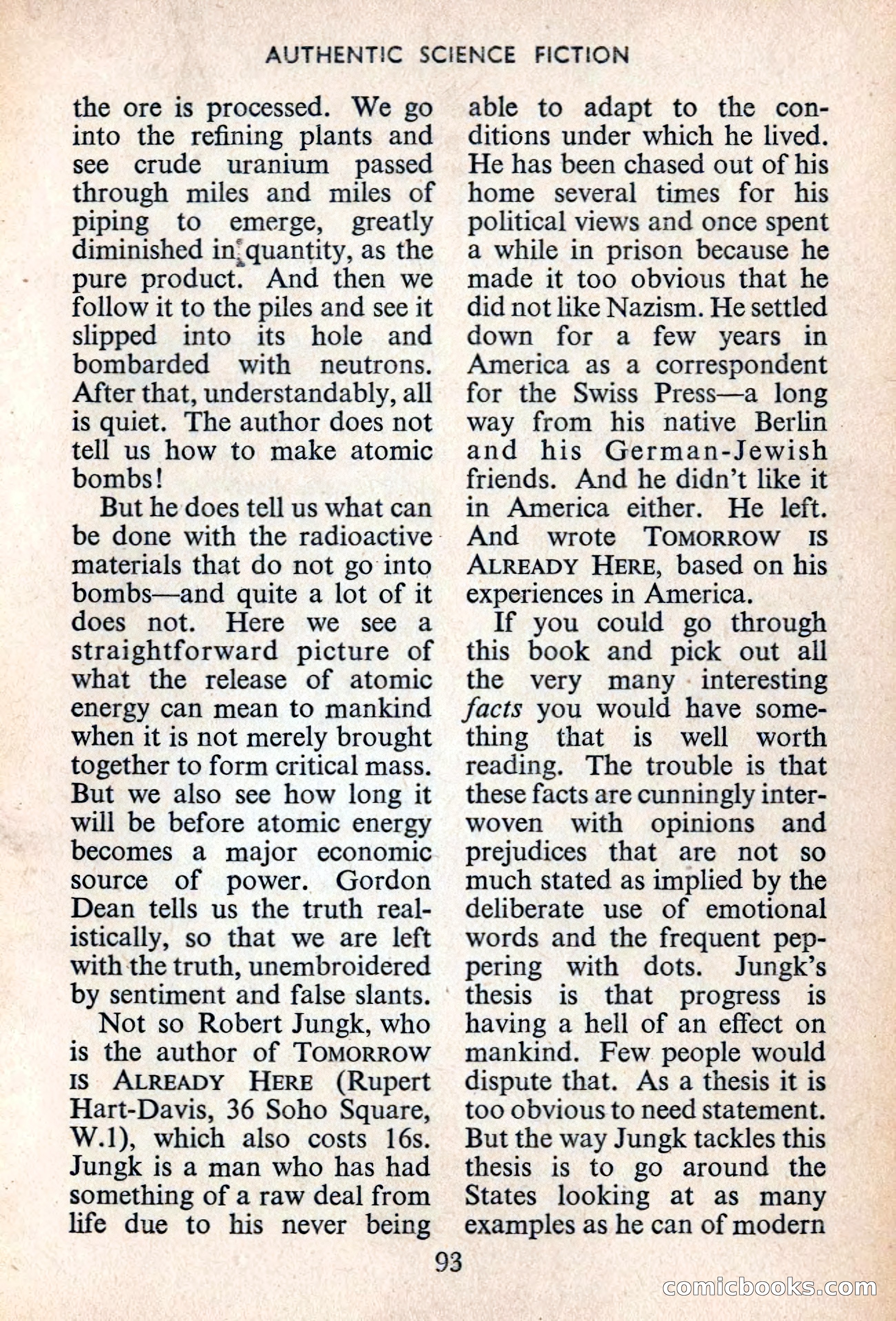
A restored page from Pulp Fiction, 1954. Page through the whole issue in the reader above.
📄 Transcribed text from this page (OCR, searchable)
Machine-transcribed from the original scan — historical spelling and the odd misread are preserved.
AUTHENTIC SCIENCE FICTION the ore is processed. We go into the refining plants and see crude uranium passed through miles and miles of piping to emerge, greatly diminished in, quantity, as the pure product. And then we follow it to the piles and see it slipped into its hole and bombarded with neutrons. After that, understandably, all is quiet. The author does not tell us how to make atomic bombs! But he does tell us what can be done with the radioactive - materials that do not go into bombs—and quite a lot of it does not. Here we see a straightforward picture of what the release of atomic energy can mean to mankind when it is not merely brought together to form critical mass. But we also see how long it will be before atomic energy becomes a major economic source of power. Gordon Dean tells us the truth real- istically, so that we are left with the truth, unembroidered by sentiment and false slants. | Not so Robert Jungk, who is the author of TomMORROW IS ALREADY HERE (Rupert Hart-Davis, 36 Soho Square, W.1), which also costs 16s. Jungk is a man who has had something of a raw deal from life due to his never being able to adapt to the con- ditions under which he lived. He has been chased out of his home several times for his political views and once spent a while in prison because he made it too obvious that he did not like Nazism. He settled down for a few years in America as a correspondent for the Swiss Press—a long way from his native Berlin | and his German-Jewish friends. And he didn’t like it in America either. He left. And wrote TOMORROW IS ALREADY HERE, based on his experiences in America. If you could go through this book and pick out all the very many - interesting facts you would have some- thing that is well worth reading. The trouble is that these facts are cunningly inter- woven with opinions and prejudices that are not so much stated as implied by the deliberate use of emotional words and the frequent pep- pering with dots. Jungk’s thesis is that progress is having a hell of an effect on mankind. Few people would dispute that. As a thesis it is too obvious to need statement. But the way Jungk tackles this thesis is to go around the States looking at as many examples as he can of modern 93 conmmicloooks.comn