
Pulp Fiction, 1954 · page 92 of 162
Authentic Science Fiction Monthly No. 44 — page 92: what you’re looking at
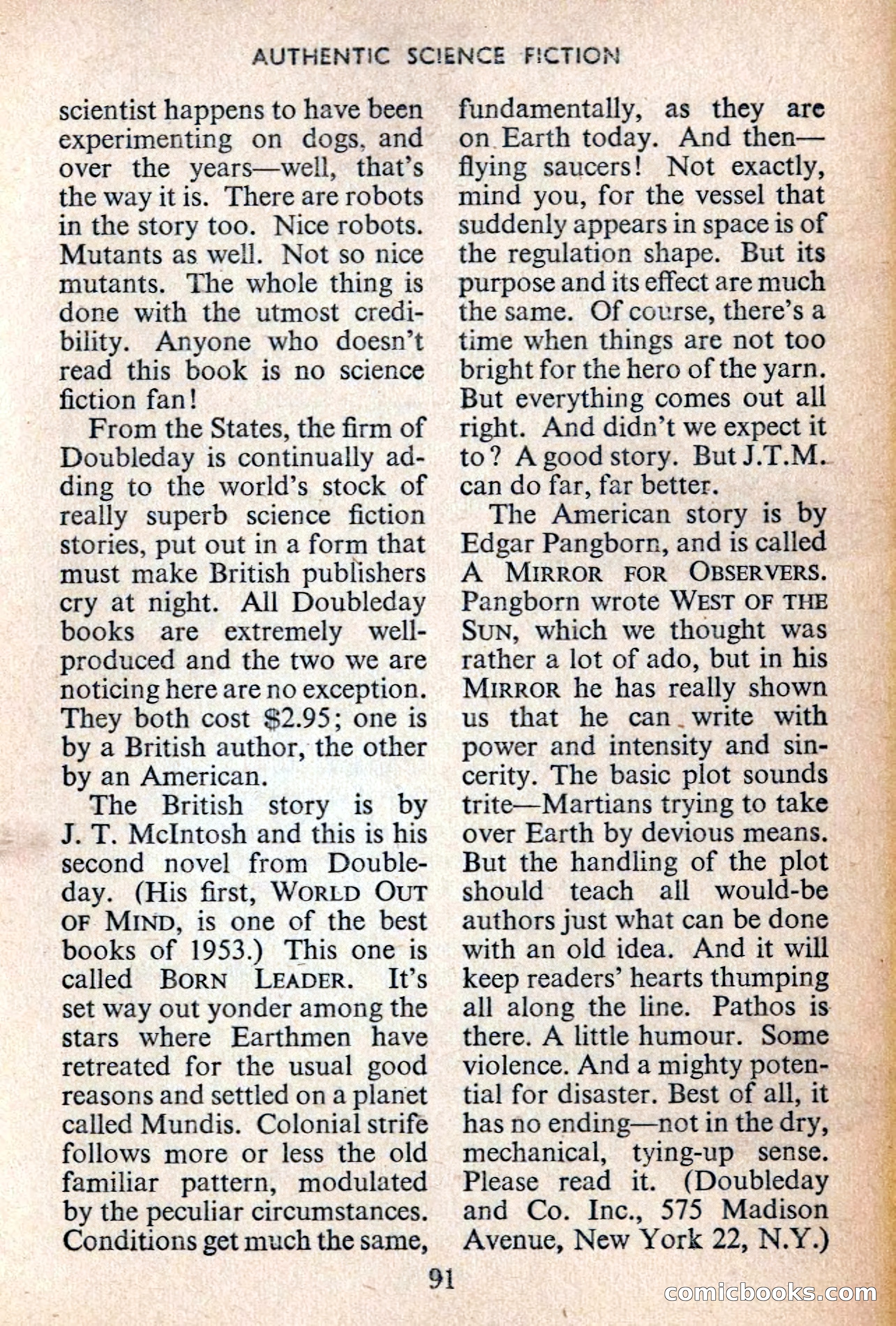
A restored page from Pulp Fiction, 1954. Page through the whole issue in the reader above.
📄 Transcribed text from this page (OCR, searchable)
Machine-transcribed from the original scan — historical spelling and the odd misread are preserved.
AUTHENTIC SCIENCE FICTION scientist happens to have been experimenting on dogs, and over the years—well, that’s the way it is. There are robots in the story too. Nice robots. Mutants as well. Not so nice mutants. The whole thing is done with the utmost credi- bility. Anyone who doesn’t read this book is no science fiction fan! From the States, the firm of Doubleday is continually ad- ding to the world’s stock of really superb science fiction stories, put out in a form that must make British publishers cry at night. All Doubleday books are extremely well- produced and the two we are noticing here are no exception. They both cost $2.95; one is by a British author, the other by an American. The British story is by J. T. McIntosh and this is his second novel from Double- day. (His first, WoRLD OUT OF MIND, is one of the best books of 1953.) This one is called BorRN LEADER. It’s set way out yonder among the stars where Earthmen have retreated for the usual good reasons and settled on a planet called Mundis. Colonial strife follows more or less the old familiar pattern, modulated by the peculiar circumstances. Conditions get much the same, 51 fundamentally, as they are on Earth today. And then— flying saucers! Not exactly, mind you, for the vessel that suddenly appears in space is of the regulation shape. But its purpose and its effect are much the same. Of course, there’s a time when things are not too bright for the hero of the yarn. But everything comes out all right. And didn’t we expect it to? A good story. But J.T.M. can do far, far better. The American story is by Edgar Pangborn, and is called A MIRROR FOR OBSERVERS. Pangborn wrote WEST OF THE SuN, which we thought was rather a lot of ado, but in his Mirror he has really shown us that he can_write with power and intensity and sin- cerity. The basic plot sounds trite— Martians trying to take over Earth by devious means. But the handling of the plot - should teach all would-be authors just what can be done with an old idea. And it will keep readers’ hearts thumping all along the line. Pathos is there. A little humour. Some violence. And a mighty poten- tial for disaster. Best of all, it has no ending—not in the dry, — mechanical, tying-up sense. Please read it. (Doubleday and Co. Inc., 575 Madison Avenue, New York 22, N.Y.) aS comicbooks.cou