
Pulp Fiction, 1954 · page 150 of 162
Authentic Science Fiction Monthly No. 44 — page 150: what you’re looking at
A restored page from Pulp Fiction, 1954. Page through the whole issue in the reader above.
📄 Transcribed text from this page (OCR, searchable)
Machine-transcribed from the original scan — historical spelling and the odd misread are preserved.
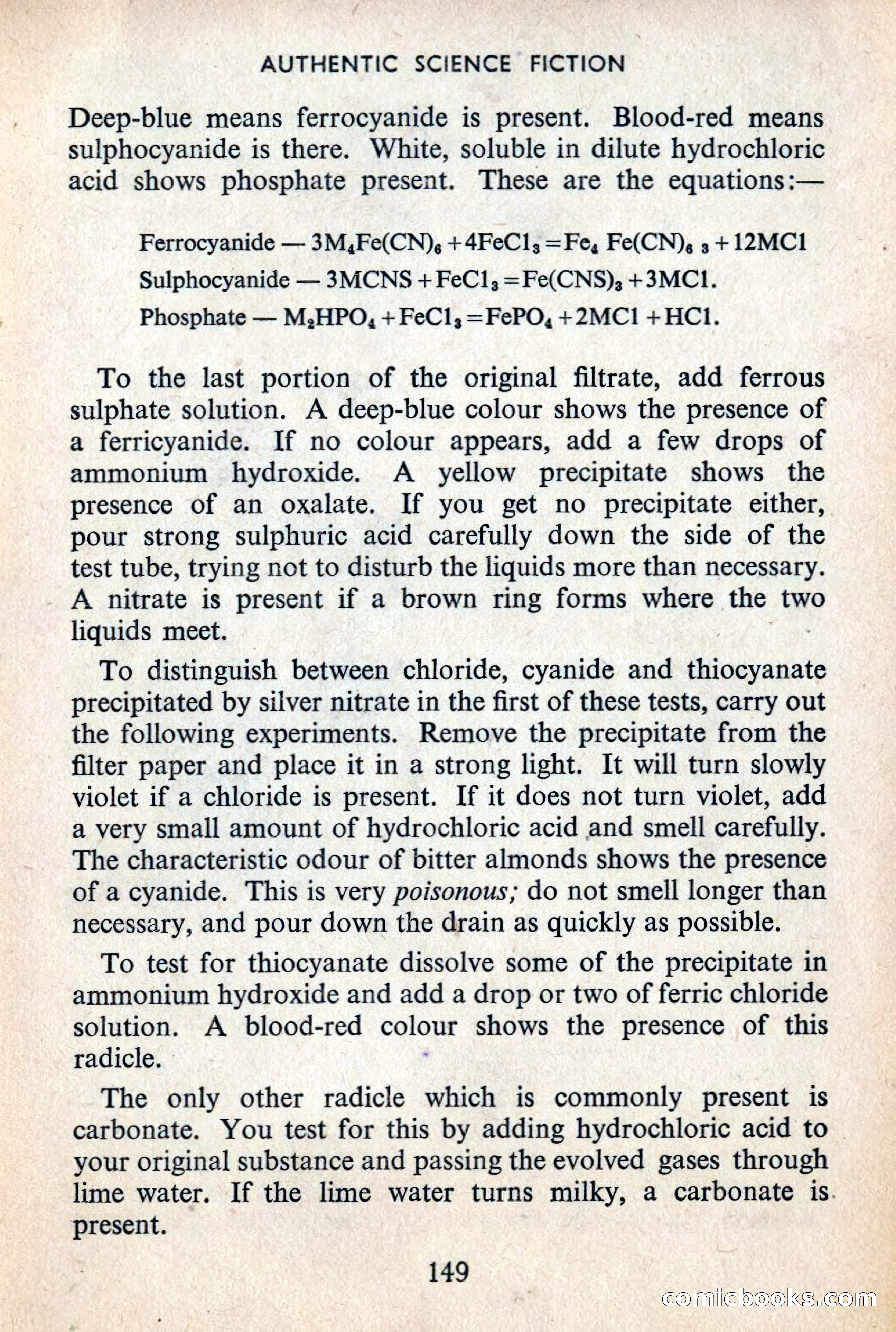
AUTHENTIC SCIENCE FICTION Deep-blue means ferrocyanide is present. Blood-red means sulphocyanide is there. White, soluble in dilute hydrochloric acid shows phosphate present. These are the equations:— Ferrocyanide — 3M,Fe(CN), +4FeCl; =Fe, Fe(CN), 3 +12MC1 Sulphocyanide — 3MCNS + FeCl; =Fe(CNS)3 +3MC1. Phosphate — M,HPO, + FeCl; =FePO, +2MC1+HCI1. To the last portion of the original filtrate, add ferrous sulphate solution. A deep-blue colour shows the presence of a ferricyanide. If no colour appears, add a few drops of ammonium hydroxide. A _ yellow precipitate shows the presence of an oxalate. If you get no precipitate either, pour strong sulphuric acid carefully down the side of the test tube, trying not to disturb the liquids more than necessary. A nitrate is present if a brown ring forms where the two liquids meet. To distinguish between chloride, cyanide and thiocyanate precipitated by silver nitrate in the first of these tests, carry out the following experiments. Remove the precipitate from the filter paper and place it in a strong light. It will turn slowly violet if a chloride is present. If it does not turn violet, add a very small amount of hydrochloric acid and smell carefully. The characteristic odour of bitter almonds shows the presence of a cyanide. This is very poisonous; do not smell longer than necessary, and pour down the drain as quickly as possible. To test for thiocyanate dissolve some of the precipitate in ammonium hydroxide and add a drop or two of ferric chloride solution. A blood-red colour shows the presence of this radicle. The only other radicle which is commonly present is carbonate. You test for this by adding hydrochloric acid to your original substance and passing the evolved gases through lime water. If the lime water turns milky, a carbonate is. present. 149 connicloooks.comnn)