
Pulp Fiction, 1954 · page 149 of 162
Authentic Science Fiction Monthly No. 44 — page 149: what you’re looking at
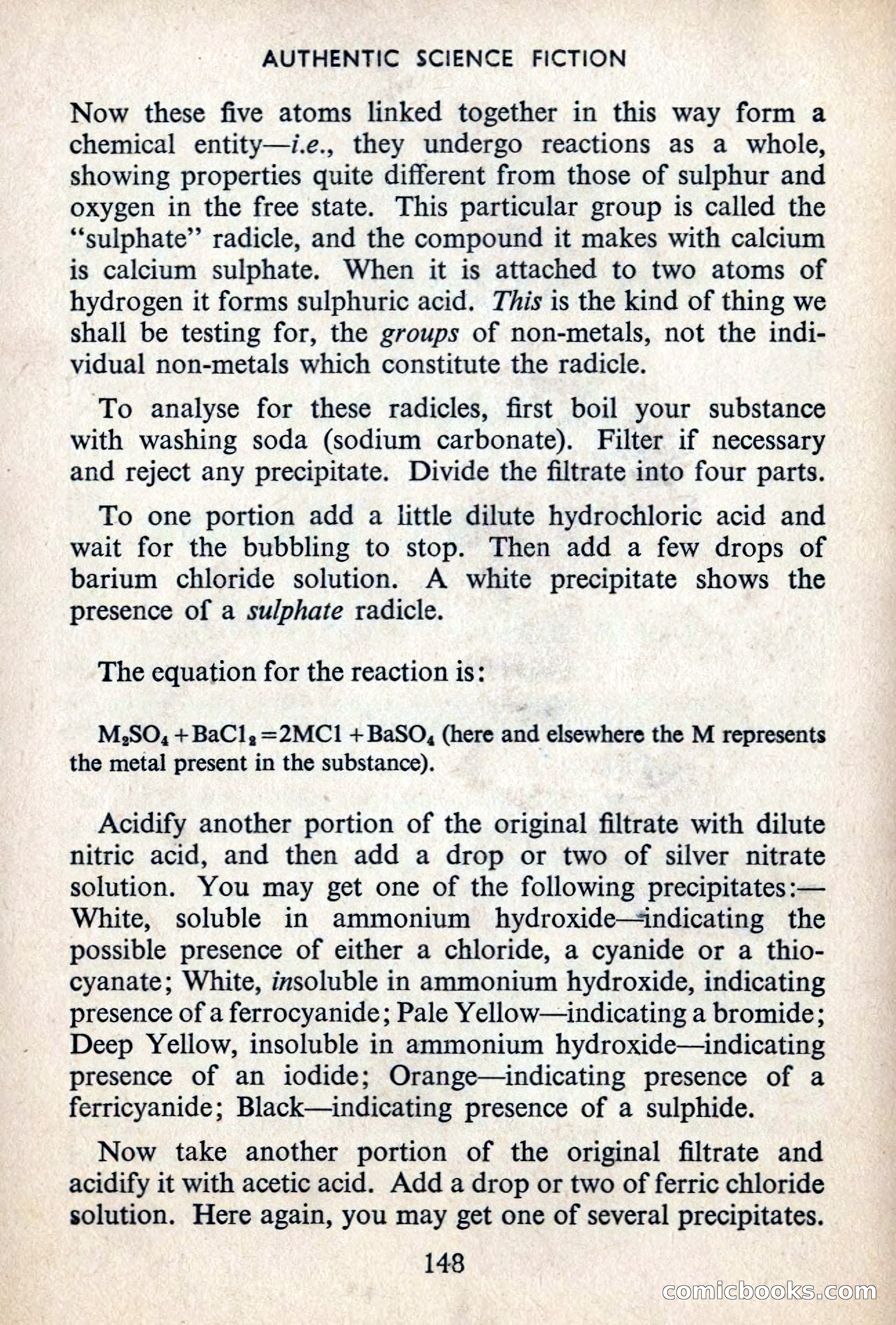
A restored page from Pulp Fiction, 1954. Page through the whole issue in the reader above.
📄 Transcribed text from this page (OCR, searchable)
Machine-transcribed from the original scan — historical spelling and the odd misread are preserved.
AUTHENTIC SCIENCE FICTION Now these five atoms linked together in this way form a chemical entity—i.e., they undergo reactions as a whole, showing properties quite different from those of sulphur and oxygen in the free state. This particular group is called the “sulphate” radicle, and the compound it makes with calcium is calcium sulphate. When it is attached to two atoms of hydrogen it forms sulphuric acid. This is the kind of thing we shall be testing for, the groups of non-metals, not the indi- vidual non-metals which constitute the radicle. To analyse for these radicles, first boil your substance with washing soda (sodium carbonate). Filter if necessary and reject any precipitate. Divide the filtrate into four parts. To one portion add a little dilute hydrochloric acid and wait for the bubbling to stop. Then add a few drops of barium chloride solution. A white precipitate shows the presence of a sulphate radicle. The equation for the reaction is: M,SO, + BaC1, =2MC1 + BaSO, (here and elsewhere the M represents the metal present in the substance). Acidify another portion of the original filtrate with dilute nitric acid, and then add a drop or two of silver nitrate solution. You may get one of the following precipitates :— White, soluble in ammonium hydroxide—indicating the possible presence of either a chloride, a cyanide or a thio- cyanate; White, insoluble in ammonium hydroxide, indicating presence of a ferrocyanide; Pale Yellow—indicating a bromide; Deep Yellow, insoluble in ammonium hydroxide—indicating presence of an iodide; Orange—indicating presence of a ferricyanide; Black—indicating presence of a sulphide. Now take another portion of the original filtrate and acidify it with acetic acid. Add a drop or two of ferric chloride solution. Here again, you may get one of several precipitates. 148 connicloooks.comn)