
Pulp Fiction, 1954 · page 94 of 162
Authentic Science Fiction Monthly No. 42 — page 94: what you’re looking at
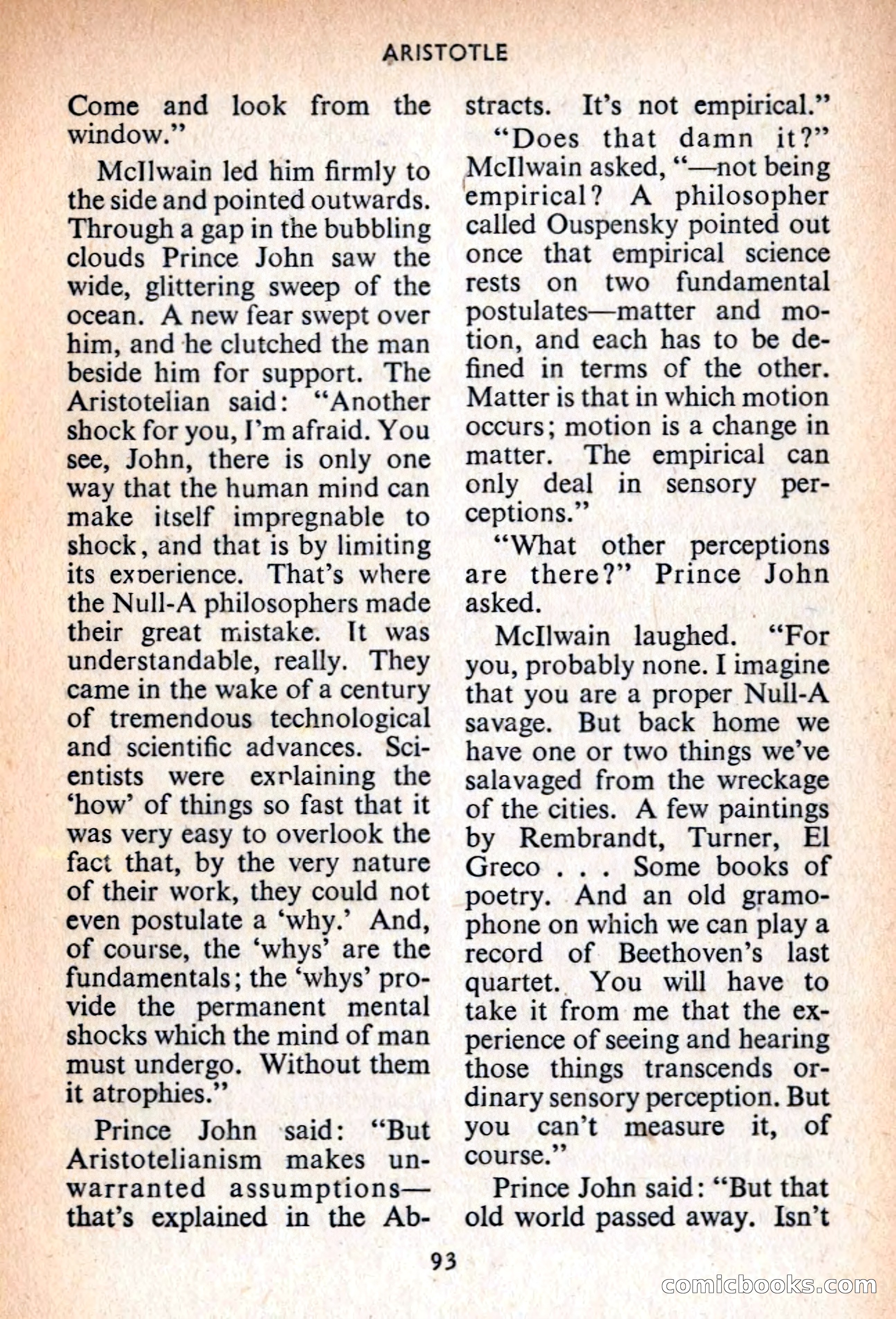
A restored page from Pulp Fiction, 1954. Page through the whole issue in the reader above.
📄 Transcribed text from this page (OCR, searchable)
Machine-transcribed from the original scan — historical spelling and the odd misread are preserved.
w % ARISTOTLE Come and look from the window.” Mcllwain led him firmly to the side and pointed outwards. Through a gap in the bubbling clouds Prince John saw the wide, glittering sweep of the ocean. A new fear swept over him, and he clutched the man beside him for support. The Aristotelian said: “Another shock for you, I’m afraid. You see, John, there is only one way that the human mind can make itself impregnable to shock, and that is by limiting its exverience. That’s where the Null-A philosophers made their great mistake. It was understandable, really. They came in the wake of a century of tremendous technological and scientific advances. Sci- entists were exrlaining the _ ‘how’ of things so fast that it was very easy to overlook the fact that, by the very nature of their work, they could not even postulate a ‘why.’ And, of course, the ‘whys’ are the fundamentals; the ‘whys’ pro- vide the permanent mental shocks which the mind of man must undergo. Without them it atrophies.”’ Prince John ‘said: “But Aristotelianism makes un- warranted assumptions— that’s explained in the Ab- 93 stracts. It’s not empirical.” “Does that damn it?” Mcllwain asked, “‘—not being empirical? A _ philosopher called Ouspensky pointed out once that empirical science rests on two fundamental postulates—matter and mo- tion, and each has to be de- fined in terms of the other. Matter is that in which motion occurs; motion is a change in matter. The empirical can only deal in sensory per- ceptions.” “What other perceptions are there?’ Prince John asked. | MclIlwain laughed. “For you, probably none. I imagine that you are a proper Null-A savage. But back home we have one or two things we’ve salavaged from the wreckage of the cities. A few paintings by Rembrandt, Turner, El Greco . . . Some books of poetry. And an old gramo- phone on which we can play a record of Beethoven’s last quartet. You will have to take it from me that the ex- perience of seeing and hearing those things transcends or- dinary sensory perception. But you can’t measure it, of course.” Prince John said: “But that old world passed away. Isn’t comicloooks.conm