
Pulp Fiction, 1954 · page 93 of 162
Authentic Science Fiction Monthly No. 42 — page 93: what you’re looking at
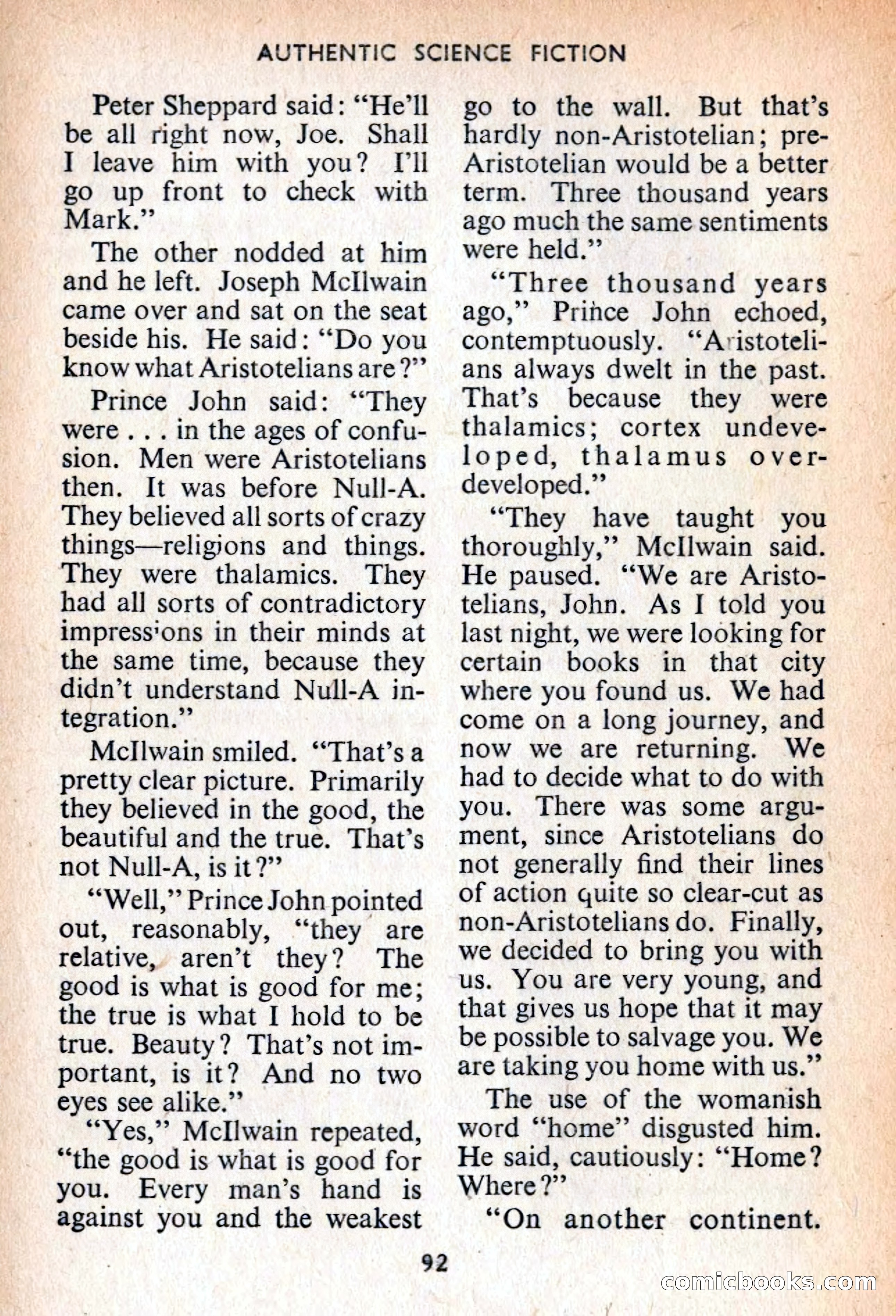
A restored page from Pulp Fiction, 1954. Page through the whole issue in the reader above.
📄 Transcribed text from this page (OCR, searchable)
Machine-transcribed from the original scan — historical spelling and the odd misread are preserved.
AUTHENTIC SCIENCE FICTION Peter Sheppard said: ““He’ll be all right now, Joe. Shall I leave him with you? [ll go up front to check with Mark.” The other nodded at him and he left. Joseph MclIlwain came over and sat on the seat beside his. He said: ‘“‘Do you know what Aristotelians are?” Prince John said: ‘““They were... in the ages of confu- sion. Men were Aristotelians then. It was before Null-A. They believed all sorts of crazy things—religions and things. They were thalamics. They had all sorts of contradictory impress‘ons in their minds at the same time, because they didn’t understand Null-A in- tegration.” MclIlwain smiled. “That’s a pretty clear picture. Primarily they believed in the good, the beautiful and the true. That’s not Null-A, is it?” “Well,” Prince John pointed out, reasonably, “they are relative, aren’t they? The good is what is good for me; the true is what I hold to be true. Beauty? That’s not im- portant, is it? And no two eyes see alike.” “Yes,” McIlwain repeated, ““‘the good is what is good for you. Every man’s hand is against you and the weakest 92 go to the wall. But that’s hardly non-Aristotelian; pre- Aristotelian would be a better term. Three thousand years ago much the same sentiments were held.”’ “Three thousand years ago,” Prince John echoed, contemptuously. ‘“‘Aristoteli- ans always dwelt in the past. That’s because they were thalamics; cortex undeve- loped, thalamus over- developed.” “They have taught you thoroughly,’’ Mcllwain said. He paused. ‘“‘We are Aristo- telians, John. As I told you last night, we were looking for certain books in that city where you found us. We had come on a long journey, and now we are returning. We had to decide what to do with you. There was some argu- ment, since Aristotelians do not generally find their lines of action quite so clear-cut as non-Aristotelians do. Finally, we decided to bring you with us. You are very young, and that gives us hope that it may be possible to salvage you. We are taking you home with us.” The use of the womanish word “‘home”’ disgusted him. He said, cautiously: ““Home? Where ?” | “On another continent. comiclooks.comn