
Pulp Fiction, 1954 · page 95 of 162
Authentic Science Fiction Monthly No. 42 — page 95: what you’re looking at
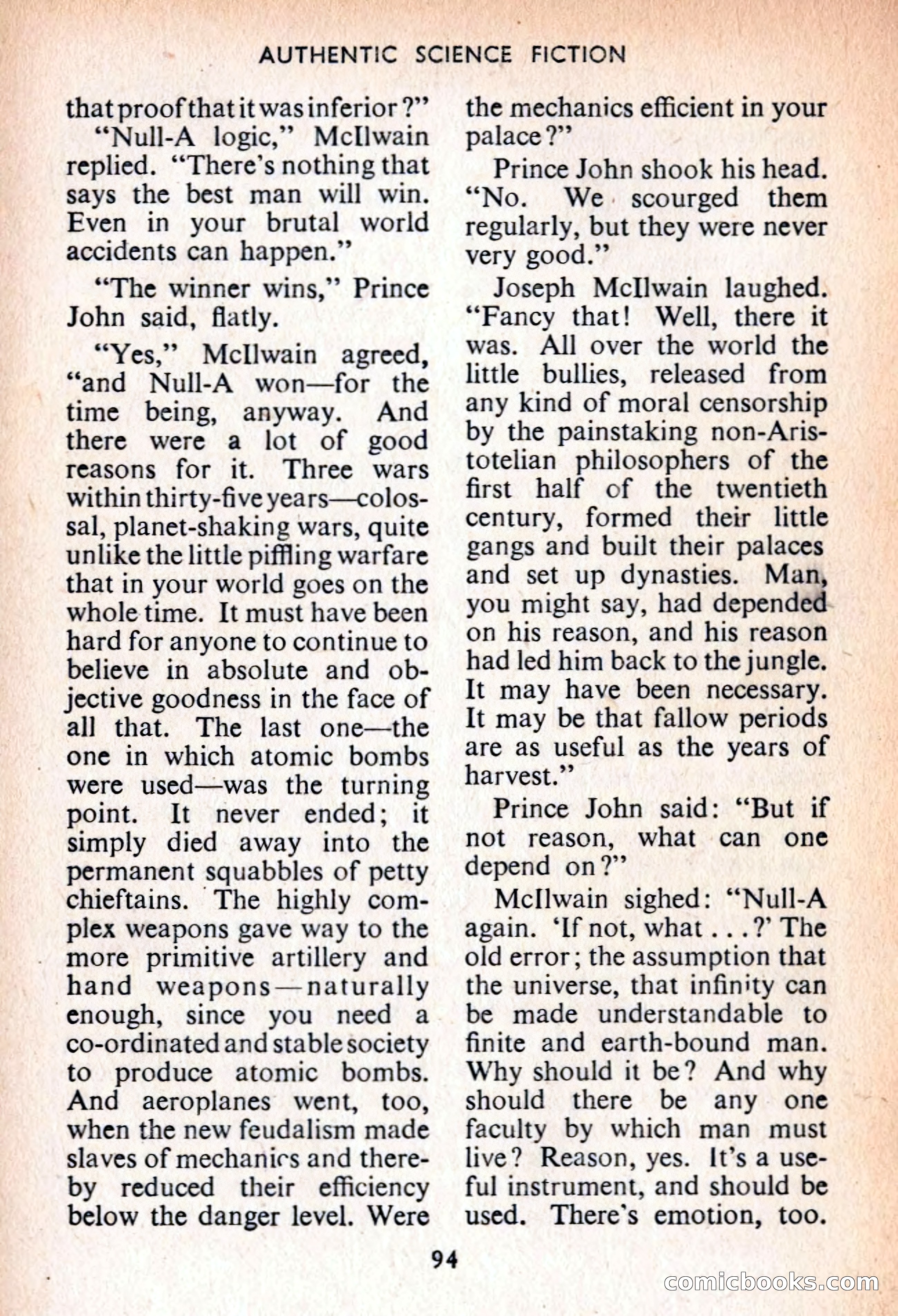
A restored page from Pulp Fiction, 1954. Page through the whole issue in the reader above.
📄 Transcribed text from this page (OCR, searchable)
Machine-transcribed from the original scan — historical spelling and the odd misread are preserved.
AUTHENTIC SCIENCE FICTION that proof thatit wasinferior ?” ““Null-A_ logic,’”? Mcllwain replied. ‘“‘There’s nothing that says the best man will win. Even in your brutal world accidents can happen.” “The winner wins,” Prince John said, flatly. “Yes,” Mcllwain agreed, “and Null-A won—for the time being, anyway. And there were a lot of good reasons for it. Three wars within thirty-five years—colos- sal, planet-shaking wars, quite unlike the little piffing warfare that in your world goes on the whole time. It must have been hard for anyone to continue to believe in absolute and ob- jective goodness in the face of all that. The last one—the one in which atomic bombs were used—was the turning point. It never ended; it simply died away into the permanent squabbles of petty chieftains. The highly com- plex weapons gave way to the more primitive artillery and hand weapons—naturally enough, since you need a co-ordinated and stable society to produce atomic bombs. And aeroplanes went, too, when the new feudalism made slaves of mechanics and there- by reduced their efficiency below the danger level. Were 94 the mechanics efficient in your palace ?”’ Prince John shook his head. “No. We. scourged them regularly, but they were never very good.” Joseph MclIlwain laughed. “Fancy that! Well, there it was. All over the world the little bullies, released from any kind of moral censorship by the painstaking non-Aris- totelian philosophers of the first half of the twentieth century, formed their little gangs and built their palaces and set up dynasties. Man, you might say, had depended on his reason, and his reason had led him back to the jungle. It may have been necessary. It may be that fallow periods are as uSeful as the years of harvest.” Prince John said: “But if not reason, what can one depend on?” MclIlwain sighed: “Null-A again. ‘If not, what...?’ The old error; the assumption that the universe, that infinity can be made understandable to finite and earth-bound man. Why should it be? And why should there be any one faculty by which man must live? Reason, yes. It’s a use- ful instrument, and should be used. There’s emotion, too. comcloooks.comn