
Pulp Fiction, 1954 · page 92 of 162
Authentic Science Fiction Monthly No. 42 — page 92: what you’re looking at
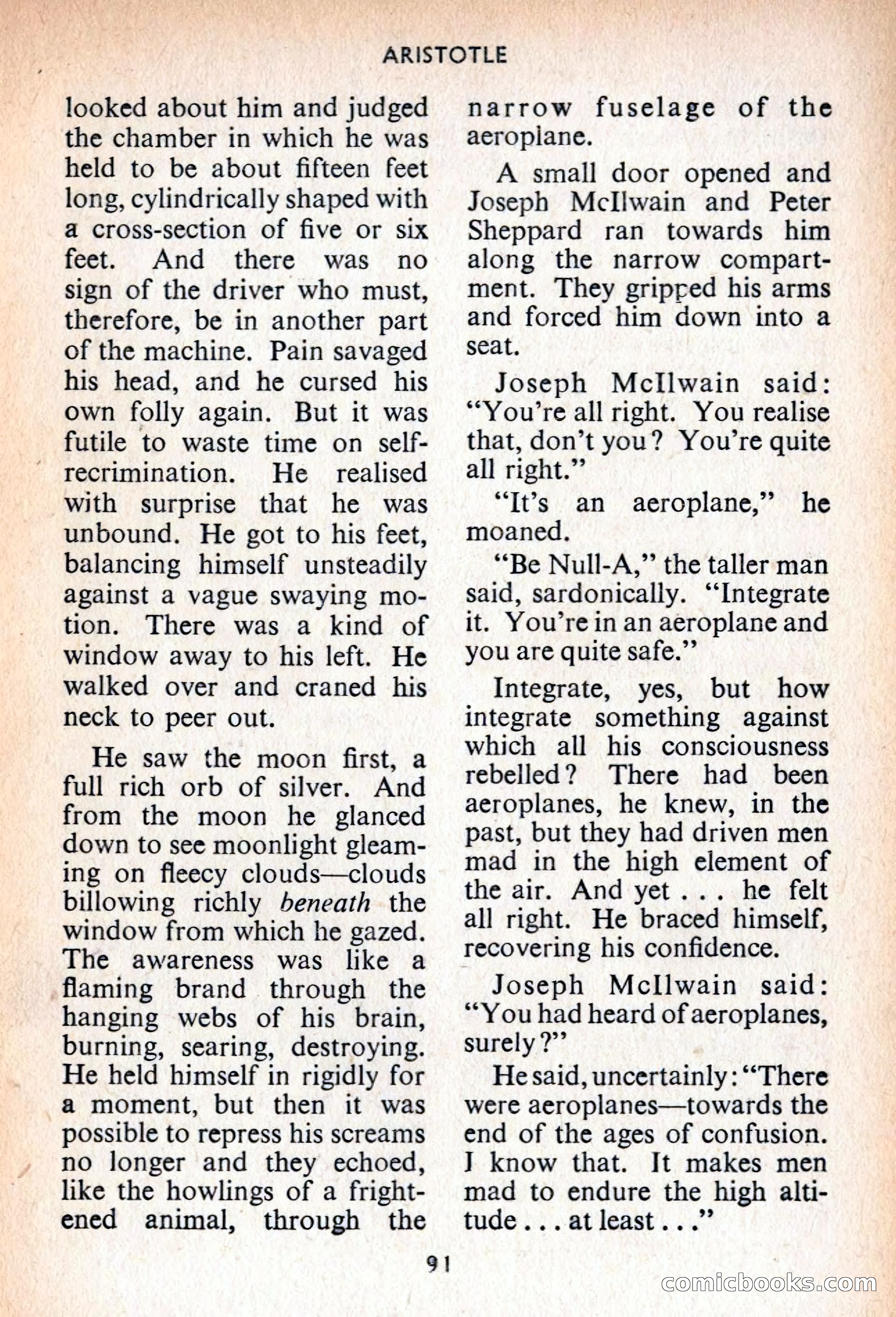
A restored page from Pulp Fiction, 1954. Page through the whole issue in the reader above.
📄 Transcribed text from this page (OCR, searchable)
Machine-transcribed from the original scan — historical spelling and the odd misread are preserved.
- recrimination. He ARISTOTLE looked about him and judged the chamber in which he was held to be about fifteen feet long, cylindrically shaped with a cross-section of five or six feet. And there was no sign of the driver who must, therefore, be in another part of the machine. Pain savaged his head, and he cursed his own folly again. But it was futile to waste time on self- realised with surprise that he was unbound. He got to his feet, balancing himself unsteadily against a vague swaying mo- tion. There was a kind of window away to his left. He walked over and craned his neck to peer out. He saw the moon first, a full rich orb of silver. And from the moon he glanced down to see moonlight gleam- ing on fleecy clouds—clouds billowing richly beneath the window from which he gazed. The awareness was like a flaming brand through the hanging webs of his brain, burning, searing, destroying. He held himself in rigidly for a moment, but then it was possible to repress his screams no longer and they echoed, like the howlings of a fright- ened animal, through the $1 narrow fuselage of the aeroplane. A small door opened and Joseph MclIlwain and Peter Sheppard ran towards him along the narrow compart- ment. They gripped his arms and forced him down into a seat. Joseph MclIlwain said: “You're all right. You realise that, don’t you? You’re quite all right.” “It’s an aeroplane,” he moaned, “Be Null-A,”’ the taller man said, sardonically. “Integrate it. You’re in an aeroplane and you are quite safe.” Integrate, yes, but how integrate something against which all his consciousness rebelled? There had been aeroplanes, he knew, in the past, but they had driven men mad in the high element of the air. And yet... he felt all right. He braced himself, recovering his confidence. Joseph MclIlwain said: “You had heard of aeroplanes, surely?” He said, uncertainly: ““There were aeroplanes—towards the end of the ages of confusion. J] know that. It makes men mad to endure the high alti- tude... atleast...” comiclooks.com