
Pulp Fiction, 1954 · page 45 of 162
Authentic Science Fiction Monthly No. 41 — page 45: what you’re looking at
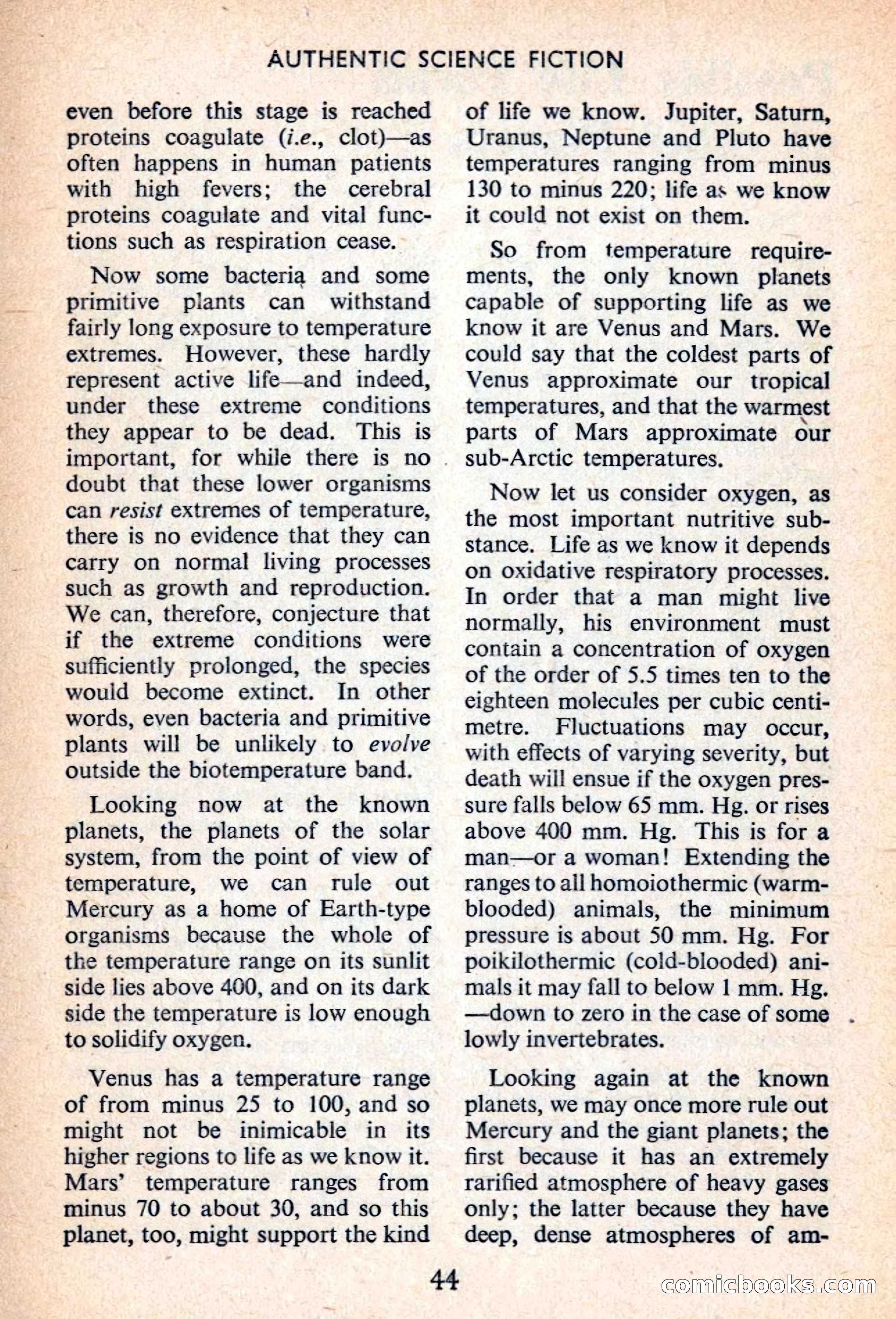
A restored page from Pulp Fiction, 1954. Page through the whole issue in the reader above.
📄 Transcribed text from this page (OCR, searchable)
Machine-transcribed from the original scan — historical spelling and the odd misread are preserved.
AUTHENTIC SCIENCE FICTION even before this stage is reached proteins coagulate (i.e., clot)—as often happens in human patients with high fevers; the cerebral proteins coagulate and vital func- tions such as respiration cease. Now some bacteria and some primitive plants can withstand fairly long exposure to temperature extremes. However, these hardly represent active life—and indeed, under these extreme conditions they appear to be dead. This is important, for while there is no . doubt that these lower organisms can resist extremes of temperature, there is no evidence that they can carry on normal living processes such as growth and reproduction. We can, therefore, conjecture that if the extreme conditions were sufficiently prolonged, the species would become extinct. In other words, even bacteria and primitive plants will be unlikely to evolve outside the biotemperature band. Looking now at the known planets, the planets of the solar system, from the point of view of temperature, we can rule out Mercury as a home of Earth-type organisms because the whole of the temperature range on its sunlit side lies above 400, and on its dark side the temperature is low enough to solidify oxygen. Venus has a temperature range of from minus 25 to 100, and so might not be inimicable in its higher regions to life as we know it. Mars’ temperature ranges from minus 70 to about 30, and so this planet, too, might support the kind 44 of life we know. Jupiter, Saturn, Uranus, Neptune and Pluto have temperatures ranging from minus 130 to minus 220; life as we know it could not exist on them. So from temperature require- ments, the only known planets capable of supporting life as we know it are Venus and Mars. We could say that the coldest parts of Venus approximate our tropical temperatures, and that the warmest parts of Mars approximate our sub-Arctic temperatures. Now let us consider oxygen, as the most important nutritive sub- stance. Life as we know it depends on oxidative respiratory processes. In order that a man might live normally, his environment must contain a concentration of oxygen of the order of 5.5 times ten to the eighteen molecules per cubic centi- metre. Fluctuations may occur, with effects of varying severity, but death will ensue if the oxygen pres- sure falls below 65 mm. Hg. or rises above 400 mm. Hg. This is for a man—or a woman! Extending the ranges to all homoiothermic (warm- blooded) animals, the minimum pressure is about 50 mm. Hg. For poikilothermic (cold-blooded) ani- mals it may fall to below 1 mm. Hg. —down to zero in the case of some lowly invertebrates. Looking again at the known planets, we may once more rule out Mercury and the giant planets; the first because it has an extremely rarified atmosphere of heavy gases only; the latter because they have deep, dense atmospheres of am- comicbooks.com