
Pulp Fiction, 1954 · page 44 of 162
Authentic Science Fiction Monthly No. 41 — page 44: what you’re looking at
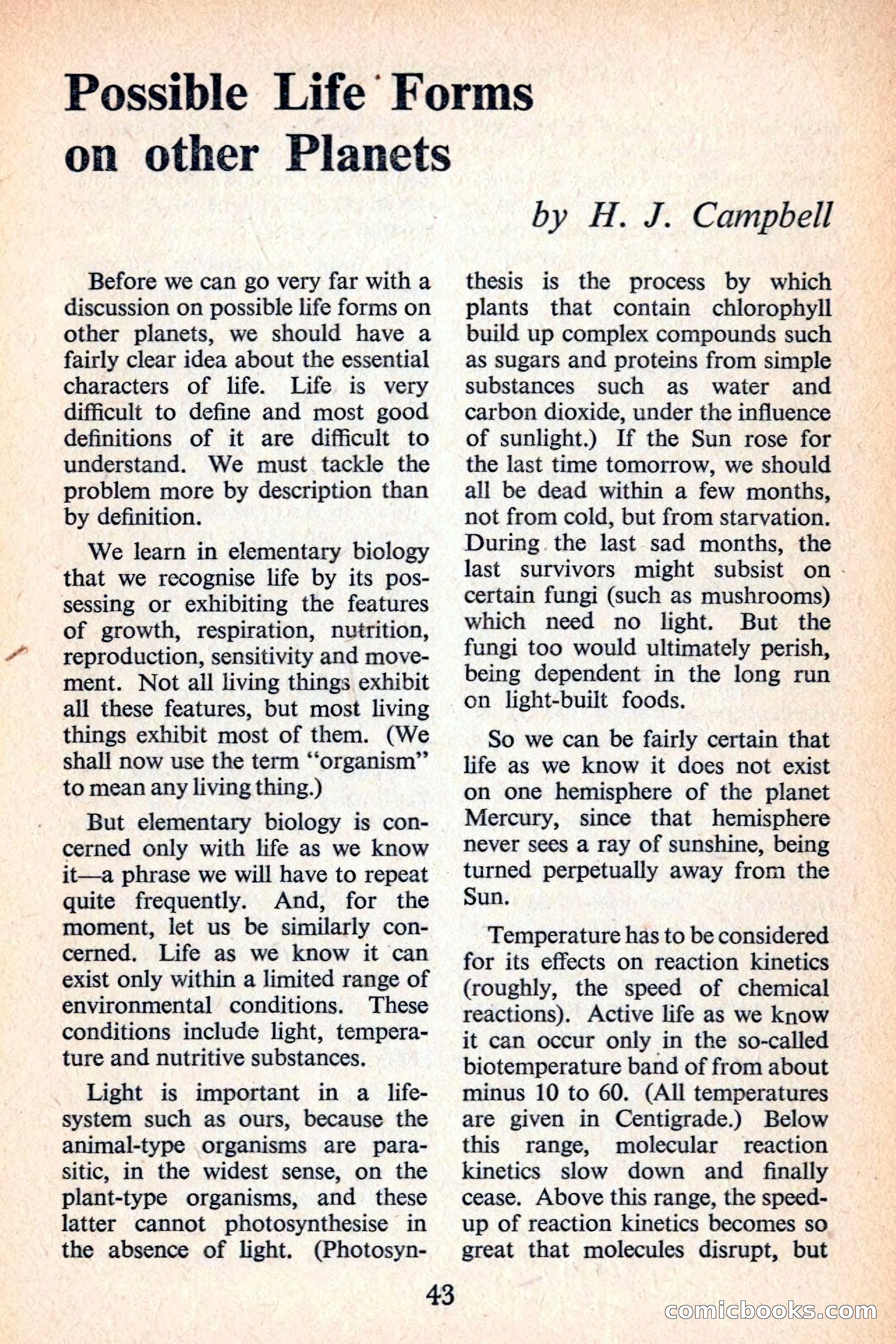
A restored page from Pulp Fiction, 1954. Page through the whole issue in the reader above.
📄 Transcribed text from this page (OCR, searchable)
Machine-transcribed from the original scan — historical spelling and the odd misread are preserved.
Possible Life Forms on other Planets Before we can go very far with a discussion on possible life forms on other planets, we should have a fairly clear idea about the essential characters of life. Life is very difficult to define and most good definitions of it are difficult to understand. We must tackle the problem more by description than by definition. We learn in elementary biology that we recognise life by its pos- sessing or exhibiting the features of growth, respiration, nutrition, reproduction, sensitivity and move- ment. Not ail living things exhibit all these features, but most living things exhibit most of them. (We shall now use the term “‘organism”’ to mean any living thing.) But elementary biology is con- cerned only with life as we know it—a phrase we will have to repeat quite frequently. And, for the moment, let us be similarly con- cerned, Life as we know it can exist only within a limited range of environmental conditions. These conditions include light, tempera- ture and nutritive substances, Light is important in a life- system such as ours, because the animal-type organisms are para- sitic, in the widest sense, on the plant-type organisms, and these latter cannot photosynthesise in the absence of light. (Photosyn- 43 by H. J. Campbell thesis is the process by which plants that contain chlorophyll build up complex compounds such as sugars and proteins from simple substances such as water and carbon dioxide, under the influence of sunlight.) If the Sun rose for the last time tomorrow, we should all be dead within a few months, not from cold, but from starvation. During. the last sad months, the last survivors might subsist on - certain fungi (such as mushrooms) which need no light. But the fungi too would ultimately perish, being dependent in the long run on light-built foods. So we can be fairly certain that life as we know it does not exist on one hemisphere of the planet Mercury, since that hemisphere never sees a ray of sunshine, being turned perpetually away from the Sun. Temperature has to be considered for its effects on reaction kinetics (roughly, the speed of chemical reactions). Active life as we know it can occur only in the so-called biotemperature band of from about minus 10 to 60. (All temperatures are given in Centigrade.) Below this range, molecular reaction kinetics slow down and _ finally cease. Above this range, the speed- up of reaction kinetics becomes so great that molecules disrupt, but comiclooks.conrn