
Pulp Fiction, 1954 · page 46 of 162
Authentic Science Fiction Monthly No. 41 — page 46: what you’re looking at
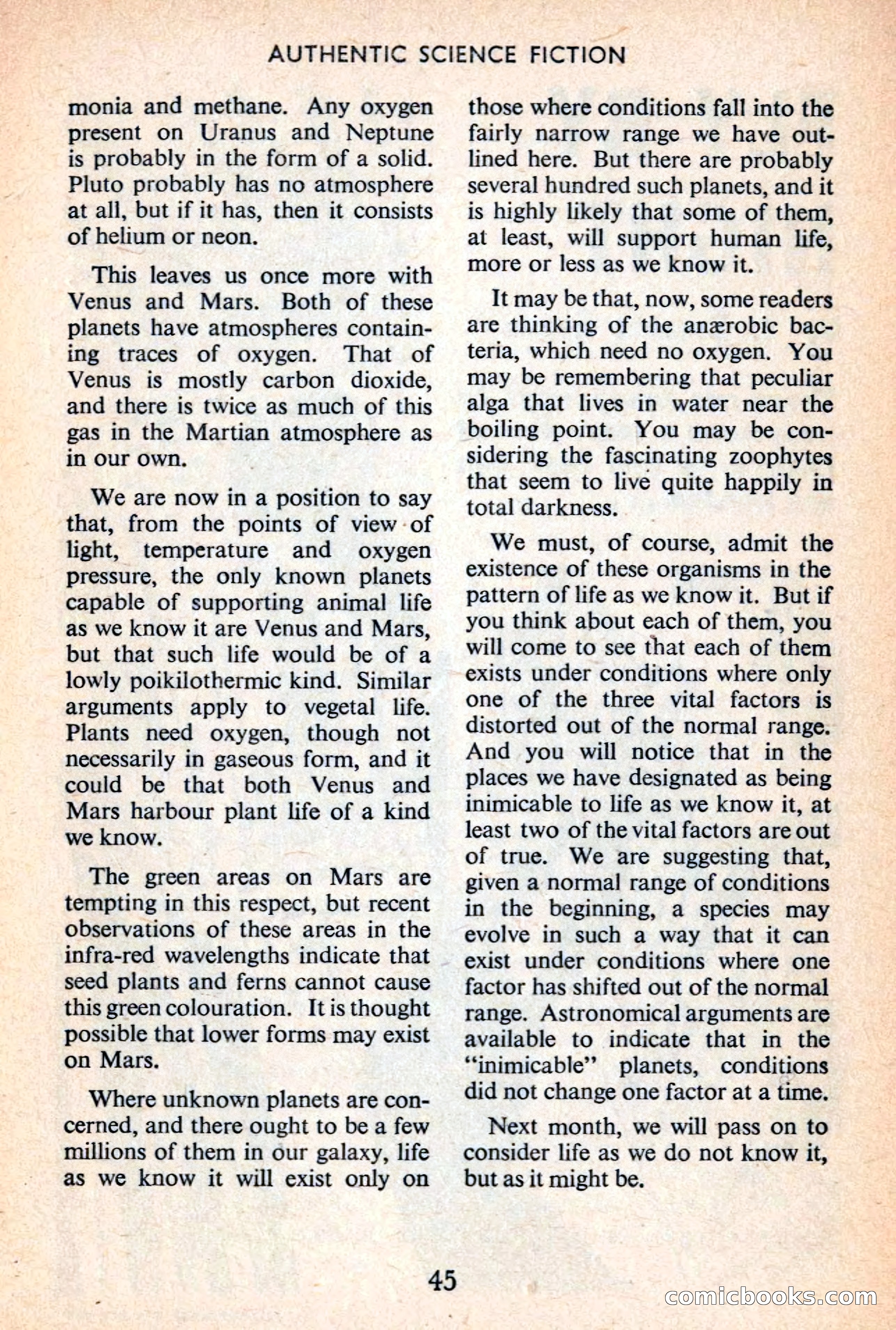
A restored page from Pulp Fiction, 1954. Page through the whole issue in the reader above.
📄 Transcribed text from this page (OCR, searchable)
Machine-transcribed from the original scan — historical spelling and the odd misread are preserved.
AUTHENTIC SCIENCE FICTION monia and methane. Any oxygen present on Uranus and Neptune is probably in the form of a solid. Pluto probably has no atmosphere at all, but if it has, then it consists of helium or neon. This leaves us once more with Venus and Mars. Both of these planets have atmospheres contain- ing traces of oxygen. That of Venus is mostly carbon dioxide, and there is twice as much of this gas in the Martian atmosphere as in our own. We are now in a position to say that, from the points of view of light, temperature and oxygen pressure, the only known planets capable of supporting animal life as we know it are Venus and Mars, but that such life would be of a lowly poikilothermic kind. Similar arguments apply to vegetal life. Plants need oxygen, though not necessarily in gaseous form, and it could be that both Venus and Mars harbour plant life of a kind we know. The green areas on Mars are tempting in this respect, but recent observations of these areas in the infra-red wavelengths indicate that seed plants and ferns cannot cause this green colouration. It is thought possible that lower forms may exist on Mars. Where unknown planets are con- cerned, and there ought to be a few millions of them in our galaxy, life as we know it will exist only on 45 those where conditions fall into the fairly narrow range we have out- lined here. But there are probably several hundred such planets, and it is highly likely that some of them, at least, will support human life, more or less as we know it. It may be that, now, some readers are thinking of the anzrobic bac- teria, which need no oxygen. You may be remembering that peculiar alga that lives in water near the boiling point. You may be con- sidering the fascinating zoophytes that seem to live quite happily in total darkness. We must, of course, admit the existence of these organisms in the pattern of life as we know it. But if you think about each of them, you will come to see that each of them exists under conditions where only one of the three vital factors is distorted out of the normal range. And you will notice that in the places we have designated as being inimicable to life as we know it, at least two of the vital factors are out of true. We are suggesting that, given a normal range of conditions in the beginning, a species may evolve in such a way that it can exist under conditions where one factor has shifted out of the normal range. Astronomical arguments are available to indicate that in the “‘inimicable’”’ planets, conditions did not change one factor at a time. Next month, we will pass on to consider life as we do not know it, but as it might be. comiclooks.conrn