
Pulp Fiction, 1954 · page 52 of 132
Astounding Science Fiction, British Edition — page 52: what you’re looking at
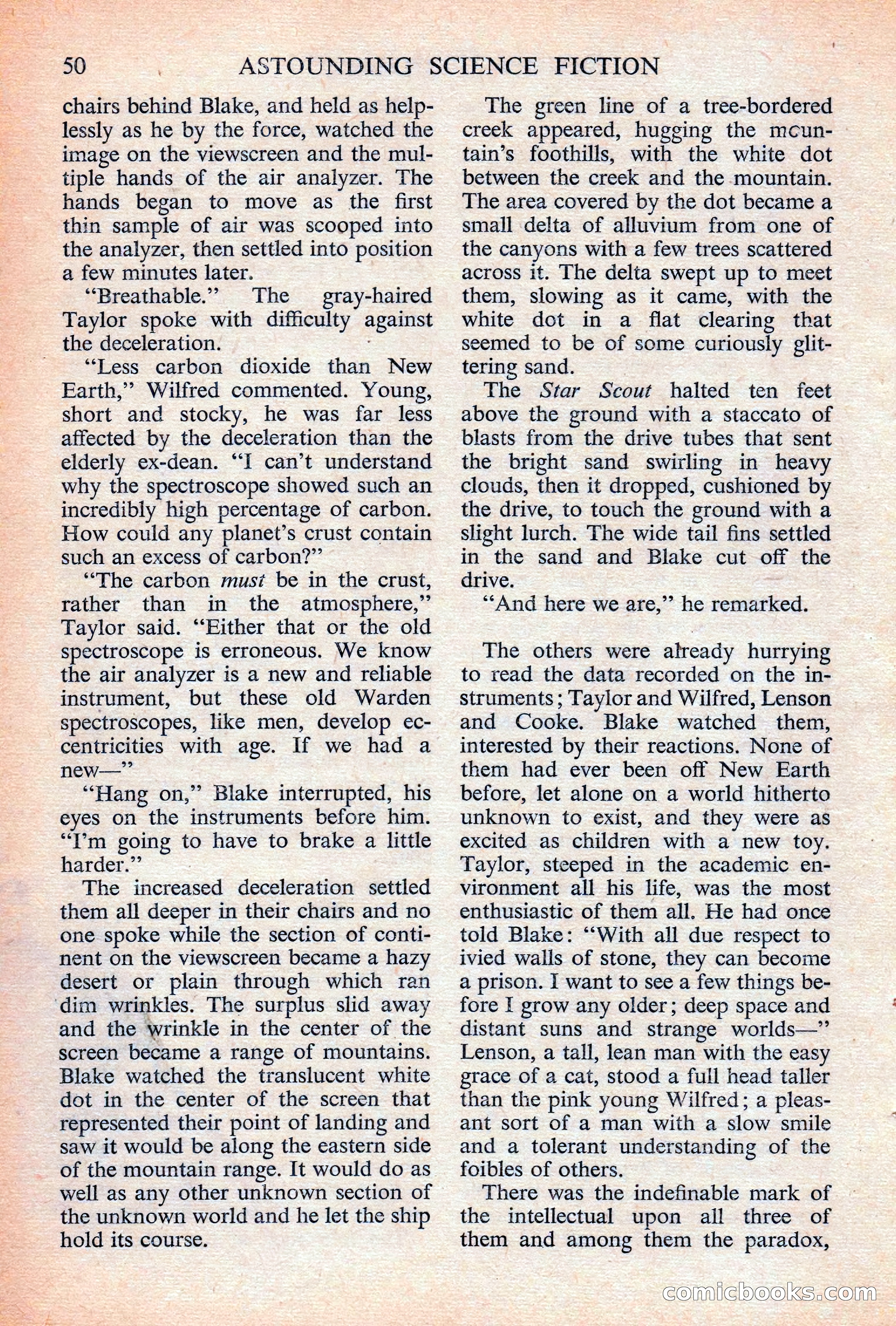
A restored page from Pulp Fiction, 1954. Page through the whole issue in the reader above.
📄 Transcribed text from this page (OCR, searchable)
Machine-transcribed from the original scan — historical spelling and the odd misread are preserved.
50 ASTOUNDING SCIENCE FICTION chairs behind Blake, and held as help- lessly as he by the force, watched the image on the viewscreen and the mul- tiple hands of the air analyzer. The hands began to move as the first thin sample of air was scooped into the analyzer, then settled into position a few minutes later. “Breathable.” The gray-haired Taylor spoke with difficulty ss sg the deceleration. “Less carbon dioxide than New Earth,’ Wilfred commented. Young, short and stocky, he was far less affected by the deceleration than the elderly ex-dean. “I can’t understand why the spectroscope showed such an incredibly high percentage of carbon. How could any planet’s crust contain such an excess of carbon?” ‘‘The carbon must be in the crust, rather than in the atmosphere,” Taylor said. “Either that or the old spectroscope is erroneous. We know the air analyzer is a new and reliable instrument, but these old Warden spectroscopes, like men, develop ec- centricities with age. If we had a new—” “Hang on,” Blake interrupted, his eyes on the instruments before him. “I’m going to have to brake a little harder.”’ The increased deceleration settled them all deeper in their chairs and no one spoke while the section of conti- nent on the viewscreen became a hazy desert or plain through which ran ‘dim wrinkles. The surplus slid away and the wrinkle in the center of the screen became a range of mountains. Blake watched the translucent white dot in the center of the screen that represented their point of landing and saw it would be along the eastern side of the mountain range. It would do as well as any other unknown section of the unknown world and he let the ship hold its course. The green line of a tree-bordered creek appeared, hugging the mcun- tain’s foothills, with the white dot between the creek and the mountain. The area covered by the dot became a small delta of alluvium from one of the canyons with a few trees scattered across it. The delia swept up to meet them, slowing as it came, with the white dot in a flat clearing that seemed to be of some curiously glit- tering sand. The Star Scout halted ten feet above the ground with a staccato of blasts from the drive tubes that sent the bright sand swirling in heavy Clouds, then it dropped, cushioned by the drive, to touch the ground with a slight lurch. The wide tail fins settled in the sand and Blake cut off the drive. “‘And here we are,”’ he remarked. The others were already hurrying to read the data recorded on the in- struments ; Taylor and Wilfred, Lenson and Cooke. Blake watched them, interested by their reactions. None of them had ever been off New Earth before, let alone on a world hitherto unknown to exist, and they were as excited as children with a new toy. Taylor, steeped in the academic en- vironment all his life, was the most enthusiastic of them all. He had once told Blake: “With all due respect to ivied walls of stone, they can become a prison. I want to see a few things be- fore I grow any older; deep space and distant suns and strange worlds—”’ Lenson, a tall, lean man with the easy grace of a cat, stood a full head taller than the pink young Wilfred; a pleas- ant sort of a man with a slow smile and a tolerant understanding of the foibles of others. There was the indefinable mark of the intellectual upon ail three of them and among them the paradox, Cconnicloooks.c@ Al