
Pulp Fiction, 1954 · page 51 of 132
Astounding Science Fiction, British Edition — page 51: what you’re looking at
A restored page from Pulp Fiction, 1954. Page through the whole issue in the reader above.
📄 Transcribed text from this page (OCR, searchable)
Machine-transcribed from the original scan — historical spelling and the odd misread are preserved.
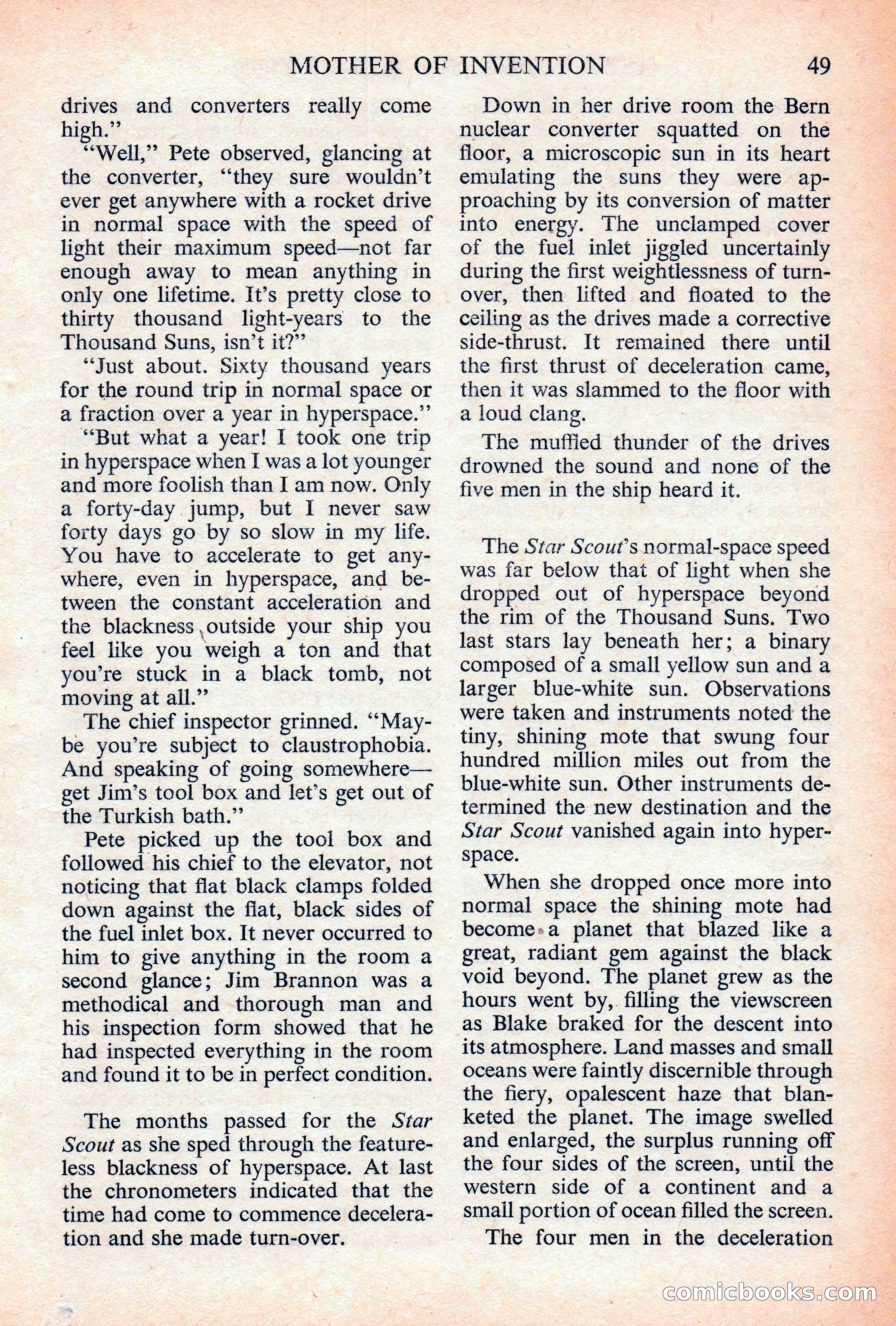
MOTHER OF INVENTION drives and converters really come high.” “Well,’’ Pete observed, glancing at the converter, “they sure wouldn’t ever get anywhere with a rocket drive in normal space with the speed of light their maximum speed—not far enough away to mean anything in only one lifetime. It’s pretty close to thirty thousand light-years to the Thousand Suns, isn’t it?” “Just about. Sixty thousand years for the round trip in normal space or a fraction over a year in hyperspace.” “But what a year! I took one trip in hyperspace when I was a lot younger and more foolish than I am now. Only a forty-day. jump, but I never saw forty days go by so slow in my life. You have to accelerate to get any- where, even in hyperspace, and be- tween the constant acceleration and the blackness outside your ship you feel like you weigh a ton and that you’re stuck in a black tomb, not moving at all.” The chief inspector grinned. “‘May- be you’re subject to claustrophobia. And speaking of going somewhere— get Jim’s tool box and let’s get out of the Turkish bath.” Pete picked up the tooi box and followed his chief to the elevator, not noticing that flat black clamps folded down against the fiat, black sides of the fuel inlet box. It never occurred to him to give anything in the room a second glance; Jim Brannon was a methodical and thorough man and his inspection form showed that he had inspected everything in the room and found it to be in perfect condition. The months passed for the Star Scout as she sped through the feature- less blackness of hyperspace. At last the chronometers indicated that the time had come to commence decelera- tion and she made turn-over. 49 Down in her drive room the Bern nuclear converter squatted on the ~ floor, a microscopic sun in its heart emulating the suns they were ap- proaching by its conversion of matter into energy. The unclamped cover of the fuel inlet jiggled uncertainly during the first weightlessness of turn- over, then lifted and floated to the ceiling as the drives made a corrective side-thrust. It remained there until the first thrust of deceleration came, then it was slammed to the floor with a loud clang. The muffied thunder of the drives drowned the sound and none of the five men in the ship heard it. The Star Scout’s normal-space speed was far below that of light when she dropped out of hyperspace beyond the rim of the Thousand Suns. Two last stars lay beneath her; a binary composed of a small yellow sun and a larger blue-white sun. Observations were taken and instruments noted the tiny, shining mote that swung four hundred million miles out from the blue-white sun. Other instruments de- termined the new destination and the Star Scout vanished again into hyper- space. When she dropped once more into normal space the shining mote had become»a planet that blazed like a great, radiant gem against the black void beyond. The planet grew as the hours went by, filling the viewscreen as Blake braked for the descent into its atmosphere. Land masses and small oceans were faintly discernible through the fiery, opalescent haze that blan- keted the planet. The image swelled and enlarged, the surplus running off the four sides of the screen, until the western side of a continent and a smail portion of ocean filled the screen. The four men in the deceleration COMIGIOOKSicO me