
Pulp Fiction, 1954 · page 53 of 132
Astounding Science Fiction, British Edition — page 53: what you’re looking at
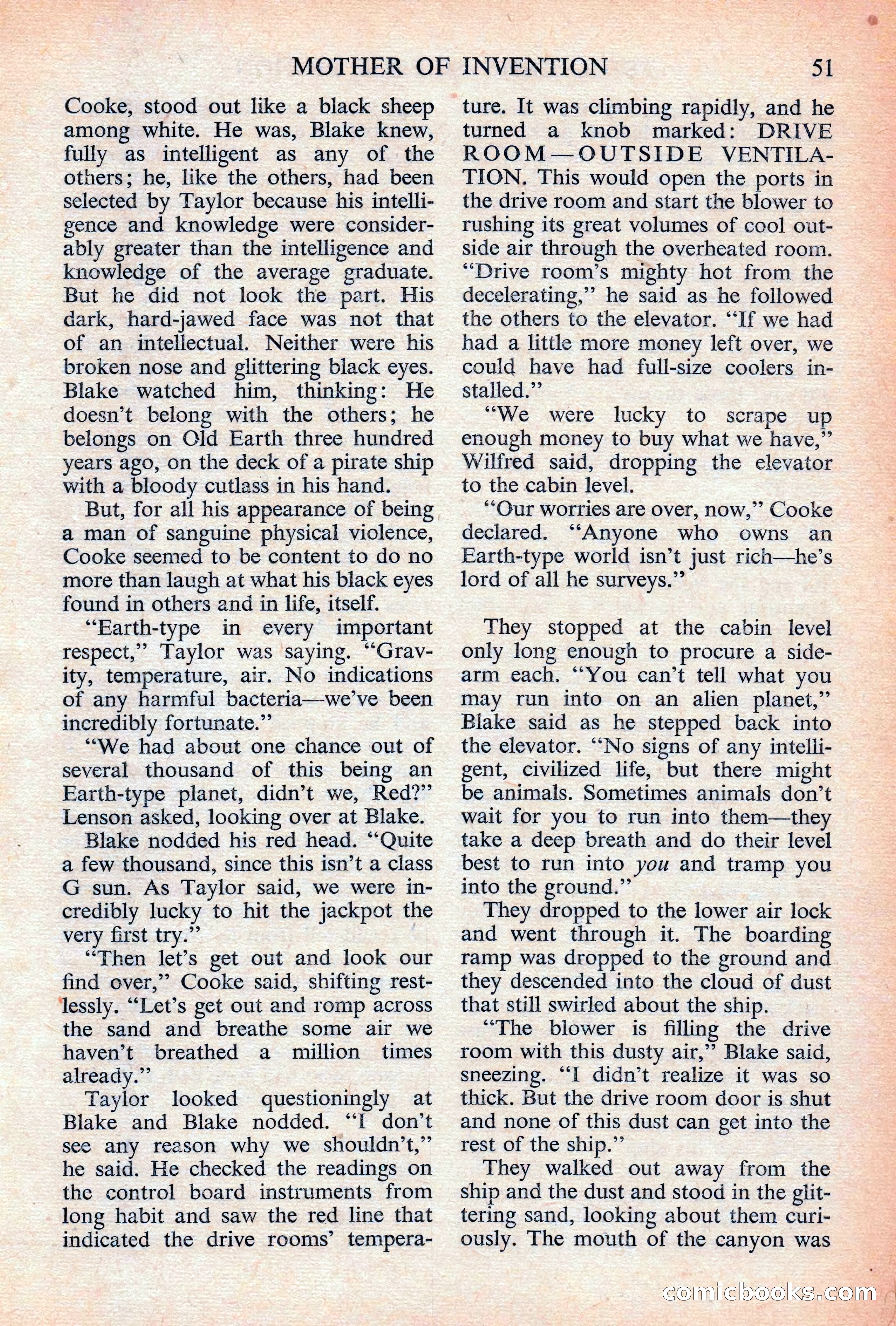
A restored page from Pulp Fiction, 1954. Page through the whole issue in the reader above.
📄 Transcribed text from this page (OCR, searchable)
Machine-transcribed from the original scan — historical spelling and the odd misread are preserved.
MOTHER OF INVENTION Si Cooke, stood out like a black sheep among white. He was, Blake knew, fully as intelligent as any of the others; he, like the others, had been selected by Taylor because his intelli- gence and knowledge were consider- ably greater than the intelligence and knowledge of the average graduate. But he did not look the part. His dark, hard-jawed face was not that of an intellectual. Neither were his broken nose and glittering biack eyes. Blake watched him, thinking: He doesn’t belong with the others; he belongs on Old Earth three hundred years ago, on the deck of a pirate ship with a bloody cutlass in his hand. But, for all his appearance of being a man of sanguine physical violence, Cooke seemed to be content to do no more than laugh at what his black eyes found in others and in life, itself. ‘““Earth-type in every important respect,” Taylor was saying. “Grav- ity, temperature, air. No indications of any harmful bacteria—we’ve been incredibly fortunate.” “We had about one chance out of several thousand of this being an Earth-type planet, didn’t we, Red?” Lenson asked, looking over at Blake. Blake nodded his red head. “‘Quite a few thousand, since this isn’t a class G sun. As Taylor said, we were in- credibly lucky to hit the jackpot the very first try.” “Then let’s get out and look our find over,” Cooke said, shifting rest- lessly. “Let’s get out and romp across the sand and breathe some air we haven’t breathed a million times already.” Taylor looked questioningly at Blake and Blake nodded. “I don’t see any reason why we shouldn’t,” he said. He checked the readings on the control board instruments from long habit and saw the red line that indicated the drive rooms’ tempera- ture. It was climbing rapidly, and he turned a knob marked: DRIVE ROOM—OUTSIDE VENTILA- TION. This would open the ports in the drive room and start the blower to rushing its great volumes of cool out- side air through the overheated room. “Drive room’s mighty hot from the decelerating,’ he said as he followed the others to the elevator. “If we had had a little more money left over, we could have had full-size coolers in- stalled.”’ “We were lucky to scrape up enough money to buy what we have,” Wilfred said, dropping the elevator to the cabin level. *“Our wotries are over, now,’ Cooke declared. “Anyone who owns an Earth-type world isn’t just rich—he’s lord of all he surveys.” They stopped at the cabin level only long enough to procure a side- arm each. “You can’t tell what you may run into on an alien planet,” Blake said as he stepped back into the elevator. “‘No signs of any intelli- gent, civilized life, but there might be animals. Sometimes animals don’t wait for you to run into them—they take a deep breath and do their level best to run into you and tramp you into the ground.” They dropped to the lower air lock and went through it. The boarding ramp was dropped to the ground and they descended into the cloud of dust that still swirled about the ship. “The blower is filling the drive room with this dusty air,’ Blake said, sneezing. “I didn’t realize it was so thick. But the drive room door is shut and none of this dust can get into the rest of the ship.”’ They walked out away from the ship and the dust and stood in the glit- tering sand, looking about them curi- ously. The mouth of the canyon was Connie ooolkks.e@ . oN i : 1 }