
Pulp Fiction, 1954 · page 5 of 132
Astounding Science Fiction, British Edition — page 5: what you’re looking at
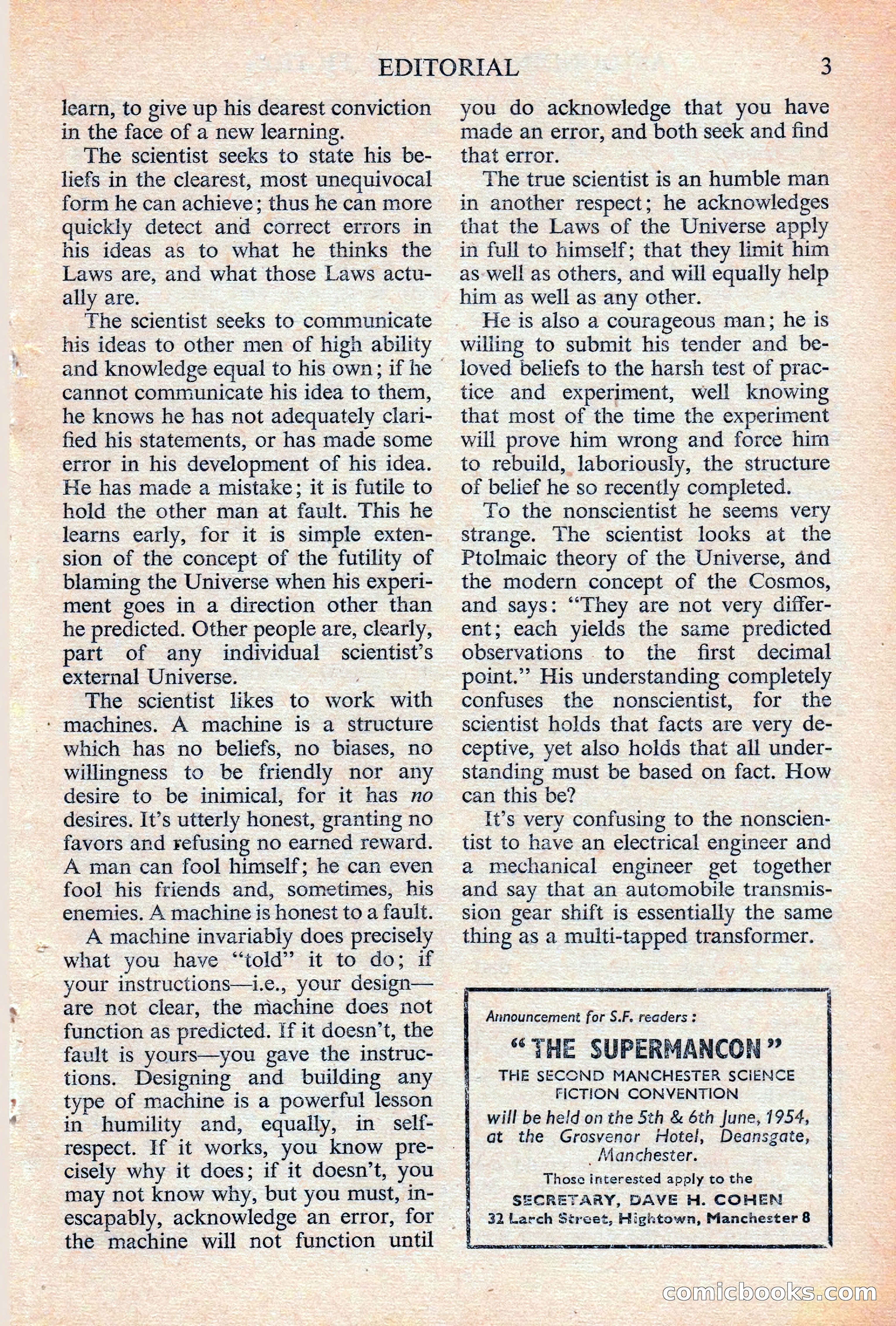
A restored page from Pulp Fiction, 1954. Page through the whole issue in the reader above.
📄 Transcribed text from this page (OCR, searchable)
Machine-transcribed from the original scan — historical spelling and the odd misread are preserved.
EDITORIAL 3 learn, to give up his dearest conviction in the face of a new learning. The scientist seeks to state his be- liefs in the clearest, most unequivocal form he can achieve; thus he can more quickly detect and correct errors in his ideas as to what he thinks the Laws are, and what those Laws actu- ally are. The scientist seeks to communicate his ideas to other men of high ability and knowledge equal to his own; if he © cannot communicate his idea to them, he knows he has not adequately clari- fied his statements, or has made some error in his development of his idea. He has made a mistake; it is futile to hold the other man at fault. This he learns early, for it is simple exten- sion of the concept of the futility of blaming the Universe when his experi- ment goes in a direction other than he predicted. Other people are, clearly, part of any individual scientist’s external Universe. | The scientist likes to work with ‘ machines. A machine is a structure which has no beliefs, no biases, no willingness to be friendly nor any desire to be inimical, for it has no desires. It’s utterly honest, granting no favors and refusing no earned reward. A man can fool himself; he can even fool his friends and, sometimes, his enemies. A machine is honest to a fault. A machine invariably does precisely what you have “told” it to do; if your instructions—i.e., your design— are not clear, the machine does not function as predicted. If it doesn’t, the fault is yours—you gave the instruc- tions. Designing and building any type of machine is a powerful lesson in humility and, equally, in self- respect. If it works, you know pre- cisely why it does; if it doesn’t, you may not know why, but you must, in- escapably, acknowledge an error, for the machine will not function until you do acknowledge that you have made an error, and both seek and find that error. The true scientist is an humble man in another respect; he acknowledges that the Laws of the Universe apply in full to himself; that they limit him as well as others, and will equally help him as well as any other. He is also a courageous man; he is willing to submit his tender and be- loved beliefs to the harsh test of prac- tice and experiment, well knowing that most of the time the experiment will prove him wrong and force him to rebuild, laboriously, the structure of belief he so recently completed. To the nonscientist he seems very strange. The scientist looks at the Ptolmaic theory of the Universe, and the modern concept of the Cosmos, and says: ““They are not very diifer- ent; each yields the same predicted observations to the first decimal point.’’ His understanding completely confuses the nonscientist, for the scientist holds that facts are very de- ceptive, yet also holds thai all under- standing must be based on fact. How can this be? It’s very confusing to the nonscien- tist to have an electrical engineer and a mechanical engineer get together and say that an automobile transmis- sion gear shift is essentially the same thing as a multi-tapped transformer. Arinouncement for S.F. readers : “THE SUPERMANCON ” THE SECCND MANCHESTER SCiENCE FICTION CONVENTION will be held on the 5th & 6th June, 1954, at the Grosvenor Hotel, Deansgate, _ Manchester. Those interested apply to the SECRETARY, DAVE H. COHEN 32 Larch Street, Hightown, Manchester 8 ; ECOMmichdooksco im