
Pulp Fiction, 1954 · page 6 of 132
Astounding Science Fiction, British Edition — page 6: what you’re looking at
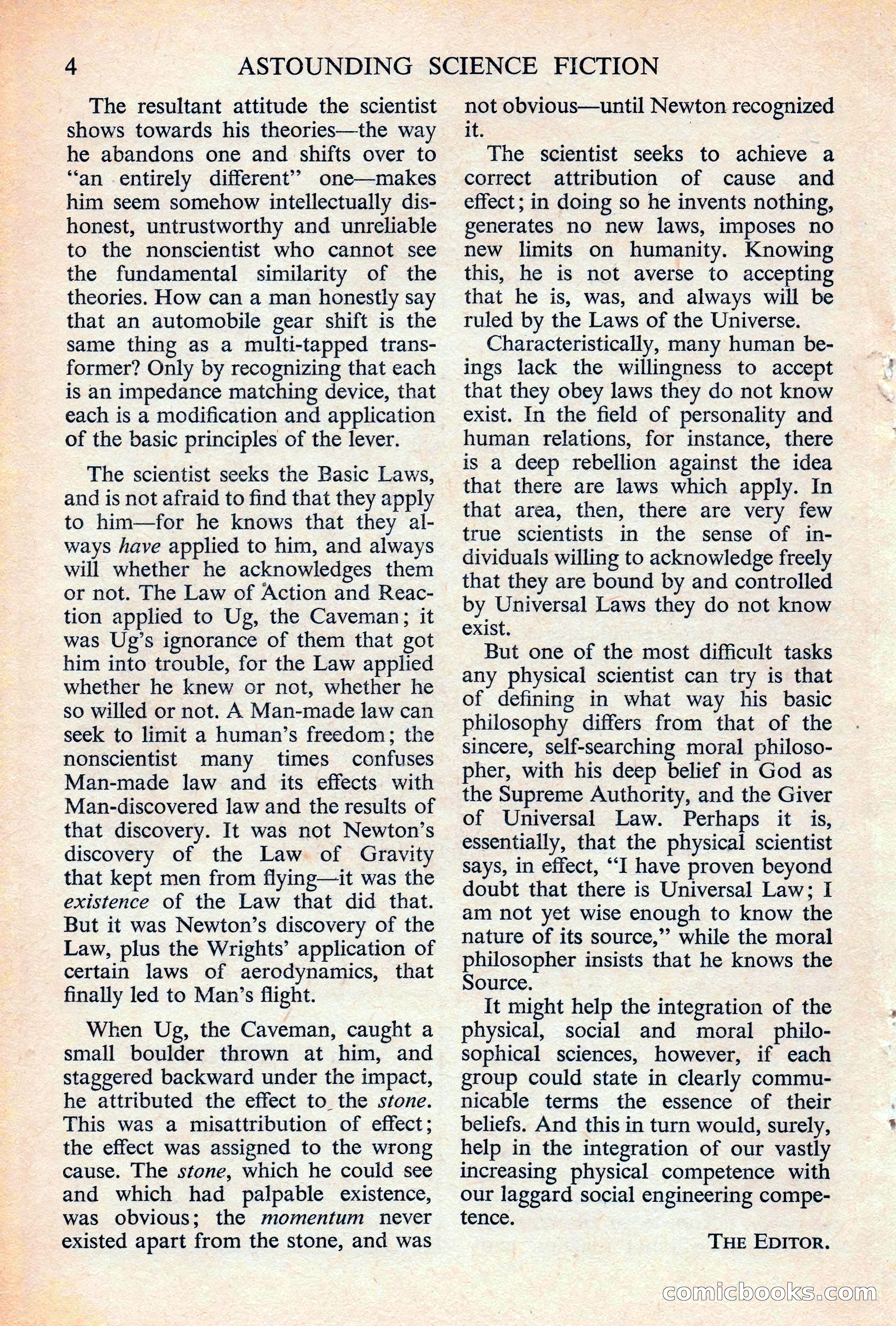
A restored page from Pulp Fiction, 1954. Page through the whole issue in the reader above.
📄 Transcribed text from this page (OCR, searchable)
Machine-transcribed from the original scan — historical spelling and the odd misread are preserved.
a ASTOUNDING SCIENCE FICTION The resultant attitude the scientist shows towards his theories—the way he abandons one and shifts over to “an entirely different’? one—makes him seem somehow intellectually dis- honest, untrustworthy and unreliable to the nonscientist who cannot see the fundamental similarity of the theories. How can a man honestly say that an automobile gear shift is the same thing as a multi-tapped trans- former? Only by recognizing that each is an impedance matching device, that each is a modification and application of the basic principles of the lever. The scientist seeks the Basic Laws, and is not afraid to find that they apply to him—for he knows that they al- ways have applied to him, and always will whether he acknowledges them or not. The Law of Action and Reac- tion applied to Ug, the Caveman; it was Ug’s ignorance of them that got him into trouble, for the Law applied whether he knew or not, whether he so willed or not. A Man-made law can seek to limit a human’s freedom; the nonscientist many times confuses Man-made law and its effects with Man-discovered law and the results of that discovery. It was not Newton’s discovery of the Law of Gravity that kept men from flying—it was the existence of the Law that did that. But it was Newton’s discovery of the Law, plus the Wrights’ application of certain laws of aerodynamics, that finally led to Man’s flight. When Ug, the Caveman, caught a small boulder thrown at him, and staggered backward under the impact, he attributed the effect to the stone. This was a misattribution of effect; the effect was assigned to the wrong cause. The stone, which he could see and which had palpable existence, was obvious; the momentum never existed apart from the stone, and was not obvious—until Newton recognized it. : The scientist seeks to achieve a correct attribution of cause and effect ; in doing so he invents nothing, generates no new laws, imposes no new limits on humanity. Knowing this, he is not averse to accepting that he is, was, and always will be ruled by the Laws of the Universe. Characteristically, many human be- ings lack the willingness to accept that they obey laws they do not know exist. In the field of personality and human relations, for instance, there is a deep rebellion against the idea that there are laws which apply. In that area, then, there are very few true scientists in the sense of in- dividuals willing to acknowledge freely that they are bound by and controlled by Universal Laws they do not know exist. 3 But one of the most difficult tasks any physical scientist can try is that of defining in what way his basic philosophy differs from that of the sincere, self-searching moral philoso- pher, with his deep belief in God as the Supreme Authority, and the Giver of Universal Law. Perhaps it is, essentially, that the physical scientist says, in effect, “I have proven beyond doubt that there is Universal Law; I am not yet wise enough to know the nature of its source,” while the moral philosopher insists that he knows the Source. It might help the integration of the physical, social and moral philo- sophical sciences, however, if each group could state in clearly commu- nicable terms the essence of their beliefs. And this in turn would, surely, help in the integration of our vastly increasing physical competence with our laggard social engineering compe- tence. THE EDITOR. conniclooolks.conn