
Pulp Fiction, 1954 · page 4 of 132
Astounding Science Fiction, British Edition — page 4: what you’re looking at
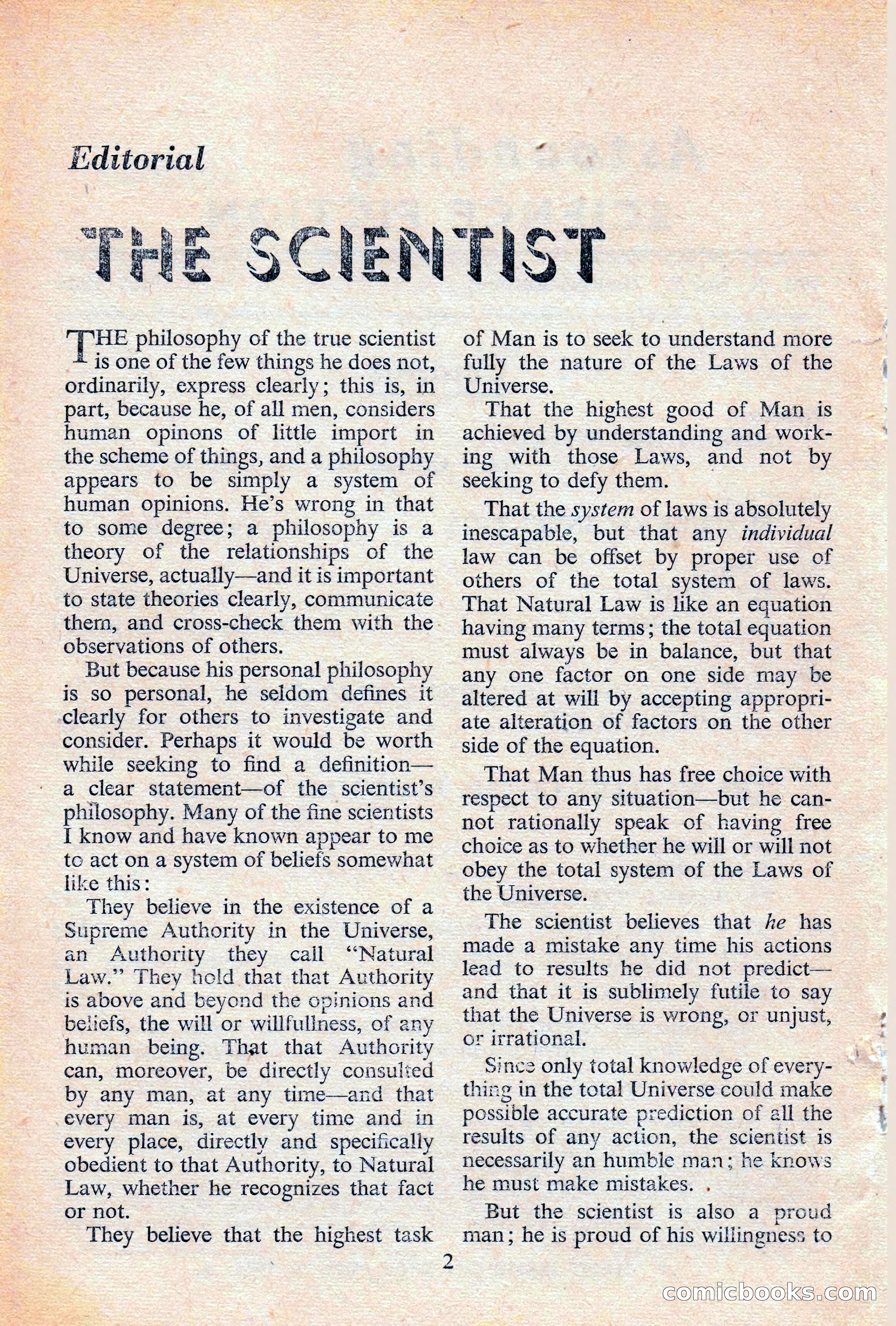
A restored page from Pulp Fiction, 1954. Page through the whole issue in the reader above.
📄 Transcribed text from this page (OCR, searchable)
Machine-transcribed from the original scan — historical spelling and the odd misread are preserved.
Editorial Trt S $2 eS philosophy of the true scientist is one of the few things he does not, ordinarily, express clearly; this is, in part, because he, of all men, considers human opinons of little import in the scheme of things, and a philosophy appears to be simply a system of human opinions. He’s wrong in that to some degree; a philosophy is a theory of the relationships of the Universe, actually—and it is important to state theories clearly, communicate thern, and cross-check them with the. observations of others. But because his personal philosophy is so personal, he seldom defines it clearly for others to investigate and consider. Perhaps it would be worth while seeking to find a definition— a clear statement—of the scientist’s philosophy. Many of the fine scientists I know and have known appear to me tc act on a system of beliefs somewhat like this: They believe in the existence of a Supreme Authority in the Universe, an Authority they call “Natural Law.” They held that that Authority is above and beyond the opinions and beefs, the will or willfuliness, of any human being. That that Authority can, moreover, be directly consulted by any man, at any time—and that every man is, at every time and in every place, directly and specifically obedient to that Authority, to Natural Law, whether he recognizes that fact or not. They believe that the highest task CIENTIST of Man is to seek to understand more fully the nature of the Laws of the Universe. That the highest good of Man is achieved by understanding and work- ing with those Laws, and not by seeking to defy them. That the system of laws is absolutely inescapable, but that any individual law can be offset by proper use of Others of the total system of laws. That Natural Law is like an equation having many terms; the total equation must always be in balance, but that any one factor on one side may be altered at will by accepting appropri- ate alteration of factors on the other side of the equation. That Man thus has free choice with respect to any situation—but he can- not rationally speak of having free choice as to whether he will or will not obey the total system of the Laws of the Universe. The scientist believes that ke has made a mistake any time his actions lead to results he did not predict— and that it is sublimely futile to say that the Universe is wrong, or unjust, or irrational. Since only total knowledge of every- thing in the total Universe could make possible accurate prediction of all the results of any action, the scientist is necessarily an humble man; he knows he must make mistakes. . But the scientist is also a proud man; he is proud of his willingness to Cconmicloooks.€c© iin