
Pulp Fiction, 1954 · page 27 of 132
Astounding Science Fiction, British Edition — page 27: what you’re looking at
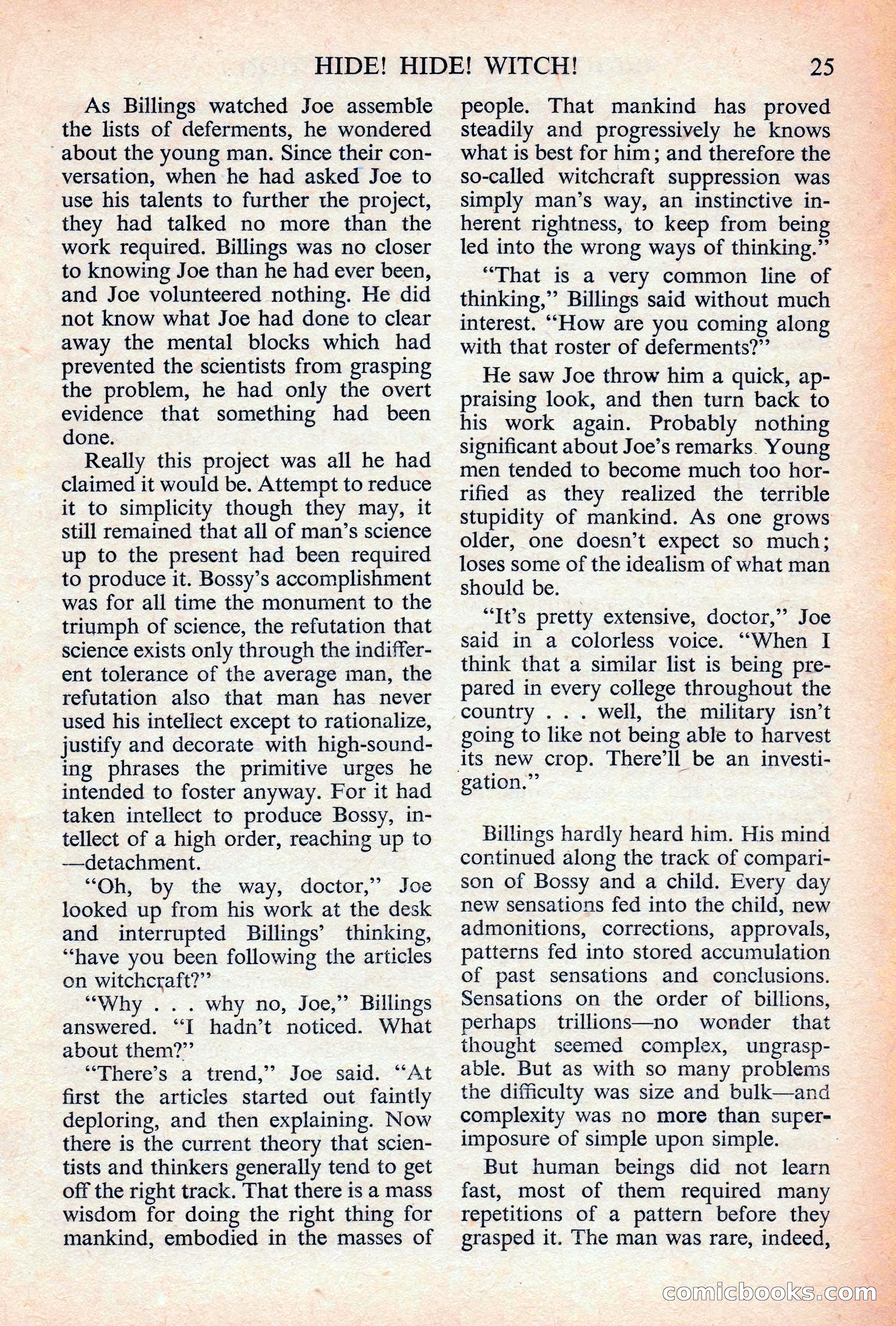
A restored page from Pulp Fiction, 1954. Page through the whole issue in the reader above.
📄 Transcribed text from this page (OCR, searchable)
Machine-transcribed from the original scan — historical spelling and the odd misread are preserved.
HIDE! HIDE! WITCH! 25 As Billings watched Joe assemble the lists of deferments, he wondered about the young man. Since their con- versation, when he had asked Joe to use his talents to further the project, they had talked no more than the work required. Billings was no closer to knowing Joe than he had ever been, and Joe volunteered nothing. He did not know what Joe had done to clear away the mental blocks which had prevented the scientists from grasping the problem, he had only the overt evidence that something had been done. Really this project was all he had claimed it would be. Attempt to reduce it to simplicity though they may, it still remained that all of man’s science up to the present had been required to produce it. Bossy’s accomplishment was for all time the monument to the triumph of science, the refutation that science exists only through the indiffer- ent tolerance of the average man, the refutation also that man has never used his intellect except to rationalize, justify and decorate with high-sound- ing phrases the primitive urges he intended to foster anyway. For it had taken intellect to produce Bossy, in- tellect of a high order, reaching up to detachment. “Oh, by the way, doctor,” Joe looked up from his work at the desk and interrupted Billings’ thinking, “have you been following the articles on witchcraft?” “Why ... why no, Joe,” Billings answered. “I hadn’t noticed. What about them?”’ ‘“*There’s a trend,’ Joe said. “At first the articles started out faintly deploring, and then explaining. Now there is the current theory that scien- tists and thinkers generally tend to get off the right track. That there is a mass wisdom for doing the right thing for mankind, embodied in the masses of people. That mankind has proved steadily and progressively he knows what is best for him; and therefore the so-called witchcraft suppression was simply man’s way, an instinctive in- herent rightness, to keep from being led into the wrong ways of thinking.” “That is a very common line of thinking,” Billings said without much interest. ““How are you coming along with that roster of deferments?”’ He saw Joe throw him a quick, ap- praising look, and then turn back to his work again. Probably nothing significant about Joe’s remarks. Young men tended to become much too hor- rified as they realized the terrible stupidity of mankind. As one grows older, one doesn’t expect so much; loses some of the idealism of what man should be. “It’s pretty extensive, doctor,” Joe said in a colorless voice. “When I think that a similar list is being pre- pared in every college throughout the country . . . well, the military isn’t going to like not being able to harvest its new crop. There'll be an investi- gation.” Billings hardly heard him. His mind continued along the track of compari- son of Bossy and a child. Every day new sensations fed into the child, new admonitions, corrections, approvals, patterns fed into stored accumulation of past sensations and conclusions. Sensations on the order of billions, perhaps trillions—no wonder that thought seemed complex, ungrasp- able. But as with so many problems the difficulty was size and bulk—and complexity was no more than super- imposure of simple upon simple. But human beings did not learn fast, most of them required many repetitions of a pattern before they grasped it. The man was rare, indeed, connicloooks.ec© im