
Pulp Fiction, 1954 · page 28 of 132
Astounding Science Fiction, British Edition — page 28: what you’re looking at
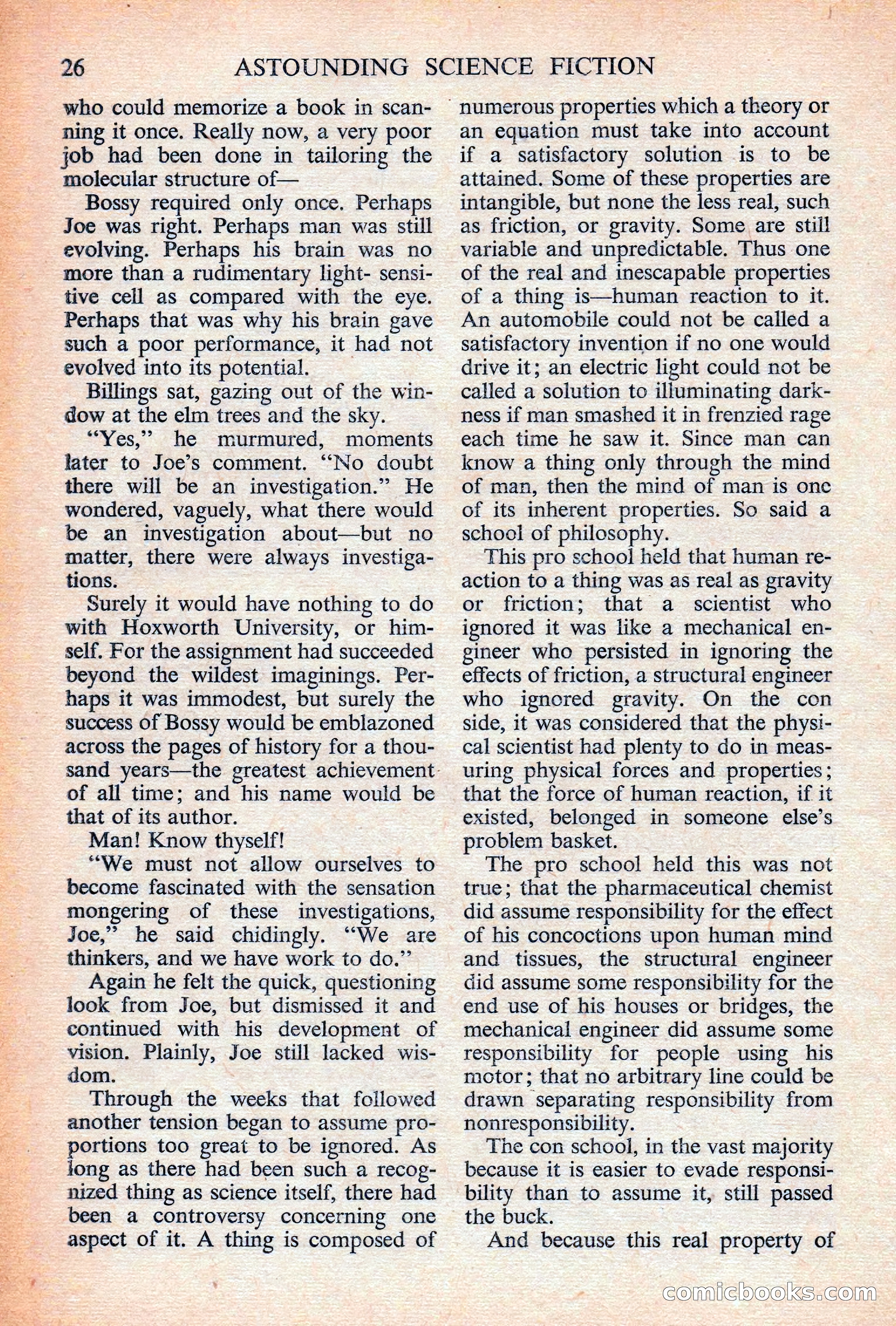
A restored page from Pulp Fiction, 1954. Page through the whole issue in the reader above.
📄 Transcribed text from this page (OCR, searchable)
Machine-transcribed from the original scan — historical spelling and the odd misread are preserved.
7S? hd Oe we ae 26 ASTOUNDING SCIENCE FICTION who could memorize a book in scan- ning it once. Really now, a very poor job had been done in tailoring the molecular structure of— Bossy required only once. Perhaps Joe was right. Perhaps man was still evolving. Perhaps his brain was no more than a rudimentary light- sensi- tive cell as compared with the eye. Perhaps that was why his brain gave such a poor performance, it had not evolved into its potential. Billings sat, gazing out of the win- dow at the elm trees and the sky. “Yes,” he murmured, moments later to Joe’s comment. “No doubt there will be an investigation.” He wondered, vaguely, what there would be an investigation about—but no matter, there were always investiga- tions. Surely it would have nothing to do with Hoxworth University, or him- self. For the assignment had succeeded beyond the wildest imaginings. Per- haps it was immodest, but surely the success of Bossy would be emblazoned across the pages of history for a thou- sand years—the greatest achievement. of all time; and his name would be that of its author. Man! Know thyself! “We must not allow ourselves to become fascinated with the sensation mongering of these investigations, Joe,” he said chidingly. “We are thinkers, and we have work to do.”’ Again he felt the quick, questioning look from Joe, but dismissed it and continued with his development of vision. Plainly, Joe still lacked wis- dom. Through the weeks that followed another tension began to assume pro- portions too great to be ignored. As jong as there had been such a recog- nized thing as science itself, there had been a controversy concerning one aspect of it. A thing is composed of numerous properties which a theory or an equation must take into account if a satisfactory solution is to be attained. Some of these properties are intangible, but none the less real, such as friction, or gravity. Some are still variable and unpredictable. Thus one of the real and inescapable properties of a thing is—human reaction to it. An automobile could not be called a satisfactory invention if no one would drive it; an electric light could not be called a solution to illuminating dark- ness if man smashed it in frenzied rage each time he saw it. Since man can know a thing only through the mind of man, then the mind of man is one of its inherent properties. So said a school of philosophy. This pro schoo] held that human re- action to a thing was as real as gravity or friction; that a _ scientist who ignored it was like a mechanical en- gineer who persisted in ignoring the effects of friction, a structural engineer who ignored gravity. On the con side, it was considered that the physi- cal scientist had plenty to do in meas- uring physical forces and properties ; that the force of human reaction, if it existed, belonged in someone else’s problem basket. The pro school held this was not true; that the pharmaceutical chemist did assume responsibility for the effect of his concoctions upon human mind and tissues, the structural engineer did assume some responsibility for the end use of his houses or bridges, the mechanical engineer did assume some responsibility for people using his motor; that no arbitrary line could be drawn separating responsibility from nonresponsibility. The con school, in the vast majority because it is easier to evade responsi- bility than to assume it, still passed the buck. And because this real property of COMmicdookssico nl