
Pulp Fiction, 1954 · page 26 of 132
Astounding Science Fiction, British Edition — page 26: what you’re looking at
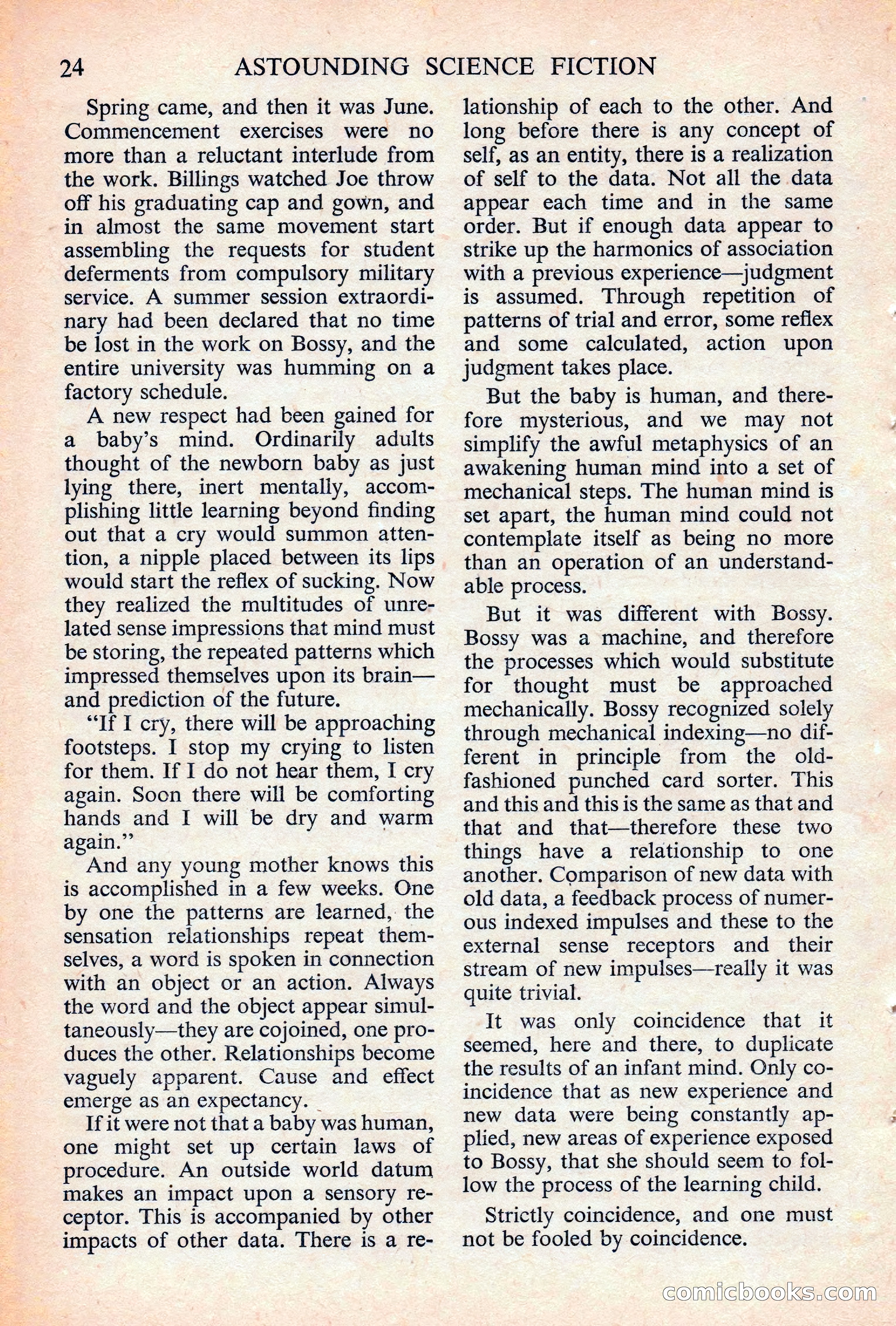
A restored page from Pulp Fiction, 1954. Page through the whole issue in the reader above.
📄 Transcribed text from this page (OCR, searchable)
Machine-transcribed from the original scan — historical spelling and the odd misread are preserved.
24 ASTOUNDING SCIENCE FICTION Spring came, and then it was June. Commencement exercises were no more than a reluctant interlude from the work. Billings watched Joe throw off his graduating cap and gown, and in almost the same movement start assembling the requests for student deferments from compulsory military service. A summer session extraordi- nary had been declared that no time be lost in the work on Bossy, and the entire university was humming on a factory schedule. A new respect had been gained for a baby’s mind. Ordinarily adults thought of the newborn baby as just lying there, inert mentally, accom- plishing little learning beyond finding out that a cry would summon atten- tion, a nipple placed between its lips would start the reflex of sucking. Now they realized the multitudes of unre- lated sense impressions that mind must be storing, the repeated patterns which impressed themselves upon its brain— and prediction of the future. “If I cry, there will be approaching footsteps. I stop my crying to listen for them. If I do not hear them, I cry again. Soon there will be comforting hands and I will be dry and warm again.” And any young mother knows this is accomplished in a few weeks. One by one the patterns are learned, the sensation relationships repeat them- selves, a word is spoken in connection with an object or an action. Always the word and the object appear simul- taneously—they are cojoined, one pro- duces the other. Relationships become vaguely apparent. Cause and effect emerge as an expectancy. If it were not that a baby was human, one might set up certain laws of procedure. An outside world datum makes an impact upon a sensory re- ceptor. This is accompanied by other impacts of other data. There is a re- lationship of each to the other. And long before there is any concept of self, as an entity, there is a realization of self to the data. Not all the data appear each time and in the same order. But if enough data appear to strike up the harmonics of association with a previous experience—judgment is assumed. Through repetition of patterns of trial and error, some reflex and some calculated, action upon judgment takes place. But the baby is human, and there- fore mysterious, and we may not simplify the awful metaphysics of an awakening human mind into a set of mechanical steps. The human mind is set apart, the human mind could not contemplate itself as being no more than an operation of an understand- able process. But it was different with Bossy. Bossy was a machine, and therefore the processes which would substitute for thought must be approached mechanically. Bossy recognized solely through mechanical indexing—no dif- ferent in principle from the old- fashioned punched card sorter. This and this and this is the same as that and that and that—therefore these two things have a relationship to one another. Comparison of new data with old data, a feedback process of numer- ous indexed impulses and these to the external sense receptors and_ their stream of new impulses—treally it was quite trivial. It was only coincidence that it seemed, here and there, to duplicate the results of an infant mind. Only co- incidence that as new experience and new data were being constantly ap- plied, new areas of experience exposed to Bossy, that she should seem to fol- low the process of the learning child. Strictly coincidence, and one must not be fooled by coincidence. connicloooks.c© in